

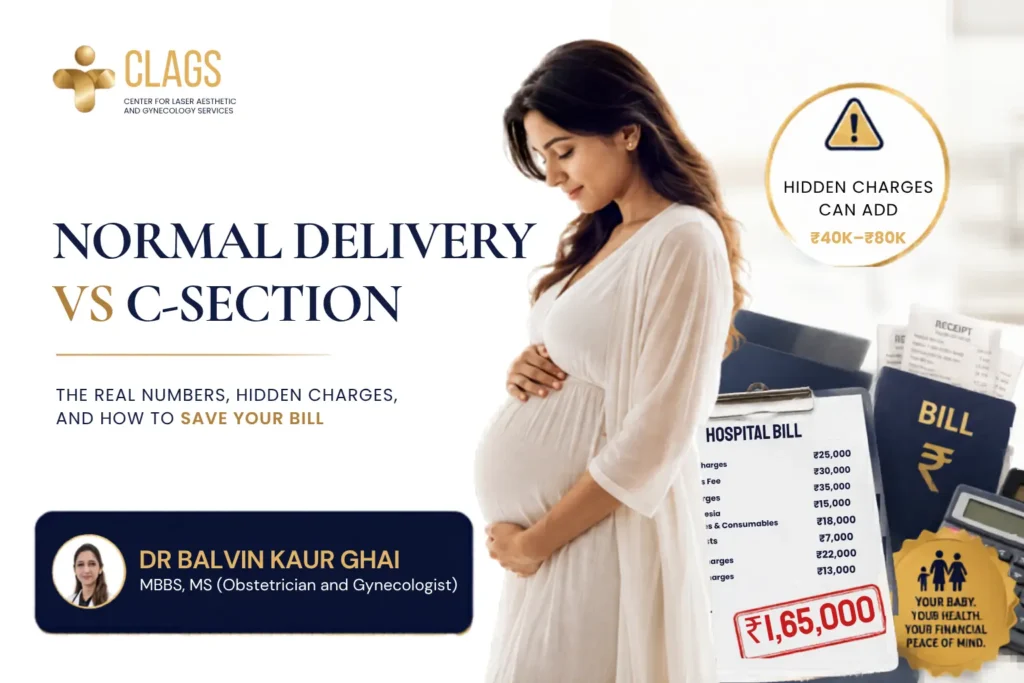
You are expecting a baby. Congratulations. Now comes the part nobody prepares you for: the hospital bill.
Most families in India walk into delivery without a clear idea of what they will owe at discharge. Some get surprised by a ₹30,000 charge for a room they did not ask for. Others discover their insurance covered barely half of what they thought it would. And a growing number of couples are quietly wondering whether the reason their doctor recommended a C-section had anything to do with the higher charges that come with it.
This article answers the one question every pregnant family is searching for: how much does delivery actually cost in India, what is the real difference between normal delivery and C-section charges, and what can you do right now to make sure you do not pay more than you need to?
No vague ranges. No “it depends.” Real numbers, honest context, and practical steps.
Why Are So Many Families Shocked by Their Delivery Bill?
India’s C-section rate has climbed sharply. As per the National Family Health Survey (NFHS-5), 21.5% of all births in India now happen via C-section, up from 17.2% in the previous survey. In private hospitals, the number is even more striking: nearly half of all deliveries in private facilities are C-sections, far above the WHO’s recommended ceiling of 10-15%.
A C-section involves surgery, anaesthesia, a longer hospital stay, and more post-operative care. Every one of those components adds to the bill. And because many families make delivery decisions in the middle of labour with very little time to think about finances, the cost conversation often happens too late.
Normal delivery and C-section are not equally priced. They never were. Understanding that gap before you walk into a hospital is the first smart financial decision you can make as a parent.
Normal Delivery Cost vs C-Section Cost: The Numbers Across India
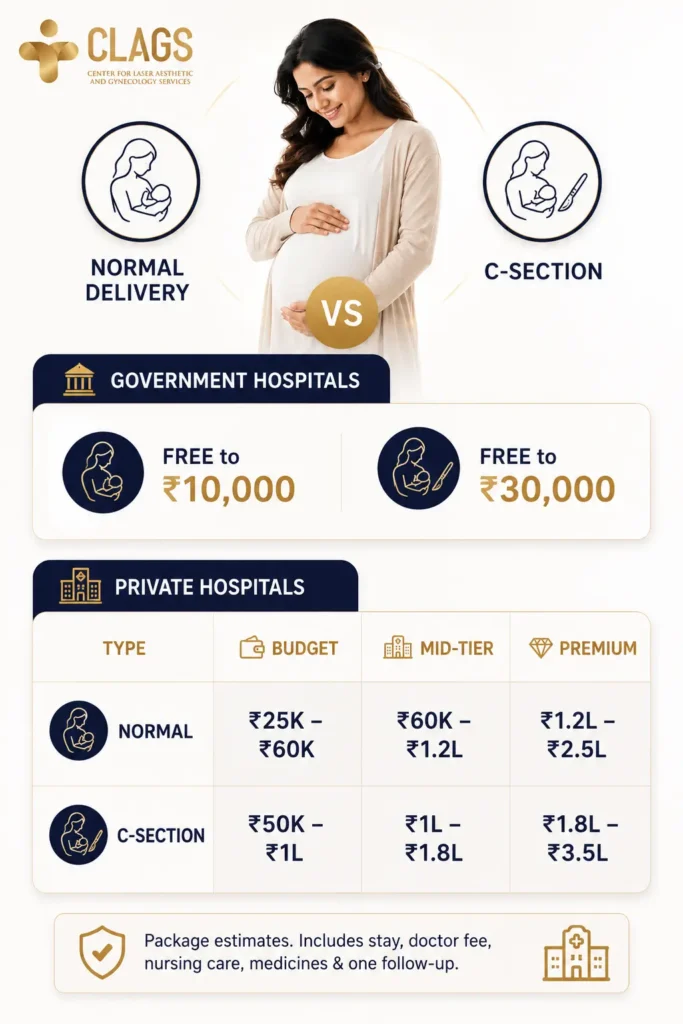
Here is an honest look at what families pay for delivery across different types of facilities.
Government Hospitals
| Delivery Type | Typical Cost | Notes |
|---|---|---|
| Normal Delivery | Free to ₹10,000 | Often free under PMJAY or JSY; nominal charges at district hospitals |
| C-Section | Free to ₹30,000 | Surgical consumables and anaesthesia may be charged separately |
Private Hospitals
| Delivery Type | Budget Private Hospital | Mid-Tier Private | Premium / Corporate |
|---|---|---|---|
| Normal Delivery | ₹25,000 – ₹60,000 | ₹60,000 – ₹1,20,000 | ₹1,20,000 – ₹2,50,000 |
| C-Section | ₹50,000 – ₹1,00,000 | ₹1,00,000 – ₹1,80,000 | ₹1,80,000 – ₹3,50,000 |
These are package estimates. They typically include hospital stay, doctor’s delivery fee, nursing care, basic medications during admission, and one post-delivery follow-up. What they often do not include is discussed in the next section.
Why C-Section Always Costs More Than Normal Delivery
Every single cost component is higher in a C-section:
- You stay 4 to 5 days versus 2 to 3 days for a normal delivery — that is extra room rent every day
- Anaesthesia is a separate billable item, usually ₹8,000 to ₹25,000
- The operation theatre charges are added on top of the doctor’s fee
- Surgical consumables — sutures, drapes, instruments — are billed separately at most hospitals
- Post-operative pain medication and wound dressings add to the pharmacy bill
- NICU charges for the newborn, if the baby needs observation, come separately
When you add it all up, a C-section in an average private hospital in India typically costs 1.5 to 2.5 times more than a normal delivery in the same facility.
What the Hospital Package Includes (And What It Quietly Leaves Out)
This is where most families get caught off guard. A maternity package sounds complete. It rarely is.
What Is Usually Included
- Delivery room charges
- Doctor’s delivery fee (not always the specialist’s full fee)
- Nursing care during hospital stay
- Basic medications given at delivery
- Routine newborn care in the delivery room
- One post-discharge OPD visit
What Is Frequently Charged Separately
- Epidural or anaesthesia for normal delivery — ₹10,000 to ₹30,000
- Lab tests during admission — ₹3,000 to ₹8,000
- Paediatrician visit charges for the newborn — billed per day
- NICU charges if the baby is placed under observation
- Meals for the mother and the attendant
- Room upgrades if a private room was chosen instead of the package ward
- Additional medications not on the hospital formulary
- Circumcision, hearing screening, or newborn vaccination — often not included
In a mid-tier private hospital, these add-ons can push the final bill ₹40,000 to ₹80,000 above the original package quote. Nobody tells you this when you sign the admission form.
City-Wise Cost Comparison: Normal Delivery vs C-Section
| City | Normal Delivery (Private) | C-Section (Private) |
|---|---|---|
| Mumbai / Delhi / Bengaluru | ₹80,000 – ₹2,50,000 | ₹1,50,000 – ₹3,50,000 |
| Hyderabad / Pune / Chennai | ₹60,000 – ₹1,50,000 | ₹1,00,000 – ₹2,50,000 |
| Chandigarh / Jaipur / Lucknow | ₹40,000 – ₹1,00,000 | ₹70,000 – ₹1,80,000 |
| Tier 3 and Smaller Towns | ₹20,000 – ₹60,000 | ₹40,000 – ₹1,20,000 |
Metro city prices are higher, but so is the quality of neonatal infrastructure. For complicated pregnancies or high-risk deliveries, a higher-cost facility with better equipment is not a luxury — it is a necessity.
Does Your Health Insurance Actually Cover This?
Most people with health insurance assume their delivery will be covered. This assumption is only partially correct, and understanding the gap between what you expect and what your policy actually pays is the difference between a manageable bill and a financial shock.
Here is how maternity coverage typically works in India:
- Waiting Period: Most individual maternity insurance plans in India have a waiting period of 9 months to 4 years. If you buy a policy after you are already pregnant, the delivery will not be covered. Employer group policies sometimes have shorter or no waiting periods.
- Sub-limits: Even comprehensive health insurance policies have maternity sub-limits. A policy that covers hospitalisation up to ₹5 lakh may only pay ₹25,000 to ₹50,000 for a normal delivery and up to ₹1 lakh for a C-section. The rest comes from your pocket.
- Network Hospitals: Cashless hospitalisation is only available at your insurer’s empanelled hospitals. If you deliver at a non-network hospital, you pay the full bill upfront and then claim reimbursement — which can take weeks.
- Pre and Post-Natal Coverage: Some plans include antenatal consultations and tests. Many do not. Check this specifically, because prenatal costs can add ₹20,000 to ₹50,000 to the total spend before you even reach delivery day.
According to health insurance guidance from Universal Sompo, all maternity plans have sub-limits, meaning that even if your delivery cost is ₹90,000, your policy may only reimburse up to ₹50,000. The remaining balance is your responsibility.
Read the sub-limit clause before you choose your maternity plan. That one number will tell you exactly what to budget.
Government Schemes That Can Dramatically Cut Your Delivery Bill

Two schemes can reduce your delivery cost to near zero if you qualify. Most eligible families either do not know about them or do not apply in time.
Janani Suraksha Yojana (JSY)
JSY is a cash assistance programme that encourages institutional deliveries among low-income mothers. Eligible mothers receive a cash benefit of ₹1,400 (rural) or ₹1,000 (urban) for delivering at a government facility. The delivery itself is free at government hospitals under this scheme. If you are in a BPL family or belong to a scheduled caste or scheduled tribe, this scheme applies to you.
Ayushman Bharat (PMJAY)
For families covered under Ayushman Bharat, the government provides health insurance cover of up to ₹5 lakh per family per year for secondary and tertiary care hospitalization. Both normal delivery and C-section are covered at empanelled hospitals. PMJAY covers over 50 crore people across 10 crore families, and the cashless hospitalization is available at both government and empanelled private hospitals across India. The scheme covers pre-existing conditions from day one, with no premium required.
Check your eligibility at pmjay.gov.in using your Aadhaar number. If you qualify, your delivery cost at an empanelled hospital becomes zero.
7 Practical Ways to Save Money on Your Delivery Bill
You cannot always control which type of delivery you need. You can control how much you pay for it.
1. Buy Maternity Insurance Before You Conceive
Waiting periods on maternity insurance plans are brutal. The smart move is to buy a plan with maternity benefits at least 9 to 12 months before you plan to conceive. If your employer offers a group plan with maternity coverage, enroll during the open window and understand exactly what the sub-limits are before your first antenatal appointment.
2. Choose a Network Hospital Before You Go Into Labour
Selecting your delivery hospital in the third trimester based on your insurer’s network list is one of the highest-value financial decisions you can make. Cashless treatment at a network hospital means the insurer settles directly with the hospital. You pay only what falls outside the coverage. At a non-network hospital, you pay everything upfront and fight for reimbursement.
3. Negotiate the Package Before Admission, Not After Discharge
Most private hospitals in India have negotiable package rates. The time to negotiate is when you register for antenatal care, not when you are in labour or at the billing counter after delivery. Ask specifically what is included in the package, what is billed separately, and whether you can get a written confirmation of the total estimated cost before admission.
4. Ask for an Itemized Bill at Discharge
Hospitals in India are required to provide an itemized bill on request. Ask for one. Billing errors are common — duplicate entries, charges for services not rendered, medications listed that were never administered. Reviewing an itemized bill has saved families ₹10,000 to ₹40,000 in unnecessary charges.
5. Opt for a Shared Ward Unless Medical Need Requires Otherwise
Room rent is one of the largest line items on a hospital bill. Some insurers also cap reimbursement based on the room category you chose. Staying in a general or shared ward for 2 to 4 days versus a private room can reduce your room-related charges by ₹15,000 to ₹60,000, depending on the hospital.
6. Ask Your Doctor Directly About Medical Necessity for C-Section
A C-section is medically necessary when there are complications such as placenta previa, breech position that cannot be corrected, foetal distress, or obstructed labour. If none of these apply to you and a C-section is being suggested, ask your doctor specifically what clinical finding is driving the recommendation. You have every right to ask. A good obstetrician will explain clearly.
7. Check Your Eligibility for Ayushman Bharat Before Your First Trimester Ends
If you qualify for PMJAY, register early. Do not wait until your ninth month to find out whether you are covered. Empanelled hospitals under the scheme require pre-authorization for planned procedures including C-sections. Registering late leaves no time to sort out paperwork before delivery day.
Normal Delivery vs C-Section: The Full Cost Picture Side by Side
| Cost Component | Normal Delivery | C-Section |
|---|---|---|
| Hospital Stay | 2 to 3 days | 4 to 5 days |
| Room Charges (Shared Ward) | ₹4,000 – ₹12,000 | ₹8,000 – ₹25,000 |
| Doctor’s Delivery Fee | ₹8,000 – ₹30,000 | ₹15,000 – ₹50,000 |
| Anaesthesia | Optional (₹10K-₹30K for epidural) | Mandatory (₹10,000 – ₹25,000) |
| OT Charges | Not applicable | ₹15,000 – ₹40,000 |
| Medications and Consumables | ₹3,000 – ₹8,000 | ₹8,000 – ₹25,000 |
| Paediatrician Charges | ₹2,000 – ₹6,000 | ₹3,000 – ₹8,000 |
| Lab Tests During Admission | ₹2,000 – ₹5,000 | ₹3,000 – ₹8,000 |
| Recovery Time (Home) | 2 to 4 weeks | 6 to 8 weeks |
| Total Estimate (Mid-Tier Private) | ₹50,000 – ₹1,20,000 | ₹1,00,000 – ₹2,50,000 |
Note: Longer C-section recovery also has an indirect cost. Six to eight weeks of reduced mobility means more support needed at home, longer time before returning to work, and sometimes an extended stay for a family member who comes to help. That does not show up on the hospital bill but it shows up in your bank account.
What About Antenatal Care Costs? The Bill Starts Long Before Delivery
The focus on delivery day costs often makes families miss how much pregnancy costs before the baby arrives. A full antenatal care journey in a private hospital typically includes:
- Initial booking and confirmation visits — ₹2,000 to ₹5,000
- Monthly OPD consultations throughout the 9 months — ₹500 to ₹2,000 per visit
- 3 to 5 routine ultrasounds including Anomaly Scan and Growth Scans — ₹1,500 to ₹4,000 each
- First trimester blood panel, glucose tolerance test, thyroid, and other routine investigations — ₹5,000 to ₹15,000 total
- Iron, folic acid, calcium supplements — ₹2,000 to ₹6,000 over the pregnancy
Add it up and antenatal care alone at a mid-tier private facility runs between ₹30,000 and ₹70,000 before delivery day. Clinics offering comprehensive antenatal management as part of their obstetrics care typically bundle these visits more cost-effectively than booking each appointment separately across different providers.
When a C-Section Is Medically Unavoidable
This is not an article against C-sections. They save lives. In specific situations, a C-section is not a financial choice — it is the only safe option for the mother or the baby.
Medical indications where C-section is genuinely necessary include:
- Placenta previa — where the placenta blocks the cervix
- Foetal distress — abnormal heart rate patterns during labour
- Obstructed or prolonged labour that is not progressing safely
- Breech presentation that cannot be corrected by external cephalic version
- Twins or higher-order multiples with specific positioning
- Previous uterine surgery with risk of rupture
- Severe pre-eclampsia requiring immediate delivery
When a C-section is medically necessary, the question is not whether to have one but how to manage the cost of it well. The seven money-saving strategies in the earlier section apply equally to planned and emergency C-sections.
The World Health Organization’s position on caesarean section rates is clear: C-sections should be performed only when medically justified, and the clinical decision should never be influenced by non-medical factors.
Postpartum Costs: The Expenses That Begin After Discharge
Discharge is not the end of spending. The weeks following delivery carry their own financial weight, and C-section recovery adds more to it than most families anticipate.
Post-delivery costs to factor in:
- Follow-up OPD visits — 2 to 4 visits over 6 weeks, ₹500 to ₹2,000 each
- Wound dressing for C-section — may be charged at ₹500 to ₹1,500 per visit
- Postnatal physiotherapy — particularly relevant after C-sections; understanding how post-delivery pelvic floor recovery works can help families make informed decisions about postnatal care
- Newborn paediatrician visits — ₹300 to ₹1,000 per visit for the first 6 weeks
- Newborn vaccinations — some included in hospital package, others are not
- Lactation consultant fees if breastfeeding support is needed — ₹500 to ₹2,000
Budget an additional ₹15,000 to ₹40,000 for the six weeks post-discharge, more if the delivery was a C-section with complications.
Frequently Asked Questions About Normal Delivery Cost vs C-Section
1. What is the average difference between normal delivery cost and C-section cost in India?
In private hospitals, a C-section typically costs 1.5 to 2.5 times more than a normal delivery. A normal delivery in a mid-tier private hospital averages ₹60,000 to ₹1,20,000, while a C-section in the same facility runs ₹1,00,000 to ₹2,00,000. The gap is wider in premium hospitals and narrower in smaller facilities.
2. Is normal delivery free in government hospitals in India?
Yes. In most government hospitals, normal delivery is completely free or available at nominal cost under schemes like Janani Suraksha Yojana. C-sections in government facilities are also largely free or subsidized, though surgical consumables may sometimes be charged separately.
3. Does health insurance cover both normal delivery and C-section in India?
Most maternity insurance plans cover both, but with sub-limits. Coverage for normal delivery is typically ₹25,000 to ₹50,000 and for C-section up to ₹1 lakh, depending on the plan. The waiting period is usually 9 months to 4 years, so the policy must be in place well before pregnancy.
4. Are there hidden charges in hospital delivery packages I should watch out for?
Yes. Anaesthesia, lab tests during admission, paediatrician daily visits, NICU charges, and room upgrades are commonly billed outside the package. Always ask for a written list of what is included and what is not before you sign the admission documents.
5. Can I negotiate the delivery package cost at a private hospital?
Yes. Most private hospitals are open to negotiating package costs, particularly for planned deliveries where you are registering during early pregnancy. The best time to negotiate is during your first antenatal registration, not on delivery day. Request a written estimate before you commit.
6. How does Ayushman Bharat cover delivery costs?
Eligible PMJAY beneficiaries receive cashless coverage of up to ₹5 lakh per family per year at empanelled hospitals. Both normal delivery and C-section are covered under the scheme. Check eligibility at pmjay.gov.in and register before the third trimester to allow time for paperwork.
7. Why do private hospitals have a much higher C-section rate than government hospitals?
This is a documented pattern in India. According to NFHS-5 data, nearly half of all deliveries in private hospitals are C-sections, compared to far lower rates in government facilities. Multiple factors contribute, including scheduling convenience, medico-legal caution, and the financial difference between C-section and normal delivery billing. The WHO considers a C-section rate above 15% to indicate overuse at a population level.
8. Is an elective C-section more expensive than an emergency C-section?
Planned or elective C-sections typically cost slightly less than emergency C-sections because they are scheduled procedures. Emergency C-sections often involve after-hours OT charges, on-call anaesthesia fees, and more intensive monitoring for the newborn, all of which add to the bill. The difference is usually ₹15,000 to ₹40,000 in a typical private hospital.
9. What costs continue after discharge that most families do not plan for?
Follow-up visits, wound care for C-section, newborn paediatrician appointments, vaccination charges, and lactation support add ₹15,000 to ₹40,000 over the six weeks after discharge. Pelvic floor physiotherapy, especially after C-sections or complicated normal deliveries, is often needed and is rarely covered by insurance.
10. Does staying in a private room significantly increase the delivery bill?
Yes, significantly. Some hospitals charge ₹4,000 to ₹12,000 per day for private rooms versus ₹800 to ₹2,000 for a shared ward. Over a 4 to 5 day C-section stay, choosing a private room over a shared ward can add ₹20,000 to ₹50,000 to your final bill. Some insurance policies also cap reimbursement based on room type chosen — opting for a higher room category than your policy allows can reduce what the insurer pays for the entire hospitalization.