
There is a long list of questions women type into Google at 11 PM, alone, hoping nobody sees the search history.
Questions about their bodies. Their intimate health. Things they feel too embarrassed to say out loud even to a doctor.
Laser vaginal rejuvenation sits right at the top of that list. And yet the questions are completely valid. They deserve real, clear, judgment-free answers.
So this article does not dance around anything.
Whether you are a mother of seven who delivered normally, a 25-year-old who had one C-section, a breast cancer survivor whose treatment stopped oestrogen production, or someone simply wondering if the results are permanent – every question matters. Every concern is legitimate.
At CLAGS, Centre for Laser Aesthetics and Gynaecology Services in Mohali, Punjab, Dr. Balvin Kaur Ghai and the clinical team work with women from all walks of life who come in asking exactly these things. The conversation is private, the space is safe, and the answers are always honest.
What Laser Vaginal Rejuvenation Actually Does Inside the Body
Before getting into the specific questions, it helps to understand what this treatment actually is. A lot of confusion and fear comes from not knowing the mechanism behind it.
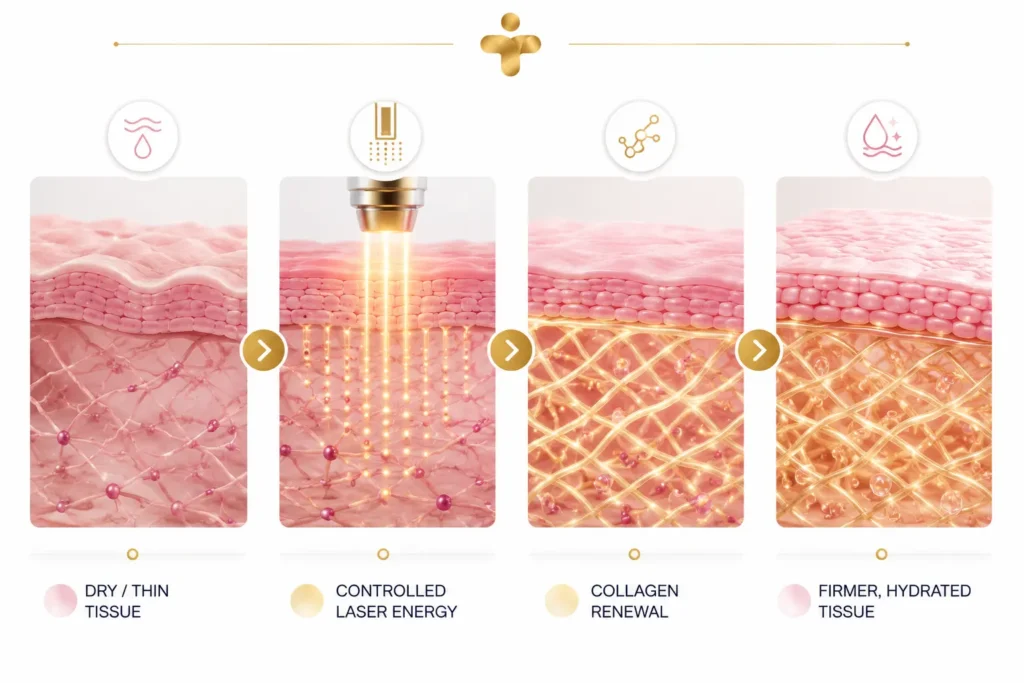
Laser vaginal rejuvenation uses a fractional CO2 laser – a highly controlled beam of light energy – delivered through a small probe that is gently inserted into the vaginal canal.
The laser creates thousands of microscopic thermal channels in the vaginal tissue. These are tiny, controlled injuries at a cellular level. The body responds the way it always responds to injury: by producing new collagen.
Collagen is the structural protein that keeps tissue firm, elastic, and well-hydrated. Vaginal tissue loses collagen over time because of childbirth, hormonal changes, ageing, or medical treatments like chemotherapy and radiation.
When collagen levels drop, the tissue becomes thinner, drier, looser, and less resilient. That is what causes the symptoms women come in about: looseness after delivery, painful dryness, reduced sensation, or discomfort during intercourse.
The fractional CO2 laser reverses this by prompting the body to rebuild.
Over the weeks following each session, the treated tissue produces fresh collagen fibres. The vaginal walls become thicker, more hydrated, and more toned. The results build gradually, which is why multiple sessions are usually recommended.
No cuts. No stitches. No general anaesthesia.
The procedure takes roughly 20 to 30 minutes and most women leave the clinic the same day with minimal discomfort.
Who Is a Good Candidate for Laser Vaginal Rejuvenation?
This is one of the most common questions at the first consultation. And the answer is broader than most women expect.
Laser vaginal rejuvenation is not just for one type of patient. Women who typically benefit include:
- Mothers who have had one or more normal vaginal deliveries and notice significant laxity or looseness
- Women experiencing vaginal dryness and thinning after menopause due to reduced oestrogen
- Cancer survivors, including breast cancer survivors, who have lost oestrogen production because of chemotherapy, radiation, or medications like Tamoxifen, and cannot use hormone replacement therapy
- Women who have had C-sections and experience vaginal dryness or laxity unrelated to the delivery itself
- Younger women, including those who have not delivered vaginally, who have concerns about tissue tone, dryness, or appearance
- Women who experience mild stress urinary incontinence — a leakage of urine when coughing, laughing, or sneezing
- Women with genitourinary syndrome of menopause, a condition involving vaginal and urinary symptoms caused by declining oestrogen
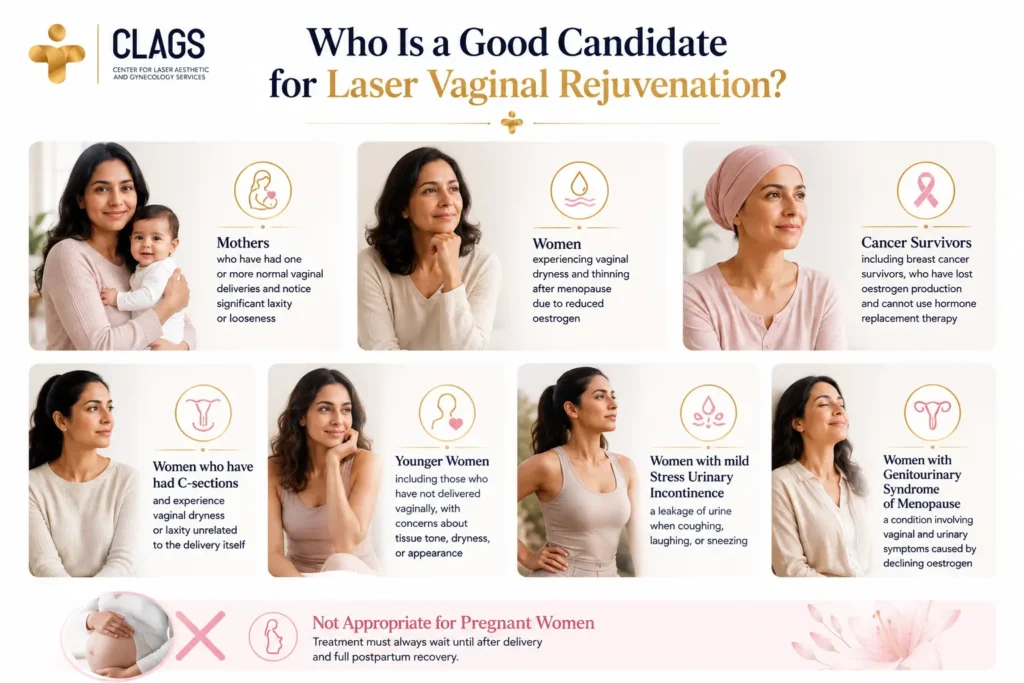
The one group for whom laser vaginal rejuvenation is not appropriate is women who are currently pregnant. Treatment must always wait until after delivery and full postpartum recovery.
The Question Every Mother Asks: Will Laser Vaginal Rejuvenation Work After Multiple Normal Deliveries?
A mother of seven children, all normal deliveries, 36 years old, came into the clinic with one straightforward question: will this even work for me?
After seven vaginal deliveries, the degree of stretching and structural change is significant. It is an understandable concern.
The honest answer is that laser vaginal rejuvenation can meaningfully improve tissue quality, tone, and moisture for women who have delivered multiple times.
However, the degree of improvement depends on how significant the laxity is.
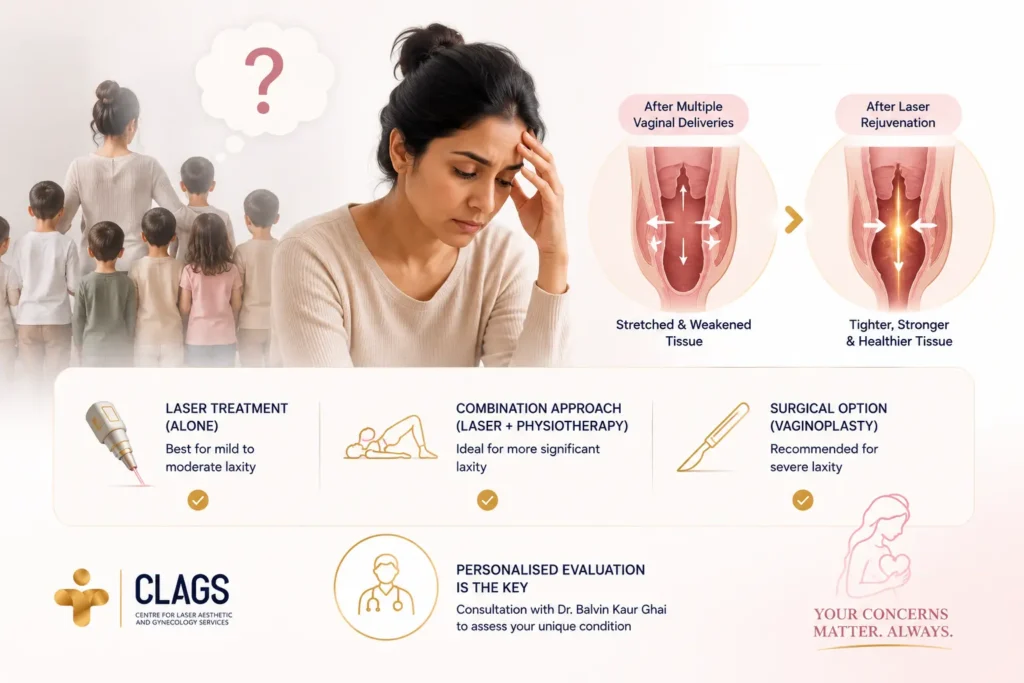
For women with mild to moderate looseness, laser treatment alone often delivers very satisfying results. For women with severe laxity, particularly where the perineal muscles and pelvic floor are significantly weakened, a combination approach may work better.
This might mean pairing laser treatment with pelvic floor physiotherapy — or discussing whether a surgical procedure like vaginoplasty at CLAGS might be a more appropriate primary solution.
The only way to give you a specific, personalised answer is through a consultation where Dr. Balvin Kaur Ghai can assess the actual tissue condition.
What is certain is that no woman should feel her concern is too extreme to bring up.
What About After a C-Section? Is Laser Vaginal Rejuvenation Safe?
This question comes up more than most people expect.
The short answer is yes — laser vaginal rejuvenation is entirely appropriate for women who have delivered by caesarean section.
Here is why the confusion exists: many people assume that because a C-section bypasses the vaginal canal, there is nothing to address in that area.
That assumption is not correct.
Vaginal laxity and dryness are not caused exclusively by vaginal delivery. Pregnancy itself — with its hormonal shifts, weight changes, and pressure on the pelvic floor over nine months — causes tissue changes that persist regardless of delivery mode. Oestrogen fluctuations during and after pregnancy affect vaginal tissue quality whether or not there was a vaginal delivery.
A 25-year-old woman who has had one C-section and has not delivered vaginally can still experience vaginal dryness, discomfort during intercourse, or reduced tissue tone.
Laser vaginal rejuvenation addresses the tissue directly. The procedure works on the vaginal mucosa itself, which is entirely separate from the abdominal incision involved in a C-section. There is no conflict between the two.
The only requirement is that the woman is fully healed postpartum – which typically means waiting at least three to six months after delivery before beginning treatment.
For Women After Cancer Treatment: When Hormones Are Gone and the Body Changes
Breast cancer survivors face a situation that is both physically difficult and emotionally isolating.
Between chemotherapy, radiation, and years on Tamoxifen or similar anti-oestrogen medications, many women find that their bodies stop producing oestrogen entirely. The vaginal tissue thins dramatically. Collagen disappears. Dryness becomes severe.
Even a routine gynaecological examination, let alone intimacy, becomes painful.
The standard treatment for vaginal atrophy is topical oestrogen. But for breast cancer survivors, oestrogen-based therapies are often contraindicated. The very medication that depletes oestrogen was prescribed to prevent cancer recurrence- so reintroducing oestrogen in any form carries risk.
This is where laser vaginal rejuvenation becomes particularly valuable.
Because it works by stimulating the body’s own collagen production through a physical mechanism rather than a hormonal one, it does not involve any oestrogen at all. It is completely hormone-free. The laser triggers collagen rebuilding from within the tissue itself, restoring thickness, elasticity, and moisture without introducing any substance that could affect cancer hormone receptors.
Research published in peer-reviewed literature, including studies indexed on PubMed, has examined fractional CO2 laser treatment specifically in women with genitourinary symptoms after breast cancer treatment. Findings have consistently supported its safety and symptom-reduction benefits in this population.
Before proceeding, the treating oncologist should always be consulted. At CLAGS, the team works with that information to create an approach that is safe for the individual patient.
How Many Sessions Does Laser Vaginal Rejuvenation Actually Require?
The most commonly asked follow-up after “Is it permanent?” is “How many sessions will I need?”
It is a fair question. Nobody wants to commit to an open-ended treatment plan without knowing what to expect.
The standard protocol for laser vaginal rejuvenation at most specialist clinics is three sessions spaced four to six weeks apart.
This spacing allows the tissue to complete its collagen remodelling cycle between sessions, which produces the best cumulative result. Some women with milder concerns see meaningful improvement after two sessions. Others with more significant tissue changes may benefit from a fourth.
Each session typically takes 20 to 30 minutes. There is no anaesthesia required for most women, though a topical numbing cream is sometimes applied beforehand for comfort. There is no hospitalisation and no recovery period requiring time off work or daily activities.
After the initial course of sessions, maintenance is usually recommended once every 12 to 18 months — to sustain the results as the natural ageing process continues to affect collagen levels over time.
Is Laser Vaginal Rejuvenation Permanent? The Honest Answer
This is the question almost every woman asks. And it deserves a straight answer rather than vague marketing language.
Laser vaginal rejuvenation is not permanent in the way that a structural surgical procedure might be. It is also not temporary in the way that a moisturiser is.
The results fall somewhere in between and understanding why helps set realistic expectations.
The laser stimulates the body to produce new collagen. That collagen is real, structural, and it genuinely improves tissue quality. Women notice firmer, better-hydrated tissue that feels meaningfully different.
Those results typically last 12 to 18 months before the natural breakdown of collagen, which continues with age and hormonal changes, begins to return the tissue toward its previous state.
This is not a failure of the treatment. It is simply the reality of how collagen works in the body.
The same is true of many skin treatments, including dermal fillers and laser skin resurfacing on the face. A maintenance session once a year or once every 18 months keeps the results sustained.
For women whose tissue changes are driven by ongoing hormonal deficiency such as post-menopausal women or those on anti-oestrogen medications the underlying cause continues to act on the tissue. In these cases, regular maintenance is especially important, and the treating specialist will advise on the appropriate interval between sessions.
How Long After the Procedure Before Resuming Intimacy?
Most women are advised to avoid sexual intercourse for five to seven days after each laser vaginal rejuvenation session.
It is important to understand that laser vaginal rejuvenation does not involve sutures. There are no stitches to “rip.” The procedure creates microscopic channels in the vaginal tissue at a cellular level — not visible incisions.
The reason for the waiting period is not suture integrity. It is tissue recovery.
The vaginal mucosa needs a short window to complete its initial healing response before being subjected to friction and pressure. Resuming intimacy too soon could cause irritation, discomfort, or minor bleeding. None of which are dangerous but all of which are avoidable.
After the five-to-seven-day window, most women can resume normal sexual activity without restriction.
Many women actually report that intimacy becomes more comfortable than it was before treatment — particularly those who were experiencing dryness and pain beforehand.
If there is any discomfort, unusual discharge, or bleeding beyond the first 48 hours, that should be reported to the treating specialist immediately.
Is It Painful? What Does the Procedure Actually Feel Like?
Anxiety about pain is real and completely understandable — especially for a procedure in such a sensitive area.
The clinical reality is that most women describe laser vaginal rejuvenation as mildly uncomfortable rather than painful.
The laser probe is smooth and designed specifically for vaginal use. There are no sharp edges and no cutting involved. What women typically feel is a mild warming sensation and occasional brief pulses of heat as the laser energy is delivered.
A topical numbing cream applied before the procedure reduces even that sensation significantly.
After the procedure, some women experience mild soreness, warmth, or a feeling of tightness for 24 to 48 hours. This settles on its own. A small amount of discharge in the first day or two is normal as the tissue begins its healing response.
Serious pain, heavy bleeding, or signs of infection are not expected outcomes and should always be evaluated promptly if they occur.
Most women leave the clinic and go about their normal day including returning to desk work — the same afternoon.
Can Young Women Have This Treatment? What If You Have Never Delivered?
Yes. Laser vaginal rejuvenation is not restricted to women who have delivered vaginally or who are past a certain age.
A 25-year-old woman with one C-section or even a young woman who has never been pregnant at all can be a candidate if there is a clinical reason for the treatment.
Reasons a younger woman might seek laser vaginal rejuvenation include:
- Vaginal dryness related to hormonal contraception, certain antidepressants, or other medications
- Discomfort during intercourse unrelated to delivery
- Postpartum tissue changes following a C-section, particularly dryness and reduced elasticity
- Recovery support after gynaecological procedures
- Aesthetic concerns related to tissue appearance, sometimes addressed alongside other procedures like labiaplasty at CLAGS
Age alone is not a contraindication. Pregnancy is.
Any woman who is currently pregnant or planning to become pregnant in the immediate future should wait until after delivery and full recovery before considering this or any cosmetic gynaecological treatment. Pregnancy will stretch and alter vaginal tissue again — meaning any treatment done beforehand may not yield lasting benefit.
What Does Laser Vaginal Rejuvenation Cost in India?
Cost is one of the most searched aspects of this treatment. And it is a completely reasonable thing to want to know before making a decision.
In India, the cost of laser vaginal rejuvenation varies depending on the clinic, the technology used, the number of sessions required, and the city.
Broadly speaking:
- A single session at a reputable specialist clinic using certified fractional CO2 laser technology ranges between Rs. 15,000 and Rs. 40,000
- A full course of three sessions typically falls between Rs. 35,000 and Rs. 90,000 depending on the provider and the individual treatment plan
At CLAGS in Mohali, the specific cost is determined after an initial consultation where Dr. Balvin Kaur Ghai assesses the tissue condition, discusses the treatment goals, and recommends the number of sessions most appropriate for the individual.
There is no one-size-fits-all pricing for a treatment that genuinely needs to be personalised.
It is worth asking any clinic upfront whether the quoted cost is per session or for a complete course, and whether the initial consultation is included. Understanding exactly what is covered avoids surprises.
A Note from Dr. Balvin Kaur Ghai, Cosmetic Gynaecologist, CLAGS Mohali
The women who walk into my consultation room have usually spent weeks, sometimes months, working up the courage to come.
They carry questions they feel embarrassed to say out loud, fears they think are unusual, and often a quiet sense of loss about changes their bodies have gone through that nobody warned them about.
What I want every woman to know is this: there is nothing unusual about your questions. Vaginal health is part of overall health. The changes that happen after childbirth, during menopause, or as a result of cancer treatment are real. They affect quality of life deeply. And they are treatable.
You do not have to accept discomfort or loss of intimacy as an inevitable outcome.
Laser vaginal rejuvenation is a tool I use carefully and selectively, always after a thorough assessment. It is not appropriate for every woman but for many, it genuinely changes how they feel about their bodies and their lives.
If you have questions, bring them. All of them. That is what this space is for.
What to Expect at Your First Consultation for Laser Vaginal Rejuvenation in Mohali
If you are considering laser vaginal rejuvenation at CLAGS, here is what the first visit looks like — so you can walk in feeling prepared rather than anxious.
- A private, detailed conversation where you describe your symptoms, concerns, and what you hope to achieve. Nothing you say will be met with judgment.
- A gynaecological assessment to evaluate the current state of the vaginal tissue. This tells the doctor exactly what is happening structurally and helps determine the most appropriate treatment plan.
- A discussion of options, which may include laser vaginal rejuvenation alone, a combination with other treatments, or an alternative approach if laser is not the best fit for your situation.
- A clear explanation of what to expect, including the number of sessions likely needed, the cost, the recovery, and realistic outcomes.
- Answers to every question you came in with — and the ones you forgot to ask.
There is no obligation to proceed with anything at the first consultation.
The goal of that first meeting is simply to give you the information you need to make a decision that feels right for your body and your life.
You can book an appointment online at CLAGS here.
What the NHS and Medical Research Say About Vaginal Laser Treatment
It is worth being transparent about where the medical evidence currently stands.
The NHS guidance on vaginal dryness and genitourinary syndrome of menopause acknowledges that vaginal laser treatment is an emerging option — particularly for women who cannot use oestrogen-based therapies. Research continues to accumulate, and results across multiple clinical studies have been encouraging, particularly for symptom relief in postmenopausal women and cancer survivors.
As with any treatment, laser vaginal rejuvenation should be discussed with a qualified, experienced specialist who can evaluate individual suitability. It is not a universal solution and it is not without limitations.
The key is an honest, informed conversation with a doctor who knows both the benefits and the boundaries of what the treatment can achieve.
At CLAGS, that conversation is always the starting point.
10 Most-Asked Questions About Laser Vaginal Rejuvenation, Answered
1. I had chemotherapy and radiation for breast cancer and stopped producing oestrogen. Can I do laser vaginal rejuvenation even if I cannot use hormones?
Yes. Laser vaginal rejuvenation is a hormone-free treatment. It stimulates your body’s own collagen production mechanically, without introducing oestrogen or any hormone. This makes it one of the very few effective options available to breast cancer survivors who cannot use topical oestrogen.
Before proceeding, share your oncology history and current medications with your treating doctor so the approach can be tailored appropriately. Your oncologist should also be informed.
2. How long after the laser procedure can I have sex without worrying about tearing or damage?
There are no sutures involved in laser vaginal rejuvenation, so there is nothing to “tear” in that sense. The standard waiting period is five to seven days after each session, to allow the vaginal mucosa to complete its initial healing response before exposure to friction.
After that window, normal intimacy can resume. If there is any unusual discomfort during that period, check with your doctor before proceeding.
3. Can girls or young women have this treatment before they have delivered a baby?
Yes, as long as they are not currently pregnant. Laser vaginal rejuvenation is not restricted by age or delivery history. A young woman experiencing vaginal dryness, discomfort, or other clinically valid concerns is a potential candidate.
The only absolute contraindication is active pregnancy. Women planning to conceive soon are generally advised to wait, since pregnancy will affect vaginal tissue again after treatment.
4. I am 36, have had seven normal deliveries. Will this treatment even work for my situation?
Laser vaginal rejuvenation can produce real improvement in tissue tone and hydration regardless of delivery history. For women with very significant laxity after multiple deliveries, the laser addresses tissue quality effectively.
A frank discussion about whether surgical options like vaginoplasty might offer more structural correction is also worthwhile. A thorough assessment at consultation will tell you exactly what is appropriate for your body.
5. Is the result permanent or will things go back to how they were?
The results are lasting but not permanent. The new collagen built by the treatment is real and durable, but the natural ageing process and any ongoing hormonal changes continue over time.
Most women find that results hold well for 12 to 18 months. Annual or 18-monthly maintenance sessions sustain the improvement. Think of it the way you would think about other collagen-stimulating treatments — rather than a single permanent fix.
6. I had a C-section. Can I still do laser vaginal rejuvenation?
Yes. C-section delivery does not contraindicate this treatment. Vaginal tissue changes happen because of pregnancy, hormones, and ageing regardless of how delivery occurred.
Women who have had C-sections frequently experience vaginal dryness, reduced elasticity, or discomfort — and laser vaginal rejuvenation addresses those tissue changes directly. Wait until at least three to six months postpartum before beginning treatment.
7. Does vaginal tightening laser treatment come in sessions? How many will I need?
Yes, it is delivered as a course of sessions. The standard protocol is three sessions spaced four to six weeks apart. Some women need two, some benefit from four.
Each session is 20 to 30 minutes. Your doctor will recommend the number of sessions based on the assessment of your tissue and your treatment goals, and will re-evaluate after each session.
8. How tight does the vagina actually get after laser treatment? Is the tightening significant?
The improvement is in tissue tone, elasticity, and thickness — not a dramatic mechanical tightening. Women describe feeling firmer, more comfortable, and significantly less dry. The improvement in sexual comfort and confidence is real.
Laser vaginal rejuvenation is not designed to create an artificially tight canal. For women seeking significant structural tightening, a surgical option like vaginoplasty may be more appropriate. A specialist consultation is the best way to determine what outcome is realistic for you.
9. Is the laser treatment safe for someone who has never had a vaginal delivery?
Yes. The tissue mechanics of the procedure are the same regardless of delivery history. Young women who have not delivered vaginally may have thicker, more elastic tissue to begin with, which means a shorter course of treatment.
Clinical suitability is assessed individually at consultation rather than determined by delivery history alone.
10. What is the approximate cost of laser vaginal rejuvenation in India?
In India, costs typically range from Rs. 15,000 to Rs. 40,000 per session at qualified specialist clinics, with a full three-session course ranging from Rs. 35,000 to Rs. 90,000 depending on the provider, city, and individual treatment requirements.
At CLAGS Mohali, the exact cost is discussed openly after the initial consultation once the treatment plan is confirmed. There are no hidden charges.