
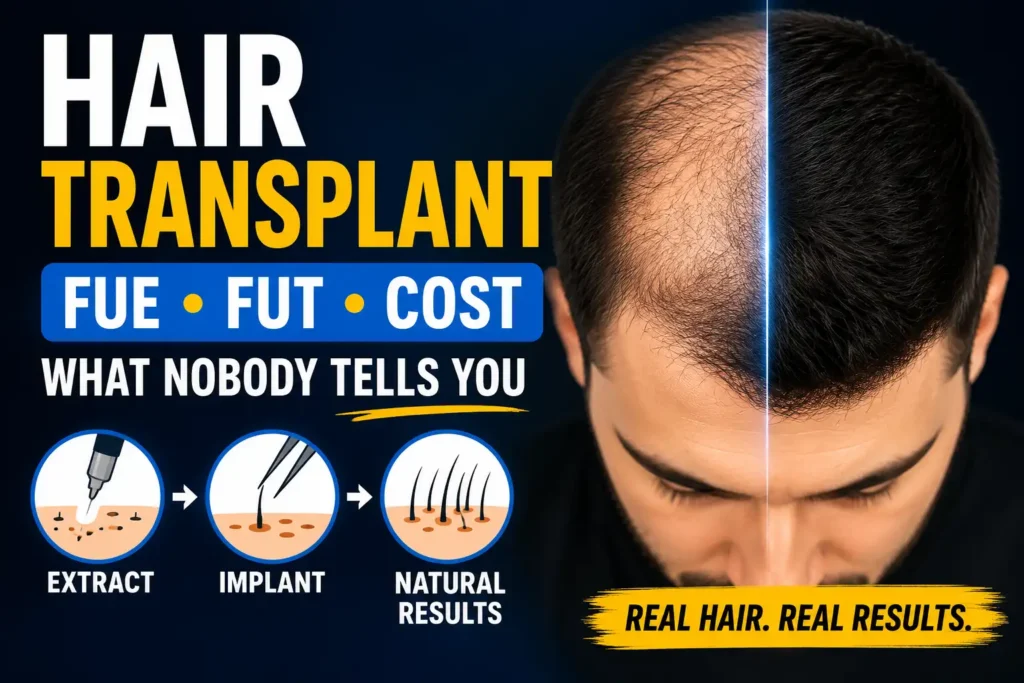
A hair transplant moves your own hair. Not synthetic fibre.
Not someone else’s follicles.
Your own DHT resistant grafts from the back and sides of your scalp, placed one by one into areas that have stopped producing hair.
When done well, the procedure produces a result so natural that a haircut later is indistinguishable from the hair you had at 22. When done badly, the result is a doll like plug appearance, an unnatural hairline, or scarring that cannot be reversed. The difference is almost entirely in the planning and the surgeon, not in the marketing.
Key facts in 30 seconds: FUE is the standard technique today, leaves no linear scar, and takes 6 to 10 hours depending on graft count. One graft equals 1 to 4 hairs. Most male patients need 1,500 to 3,500 grafts. Results are visible by month 4 and final by month 12. Transplanted hair never falls out because the donor follicles are DHT resistant. Cost at CLAGS starts from 35 rupees per graft, with full packages from 60,000 upward.
FUE vs FUT Hair Transplant in Mohali: The Honest Comparison
Every clinic in the Mohali and Chandigarh tricity offers both techniques. What they often do not explain clearly is that FUE and FUT are not interchangeable options where you pick whichever is cheaper. They suit different patients, different graft counts, and different donor characteristics.
| Feature | FUE (Follicular Unit Extraction) | FUT (Follicular Unit Transplantation) |
|---|---|---|
| How grafts are extracted | Individual follicles punched out one by one using a micro punch tool | A strip of scalp skin removed, then dissected into individual grafts |
| Scar left | Tiny dot scars scattered across donor area, invisible under 1cm hair length | Single linear scar along the back of the scalp, covered by overlying hair |
| Grafts per session | 1,000 to 3,000 typically in one day | 2,000 to 5,000 possible in one session |
| Recovery | Faster, donor area heals in 7 to 10 days | Slightly longer, linear incision heals in 2 to 3 weeks |
| Graft survival rate | 85 to 95% with skilled surgeon and proper handling | 90 to 97%, grafts stay moist longer during dissection |
| Best suited for | Patients who shave their head, low to moderate baldness (Norwood 1 to 5) | Patients needing large graft counts, Norwood 5 to 7 |
| Can it be combined with FUT? | Yes, hybrid sessions for maximum coverage | Yes, often combined with FUE to maximise donor yield |
| Cost per graft at CLAGS | 35 to 60 rupees per graft | 25 to 45 rupees per graft |
The surgeon’s recommendation between FUE and FUT should be based on your Norwood stage, donor density, scalp laxity, and lifestyle, not on which procedure the clinic makes a higher margin on.
How Many Grafts You Actually Need: Norwood Scale Guide
The single most important number in planning this procedure is your graft count. Underestimating it leaves results thin and patchy. Overestimating strips the donor area and leaves nothing for future sessions if loss progresses.
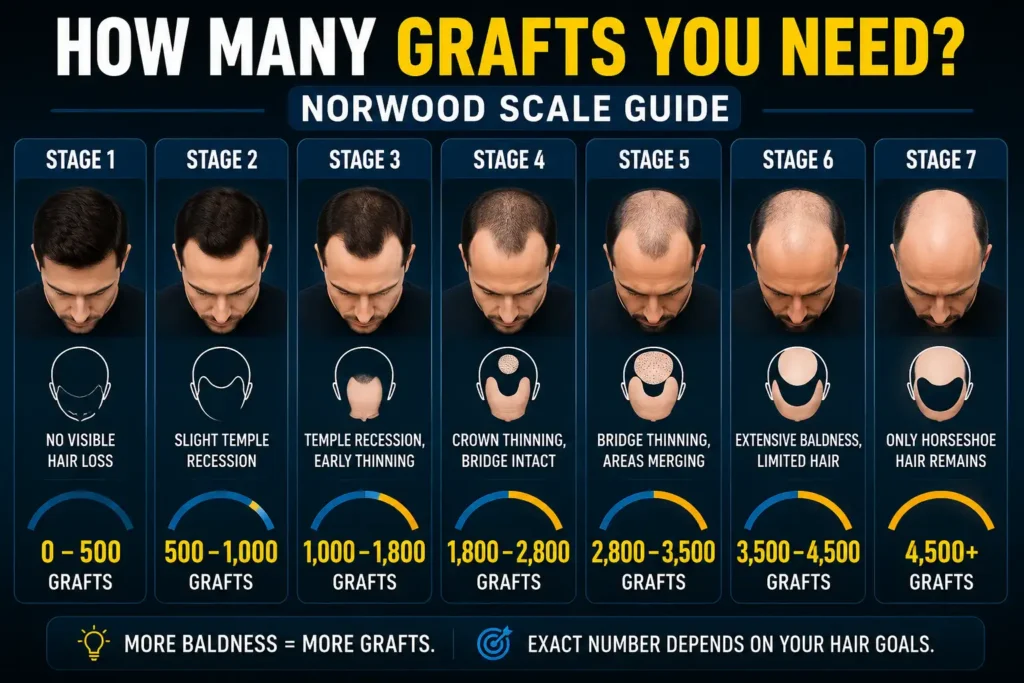
The Norwood scale grades male pattern baldness from stage 1 (no loss) to stage 7 (only a horseshoe band of hair remaining). Graft estimates by stage:
| Norwood Stage | Pattern Description | Approximate Grafts Needed |
|---|---|---|
| Stage 1 to 2 | Slight recession at temples only | 500 to 1,000 grafts |
| Stage 3 | Visible temple recession, early crown thinning | 1,000 to 1,800 grafts |
| Stage 4 | Crown bare, temples receded, bridge of hair intact | 1,800 to 2,800 grafts |
| Stage 5 | Bridge thinning, crown and front merging | 2,800 to 3,500 grafts |
| Stage 6 | Crown and temples joined, only sides and back remain | 3,500 to 4,500 grafts |
| Stage 7 | Only narrow horseshoe band remains | 4,500 to 6,000 grafts (often two sessions) |
These are estimates. Actual graft count is confirmed only after a physical donor assessment measuring follicular density per square centimetre, average hairs per graft, and safe donor zone area. A clinic that quotes a graft count before examining you in person is guessing.
“The hairline is the most artistic and most permanent decision in a hair transplant. A hairline that looks natural at 35 must still look natural at 55 as the patient continues to age. At CLAGS we design every hairline conservatively on paper before a single punch is made, with the patient’s input and full understanding of the long term vision.” Dr. Balveen Kaur Ghai, CLAGS Centre, Mohali
Who Is a Good Candidate for Hair Transplant in Mohali
A hair transplant works by relocating DHT resistant follicles from a stable donor area to areas of loss. That principle means not everyone with hair loss is a suitable candidate right now.
You are likely a good candidate if:
- Your hair loss has been stable for at least 12 months, not actively progressing
- You have adequate donor density at the back and sides of the scalp
- You are over 25 years old, so the pattern of loss is more predictable
- You have realistic expectations: density improvement, not a full head of 20 year old hair
- You are in good general health and not on anticoagulants, steroids, or immunosuppressants
You may need to wait or consider alternatives if:
- Hair loss is still actively spreading and the final pattern is unclear
- Donor density is too low to cover the balding area adequately
- You have diffuse unpatterned alopecia, where donor hair is also unstable
- The cause of your hair loss is a medical condition such as thyroid disorder, anaemia, or autoimmune alopecia, that needs treatment first
Female Hair Transplant in Mohali: A Different Protocol
Female hair transplant in Mohali follows a different protocol from male cases. Female pattern hair loss looks different and behaves differently from male pattern baldness. Most women retain the hairline but experience diffuse thinning across the crown and top. This matters for planning because the donor zone assessment is more complex and FUE requires a targeted extraction approach to avoid visible shaving of the donor area.
Female hair transplant in Mohali at CLAGS is planned around these specific considerations:
- Ludwig scale grading for women, not Norwood, to accurately map the thinning pattern.
- Hormonal assessment first. Many women lose hair due to PCOS, thyroid imbalance, or iron deficiency. A hair transplant done before treating the hormonal cause gives temporary results. At CLAGS, Dr. Balveen Kaur Ghai handles this dual assessment as a cosmetic gynaecologist and aesthetic specialist.
- Partial shave FUE where only a small strip at the back is shaved, keeping the rest of the hair intact to cover the donor area during healing.
- PRP therapy in Mohali is recommended alongside the transplant to stimulate the existing thinning native hair and improve overall density beyond the grafted zones.
Honest Hair Transplant Cost in Mohali in 2026
Hair transplant pricing in the Mohali tricity is almost always quoted per graft. This allows apples to apples comparison, but only if the clinic counts grafts the same way. The total cost is: graft count multiplied by per graft rate, plus one time facility, anaesthesia, and PRP costs.
| Procedure | Per Graft Rate at CLAGS | Typical Total (Indicative) |
|---|---|---|
| FUE hair transplant in Mohali (1,000 to 1,500 grafts) | 35 to 50 rupees | 40,000 to 75,000 rupees |
| FUE hair transplant in Mohali (2,000 to 3,000 grafts) | 35 to 50 rupees | 75,000 to 1,50,000 rupees |
| FUT hair transplant in Mohali (2,000 to 4,000 grafts) | 25 to 40 rupees | 55,000 to 1,60,000 rupees |
| Beard transplant in Mohali | 40 to 60 rupees per graft | 40,000 to 90,000 rupees |
| Female hair transplant in Mohali | 40 to 55 rupees per graft | 60,000 to 1,40,000 rupees |
| PRP therapy add on (3 sessions) | Fixed | 12,000 to 25,000 rupees |
The lowest quotes in the affordable hair transplant in Mohali market often reflect lower graft counts, technician led procedures rather than surgeon led, or clinics that count individual hairs as grafts (inflating the count number while delivering less value). Ask for the graft count in writing, confirmed before you pay.
What Happens on Hair Transplant Day: Step by Step
- Donor assessment and finalisation. The surgeon photographs and measures donor density one final time. Graft count is locked.
- Hairline design. The new hairline is drawn on the scalp with the patient sitting upright and actively involved. Nothing proceeds until both the patient and surgeon agree.
- Anaesthesia. Local anaesthetic is injected into the donor area and recipient area. The injections are the most uncomfortable part of the day. After this, the procedure is essentially painless.
- Extraction phase. For FUE, a micro punch tool extracts individual follicular units. For FUT, a strip is removed and dissected by a trained team under microscopes.
- Storage. Grafts are stored in a chilled holding solution to preserve viability. Time outside the body is minimised.
- Slit making. The surgeon creates recipient sites at precise angles, depths and densities to mimic natural hair growth direction.
- Implantation. Grafts are placed into recipient slits. Single hair grafts go into the hairline for a natural feathered edge. Multi hair grafts go behind for density.
- Dressing and discharge. The donor area is dressed. The recipient area is left open. The patient is discharged the same day with a post operative kit and written instructions.
Recovery Timeline After Surgery: What to Expect Month by Month
The most common cause of patient panic after a hair transplant is shock loss. This is normal, expected, and temporary. It must be understood before surgery, not discovered afterward.
- Days 1 to 3. Recipient area looks red with tiny scabs around each graft. Donor area is pink and tender. Sleep with the head elevated. No touching the grafts.
- Days 4 to 7. Scabs begin to loosen. Gentle washing with prescribed shampoo from day 3 or 4. Most patients return to desk work by day 5 to 7.
- Weeks 2 to 4. Shock loss begins. Transplanted hairs fall out. This is normal. The follicles enter a resting phase. Patients who are not warned feel the transplant has failed. It has not.
- Months 2 to 4. Follicles wake up. New fine hairs emerge. Growth is slow and uneven at first.
- Months 4 to 8. Density increases visibly. Most patients see clear coverage by month 6.
- Month 10 to 12. Final result. Hair is fully grown, textured, and can be cut, styled, coloured and treated exactly like native hair.
PRP Therapy in Mohali: Why It Is Recommended Alongside Hair Transplant
Platelet Rich Plasma therapy involves drawing the patient’s own blood, spinning it to concentrate the growth factors, and injecting the plasma into the scalp. It does not replace a hair graft surgery in Mohali for significant baldness, but it works alongside one in two ways.
- It improves graft survival rate in Mohali procedures by creating a growth factor rich environment in the scalp before and after the transplant session.
- It stimulates native thinning hair in areas adjacent to the transplanted zones, improving overall density beyond just the grafted region.
At CLAGS, PRP therapy in Mohali is offered as a structured plan of 3 sessions, typically one pre operatively, one at month 2, and one at month 4. This is not mandatory but significantly improves total results, particularly in patients with thin native hair density.
According to a clinical review published on PubMed on PRP in hair restoration and Cleveland Clinic’s overview of hair transplant surgery, PRP application alongside transplant surgery improved hair density and graft survival rates in the majority of patients studied.
Beard Transplant and Eyebrow Transplant in Mohali
Hair transplant techniques apply equally well to facial hair zones. At CLAGS in Mohali, the following are performed as standalone procedures or combined with scalp work in the same session.
- Beard transplant in Mohali addresses patchy beard growth, post scar blank zones in the beard line, or patients who want a fuller, more defined beard shape.
- Moustache transplant for men with genetic thinning in the upper lip hair zone.
- Eyebrow transplant for patients who have lost eyebrow hair through over plucking, alopecia, burns, or thyroid related loss.
Facial hair transplants use single hair grafts placed at very low angles, typically 10 to 15 degrees, to mimic how facial hair actually grows. Hairline design in Mohali for beard and eyebrow zones requires the same precision as scalp hairline design, and is handled personally by the surgeon, not by technicians.
Why CLAGS for Hair Transplant in Mohali
The CLAGS centre at Airport Road, Sector 79 Mohali approaches hair restoration in Mohali as a planned surgical procedure, not a walk in package. Every patient undergoes a pre operative consultation, donor density measurement, Norwood or Ludwig grading, and a written treatment plan with the exact confirmed graft count before any surgery date is set. The hair transplant surgeon in Mohali at CLAGS personally performs every step of hairline design and graft placement, not a technician team.
For patients with PCOS related or hormonal hair loss, CLAGS offers a combined approach where the underlying hormonal cause is addressed by Dr. Balveen Kaur Ghai as a cosmetic gynaecologist alongside the hair loss treatment in Mohali plan. This is a capability most standalone hair transplant clinics in the tricity do not have. Patients searching for the best hair transplant in Mohali, a top hair transplant clinic in Mohali, safe hair transplant in Mohali, or hair transplant near Mohali from Chandigarh, Panchkula, or Ludhiana will find a structured, unhurried consultation process here.
Patients who want to combine scalp work with related cosmetic treatments can also book a laser hair removal consultation for unwanted body hair, explore Botox and fillers for facial rejuvenation, or discuss body contouring options in the same centre.
“A hair transplant is one of the few cosmetic procedures where a patient who chooses the wrong clinic cannot come back to undo it. The grafts placed in the wrong direction, at the wrong angle, with the wrong hairline design are permanent. That is why we spend more time planning than operating.” Dr. Balveen Kaur Ghai, CLAGS Centre, Mohali
Red Flags to Avoid Before You Book Any Clinic in Mohali
The Mohali, Chandigarh, Panchkula tricity has a high density of hair transplant clinics at very different quality levels. These are the warning signs of a clinic that should not be on your shortlist.
- Same day consultation and procedure booking with no waiting period for a pre operative assessment
- Graft count quoted without a physical scalp examination
- Procedure performed by a technician rather than a qualified surgeon
- Unlimited graft packages, which typically use low quality grafts or count hairs rather than follicular units
- No written pre operative plan or confirmed graft count document
- Clinic cannot explain the specific hairline design rationale for your face shape and age
- No structured post operative follow up beyond a single visit
Frequently Asked Questions About Hair Transplant in Mohali
1. Is hair transplant painful?
The injections of local anaesthetic at the start of the session cause brief stinging. After that, the extraction and implantation are essentially painless. Post operatively, the donor area feels tender and tight for 3 to 5 days, manageable with prescribed oral painkillers.
2. Will the transplanted hair last forever?
Yes. Donor hair from the back and sides of the scalp is genetically programmed to be DHT resistant, meaning it does not respond to the hormone that causes pattern baldness. Once transplanted, it retains this characteristic and continues growing for life.
3. How many sessions will I need?
Most patients complete their hair restoration in one session. Patients at Norwood stage 6 or 7, or those who want very high density, sometimes need a second session 12 months after the first to add grafts to areas where more coverage is wanted.
4. What is the minimum age for a hair transplant?
Most surgeons recommend waiting until at least 25 to 28 years of age. At younger ages, the final pattern of loss is often still evolving, and a transplant done too early may look misplaced as further recession continues around the transplanted zone.
5. Can I get a hair transplant if I have very little donor hair?
Low donor density is a genuine limitation. In such cases, body hair transplant (BHT) using beard or chest hair as donor follicles is a partial solution, though graft quality and natural appearance are slightly lower than scalp donor hair. The realistic options are discussed honestly at consultation.
6. How long does the procedure take?
A session of 1,500 to 2,000 grafts takes approximately 6 to 8 hours. Sessions of 2,500 to 3,500 grafts take 8 to 10 hours, sometimes spread across two days for high graft counts.
7. When can I go back to the gym after hair transplant?
Light walking from day 4. Gym workouts and any activity that significantly raises heart rate or causes sweating should wait until day 14 minimum. Heavy lifting and contact sports are deferred until day 21 to 30.
8. Does hair transplant work for women?
Yes, but the protocol is different. Female pattern hair loss requires Ludwig scale assessment, hormonal screening, and a partial shave FUE approach to avoid visible donor shaving. At CLAGS, hormonal causes of female hair loss are evaluated and treated alongside the surgical plan.
9. What is the difference between PRP and hair transplant?
PRP stimulates existing hair follicles and improves their output. It is most effective for early to moderate thinning where follicles are present but underperforming. Once a follicle is completely dead, PRP cannot revive it. Hair transplant, by contrast, physically places new follicles. The two treatments are complementary, not alternatives.
10. How do I book a hair transplant consultation in Mohali at CLAGS?
Call the CLAGS centre directly or book online through the appointment system on the website. First consultations include donor density measurement, Norwood or Ludwig staging, a written graft count estimate, and a discussion of the technique recommended for your specific case. No procedure is booked at the first consultation.
This page is for patient education on this procedure and does not replace a direct clinical consultation. To book at CLAGS Mohali, call the clinic directly or use the online appointment system.