

Waking up after breast reduction surgery and noticing that one side looks fuller, higher, or more swollen than the other can be unsettling. Many women searching for answers about breast asymmetry after reduction in Mohali worry that something has gone wrong, when in most cases the body is simply doing what it needs to do to heal.
This concern comes up often during post-operative reviews at our clinic. Understanding why it happens, what is normal, and when it needs a second look brings real peace of mind during recovery.
Key Takeaways
- Some degree of breast asymmetry is normal even before surgery. Research on women with breast hypertrophy found that roughly 1 in 5 patients had a pre-existing volume difference greater than 200 grams between breasts before any surgery.
- Swelling rarely reduces at the same rate on both sides, which can make breasts look temporarily uneven for weeks or months after surgery.
- Most residual swelling settles within four to six months, though scars and final tissue softening can continue for up to a year.
- Minor, lasting differences in shape or size are common even after a well-healed breast reduction and do not always mean the surgery went wrong.
- Asymmetry that is severe, painful, or not improving after several months should be reviewed by your surgeon.
Why One Breast May Look Different After Breast Reduction
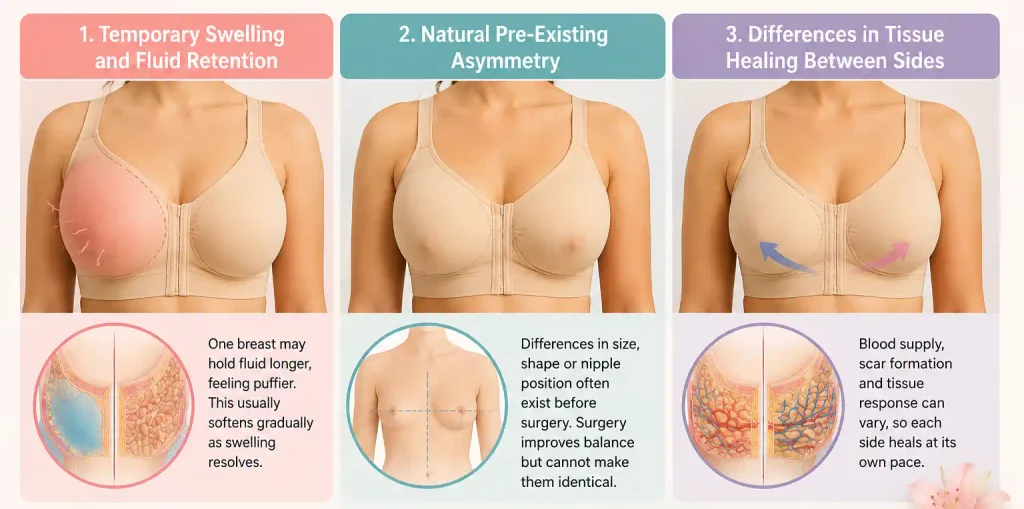
Three separate things usually explain uneven breasts after reduction: temporary swelling, natural pre-existing differences, and the pace at which each side heals. They often overlap, which is why the picture can look confusing in the early weeks.
1. Temporary Swelling and Fluid Retention
Swelling rarely arrives on cue. One breast may hold onto fluid a little longer, especially if more tissue was worked on that side. This kind of asymmetry usually feels puffier rather than firmer, and it tends to soften gradually.
2. Natural Pre-Existing Asymmetry
Very few women start out with two perfectly matched breasts. Differences in size, nipple position, or shape often exist long before surgery is considered. Reduction surgery aims to bring both breasts as close as safely possible, but it cannot erase every underlying structural difference.
3. Differences in Tissue Healing Between the Two Sides
Even with identical surgical techniques, the body does not always heal both breasts at the same speed. Blood supply, scar formation, and individual tissue response can all vary slightly from one side to the other.
“I tell my patients that breasts heal like siblings, not clones. They come from the same surgery, follow a similar path, but rarely arrive at the finish line on exactly the same day,” says Dr Balvin Kaur Ghai.
Is Breast Asymmetry After Reduction in Mohali Normal During Early Healing?
Yes, in most cases. The first few weeks after a breast reduction are when swelling, bruising, and tenderness peak, and this is also when asymmetry is most noticeable. Think of early results as a rough draft rather than the finished picture.
Why Is One Breast Bigger or More Swollen Than the Other?
A breast that had more tissue removed, more extensive reshaping, or a longer surgical time may simply take longer to calm down. None of this usually reflects a mistake. It reflects the fact that surgery on two separate structures produces two separate healing responses.
How Long Can Uneven Breasts After Reduction in Mohali Take to Settle?
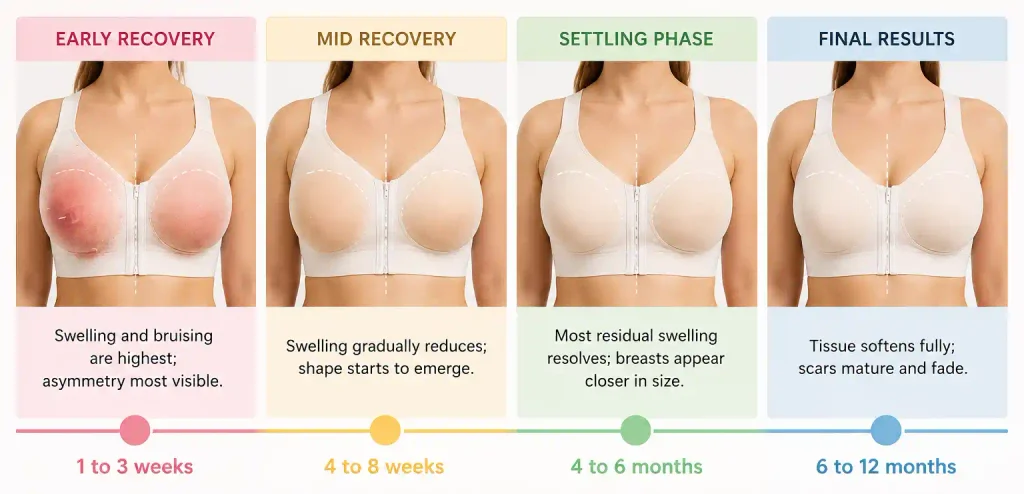
Healing timelines vary from patient to patient, but there is a general pattern most women can expect to follow.
| Recovery Stage | What Typically Happens | Approximate Timing |
|---|---|---|
| Early recovery | Swelling and bruising are highest; asymmetry most visible | 1 to 3 weeks |
| Mid recovery | Swelling gradually reduces; shape starts to emerge | 4 to 8 weeks |
| Settling phase | Most residual swelling resolves; breasts appear closer in size | 4 to 6 months |
| Final results | Tissue softens fully; scars mature and fade | 6 to 12 months |
This table is a general guide, not a guarantee. Your own timeline depends on your tissue type, the extent of the reduction, and how your body responds to healing.
Can Breast Healing Happen Differently on Each Side After Surgery?
It can, and it often does. One breast may reach the “settled” stage faster simply because it had less tissue removed or a more straightforward healing course. Photographing your progress every few weeks, rather than checking daily, gives a more honest picture of how things are moving.
Could My Breasts Have Been Naturally Uneven Before Surgery?
This is worth asking honestly, and most surgeons will have discussed it with you before your procedure. Pre-existing asymmetry is far more common than many women realise, and it is one of the main reasons surgeons take detailed measurements and photographs before ever picking up a scalpel.
- Differences in breast volume before surgery are common in women with breast hypertrophy
- One clinical study found a meaningful pre-operative volume difference in a notable proportion of patients being assessed for reduction surgery
- Nipple position, chest wall shape, and rib cage asymmetry can all contribute to uneven starting points
Can Breast Reduction Make Pre-Existing Asymmetry More Noticeable?
Occasionally, yes, though not because the surgery caused new unevenness. Once excess volume is removed, subtle differences that were previously hidden under larger breast tissue can become easier to see. This is not a failure of the procedure, simply a smaller canvas making existing lines more visible.
When Should Breast Asymmetry After Reduction Be Checked by a Surgeon?
Most fluctuations during the first few months are part of normal healing and do not need urgent attention. That said, some situations do call for a proper review rather than waiting it out.
- Sudden, painful swelling on only one side, especially if it comes with warmth or redness
- A visible size difference that is getting worse rather than better over time
- Asymmetry alongside fever, unusual discharge, or wound problems
- A difference that has not changed at all by the six-month mark
- Persistent, significant unevenness once you are well past a full year of healing
If any of these apply to you, book a review rather than searching for reassurance online.
How Can I Tell Whether It Is Swelling or a Difference in Final Results?
Swelling tends to feel soft, puffy, and slightly tender, and it usually shifts in appearance from morning to evening. A genuine difference in final shape tends to feel stable and consistent, without the day-to-day puffiness of active healing. If you are unsure which one you are seeing, that uncertainty is a good reason to book a follow-up rather than guess.
Is It Too Early to Judge My Breast Reduction Results While Still Healing?
Generally, yes. Judging final results before the four to six month mark often means judging swelling, not the actual outcome of surgery. Many surgeons ask patients to hold off on forming firm opinions until at least three to four months have passed.
Can Breast Asymmetry Become Less Noticeable as Healing Progresses?
In most cases, yes. As swelling resolves and tissue softens, breasts that looked quite different at two weeks often look remarkably similar by month four or five. Time alone resolves a large share of early asymmetry without any further treatment.
What Can Be Done If Asymmetry Remains After Breast Reduction?
If a meaningful difference remains well after full healing, several paths can be discussed at a review appointment. What suits one patient will not automatically suit another, and any next step depends entirely on individual examination.
- Continued observation if the difference is minor and stable
- Non-surgical support such as fitted garments in the short term
- Minor revision techniques for small, localised differences
- A more detailed surgical review if the asymmetry is significant
No outcome can be promised in advance, and any decision about further treatment should follow a hands-on assessment rather than a general online read.
When Might Breast Asymmetry Correction in Chandigarh Be Considered?
Correction is generally only discussed once healing is fully complete, typically beyond the one-year mark, and only if the difference is genuinely affecting comfort or confidence. Many women in the Chandigarh and tricity region who raise this find, on examination, that their asymmetry is still within a normal healing range.
How Should I Choose a Breast Reduction Surgeon in Punjab If I Am Concerned About Asymmetry?
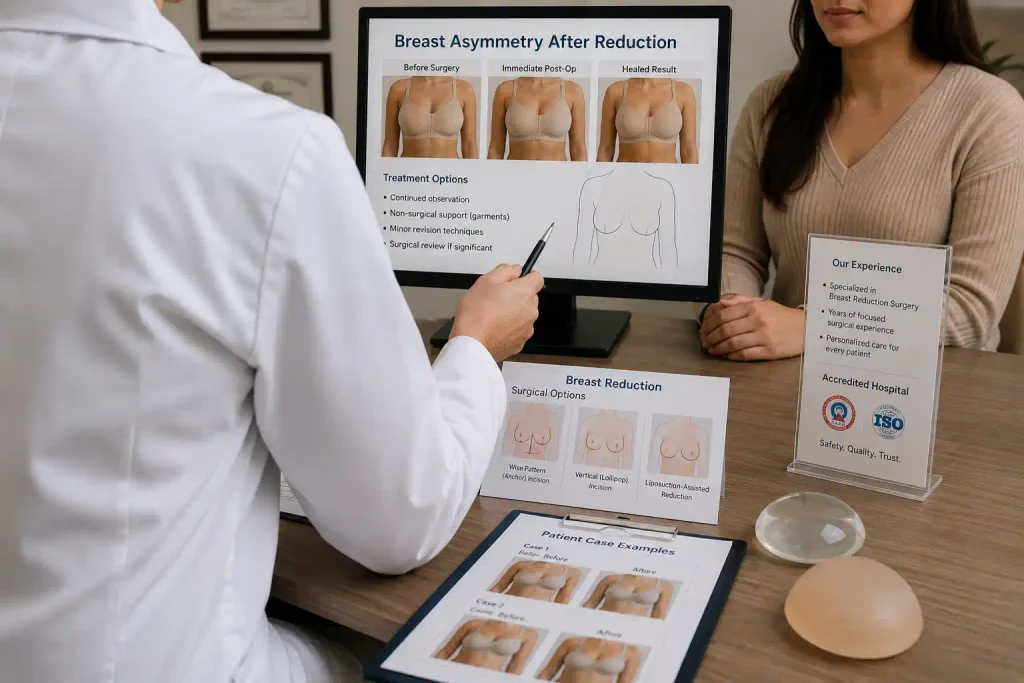
Look for a surgeon who takes detailed pre-operative measurements, discusses your existing natural asymmetry openly, and offers structured follow-up appointments well into recovery. A breast reduction surgeon in Punjab who plans review visits at one, three, and six months expects healing to be a process, not an event.
Can Breast Asymmetry Happen Again After Breasts Initially Appear Even?
It is uncommon but not impossible. Weight changes, hormonal shifts, pregnancy, or ageing can affect breast tissue over the years, sometimes unevenly. This is a separate issue from post-surgical healing and is worth mentioning at any future check-up.
A Note on Realistic Expectations
Breast reduction surgery is not designed to create two mathematically identical breasts. It is designed to bring meaningful relief from the weight and discomfort that led you to surgery, while getting both sides as close in size and shape as safely possible.
“Good breast reduction results are about balance and comfort, not perfection. I would rather a patient understand that honestly before surgery than feel disappointed by an unrealistic standard afterwards,” says Dr Ghai.
Moving Forward With Confidence
Noticing one breast look different after a reduction is common, and in the vast majority of cases it settles as healing progresses over the following months. Understanding the difference between temporary swelling, natural pre-existing asymmetry, and a genuine concern worth reviewing puts you in a far better position than guessing alone.
If your recovery is not following the pattern you expected, or you simply want an experienced set of eyes on your progress, a proper in-person review is always the right next step. You can book an appointment for a personal assessment of your healing and results.
Frequently Asked Questions
1. Why does one breast look different after breast reduction surgery?
Differences usually come down to uneven swelling, natural pre-existing asymmetry, or slightly different healing speeds on each side. Most of these differences reduce on their own as recovery progresses over the following months.
2. Is breast asymmetry after reduction in Mohali normal during the early healing stage?
Yes, it is very common in the first few weeks while swelling and bruising are at their peak. Surgeons generally expect some unevenness during this stage and only become concerned if it fails to improve over time.
3. Why is one breast bigger or more swollen than the other after reduction?
The side with more tissue removed or more extensive reshaping often takes longer to settle down. Individual differences in fluid drainage and tissue response can also make one side appear puffier for a while.
4. How long can uneven breasts after reduction in Mohali take to settle?
Most visible swelling resolves within four to six months, though full tissue softening and scar maturity can take up to a year. Patience during this window usually pays off, as many early differences fade with time.
5. Can breast healing happen differently on each side after reduction surgery?
Yes, even with identical surgical technique, the two breasts can heal at slightly different speeds. This is a normal biological response and not usually a sign of a problem.
6. Could my breasts have been naturally uneven before breast reduction?
Quite possibly. Pre-existing asymmetry is common, and many women only become fully aware of it once a surgeon measures and photographs their breasts before surgery.
7. Can breast reduction make pre-existing asymmetry more noticeable?
Sometimes, because removing excess volume can reveal subtle differences that were previously hidden. This does not mean the surgery caused the asymmetry, only that it became easier to see.
8. When should breast asymmetry after reduction be checked by a surgeon?
A review is worth booking if the difference is worsening, painful, accompanied by fever or unusual discharge, or has not changed at all after six months. Trust your instincts if something feels off rather than waiting indefinitely.
9. How can I tell whether unevenness is swelling or a difference in the final breast reduction results?
Swelling tends to feel soft and can fluctuate through the day, while a true difference in final shape stays fairly consistent. If you cannot tell the difference yourself, that is a reasonable reason to see your surgeon.
10. Is it too early to judge my breast reduction results while my breasts are still healing?
Generally yes, especially before the three to four month mark when swelling is still resolving. Final results are better judged once the tissue has had time to settle fully.
11. Can breast asymmetry after reduction become less noticeable as healing progresses?
In most cases, yes. As swelling reduces and tissue softens over several months, breasts that looked quite different early on often appear much closer in size and shape later.
12. What can be done if breast asymmetry remains after breast reduction?
Options range from continued observation to minor revision techniques, depending on how significant and stable the difference is. Any decision should follow a proper in-person examination rather than a guess based on appearance alone.
13. When might breast asymmetry correction in Chandigarh be considered after reduction surgery?
Correction is typically only discussed once healing is fully complete, usually beyond the one-year mark, and only if the difference is genuinely affecting the patient. Many concerns raised earlier than this turn out to still be within normal healing.
14. How should I choose a breast reduction surgeon in Punjab if I am concerned about asymmetry?
Look for a surgeon who takes detailed measurements before surgery, discusses natural asymmetry honestly, and schedules structured follow-up visits well into recovery. Ask directly how they handle asymmetry concerns during your consultation.
15. Can breast asymmetry happen again after the breasts initially appear even?
It is uncommon but possible, usually linked to weight changes, hormonal shifts, or aging rather than the original surgery. Any new asymmetry appearing years later is worth mentioning at a check-up as a separate issue.