


A biopsy report that comes back unclear can feel like an unfinished sentence. You waited days for an answer, and instead you received a note about limited tissue, ambiguous cells, or a result that does not match the scan. An inconclusive breast biopsy in Mohali does not mean your case has been mishandled or ignored. It means the pathologist needs more information before giving you a firm answer, and there is a defined, well understood path to get there.
Patients often assume an unclear result is rare or a sign that something has gone badly wrong. In reality, non-diagnostic biopsy findings are a recognised part of breast diagnostics worldwide, and most of them get resolved without surgery. Knowing why this happens, and what comes next, replaces anxious guessing with a clear plan.
Key Takeaways
- An inconclusive breast biopsy means the sample could not be classified as clearly benign or clearly malignant. It is a technical gap, not a diagnosis in itself.
- In one hospital based analysis of non-diagnostic core and vacuum assisted biopsies, roughly a third of the cases that went on to repeat sampling were then found to have malignancy, which is exactly why follow-up matters.
- Atypical ductal hyperplasia shows up in around three to five percent of breast biopsies. It is not cancer, though it raises future risk and needs monitoring.
- Most unclear results are resolved through repeat biopsy, extra imaging, or a second pathology opinion rather than immediate surgery.
- What happens next always depends on how well your imaging and your pathology findings agree with each other, not on the unclear result alone.
What Does an Inconclusive Breast Biopsy Mean?
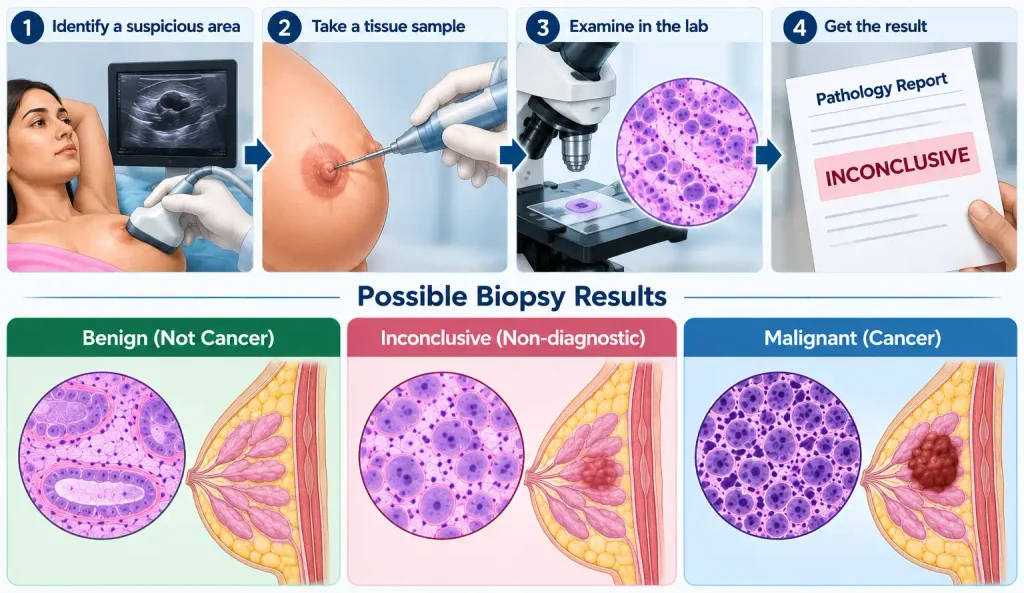
When a breast lump or a suspicious area on a scan is checked, a fine or core needle removes a small tissue sample for a pathologist to study under a microscope. Most results land clearly on one side of the line: benign or malignant. An inconclusive breast biopsy sits in between those two outcomes.
The pathologist could not confirm cancer, and could not fully rule it out either, based on the sample provided. This is usually recorded as a non-diagnostic or discordant result. It happens when the tissue does not match what the imaging suggested, or when there simply was not enough usable material to reach a confident conclusion. Neither situation is a red flag on its own, but both need a next step.
Why Do Breast Biopsy Results Come Back Unclear or Indeterminate?
Several technical and biological factors can lead to a breast biopsy inconclusive Mohali patients are told about during their follow-up visit. The table below summarises the most common ones.
| Cause | What It Actually Means |
|---|---|
| Small or damaged sample | The needle collected too little tissue, or missed the exact target area |
| Discordant imaging-pathology match | The scan pointed to one finding, but the tissue told a different story |
| Atypical cells | Cells appear abnormal but do not clearly meet the criteria for cancer |
| Dense breast tissue | Overlapping tissue on the scan can make precise sampling harder |
| Lab or processing factors | Additional staining or a second review is needed before a call can be made |
None of these causes reflect poorly on you as a patient. They are limitations of sampling a very small area of tissue from a larger lesion, and they are the reason a single unclear biopsy result is rarely the end of the diagnostic conversation.
Does an Inconclusive Biopsy Mean Cancer?
“An inconclusive result is not a diagnosis of cancer. It is a signal that we need a clearer picture before we can advise you properly,” says Dr Balvin Kaur Ghai.
Most inconclusive findings resolve as benign once additional testing is done. That said, an unclear result is not the same as a reassuring one either, which is why doctors treat it as a prompt for action rather than a reason to wait and watch indefinitely.
The right next step depends entirely on your imaging category, your age, family history, and how the lesion looks on ultrasound or mammography. Two patients with the same wording on their report can be given different advice for good clinical reasons.
Inconclusive vs Negative Biopsy: What Is the Difference?
Patients frequently confuse an inconclusive result with a negative one, but they mean quite different things for what happens next.
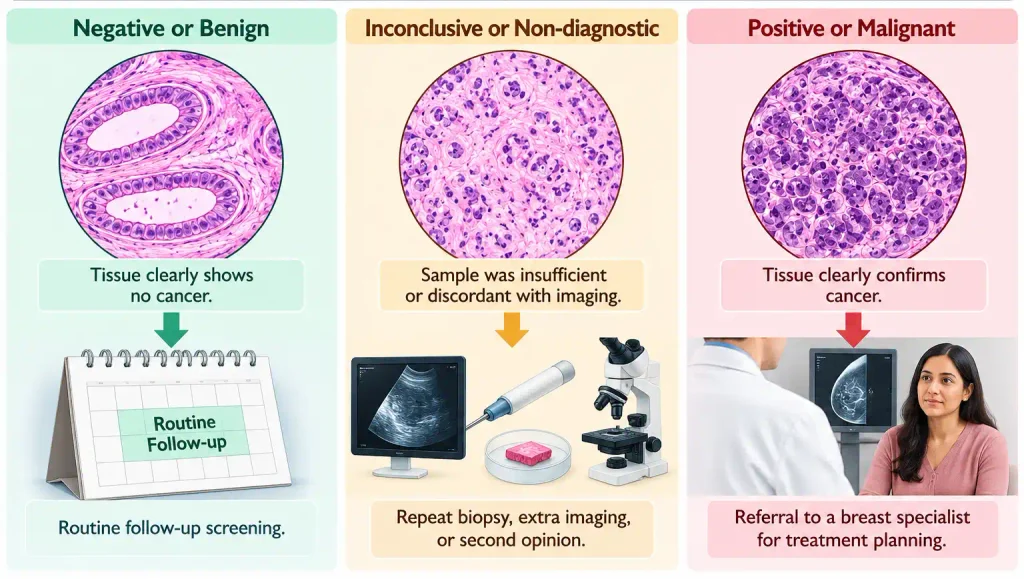
| Result Type | What It Means | Typical Next Step |
|---|---|---|
| Negative or benign | Tissue clearly shows no cancer | Routine follow-up screening |
| Inconclusive or non-diagnostic | Sample was insufficient or discordant with imaging | Repeat biopsy, extra imaging, or second opinion |
| Positive or malignant | Tissue clearly confirms cancer | Referral to a breast specialist for treatment planning |
A negative biopsy closes the loop for that particular lesion. An inconclusive one keeps the file open until the imaging and the pathology agree.
Understanding Atypia and Atypical Ductal Hyperplasia After a Biopsy
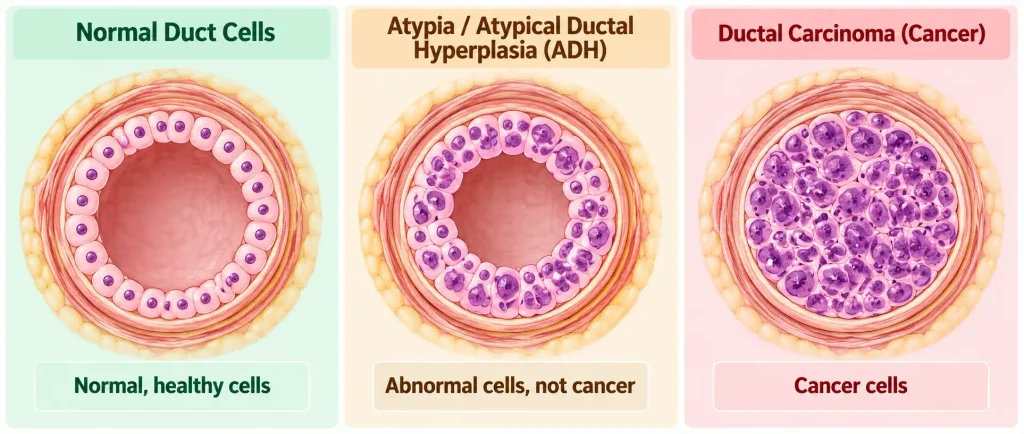
Sometimes an unclear biopsy result includes the word atypia or atypical ductal hyperplasia, often shortened to ADH. This means the cells look somewhat abnormal but do not have all the features needed for a cancer diagnosis.
ADH is not cancer. It is classed as a high-risk finding because it slightly raises the chance of developing breast cancer later, in either breast, which is why doctors usually recommend closer monitoring or a larger excisional biopsy after it shows up on a core needle sample. Seeing this term on an inconclusive breast biopsy report is not a cause for panic. It is a prompt to plan the right monitoring schedule with your specialist.
What Happens After an Inconclusive Breast Biopsy in Mohali?
Management is never one-size-fits-all. It depends on the clinical picture, the imaging findings, and how confident the radiology-pathology correlation is for your specific lesion.
1. Repeat Breast Biopsy
A repeat breast biopsy is one of the most common next steps when the first sample was too small, too damaged, or simply did not match the scan. A different technique, such as a vacuum-assisted biopsy instead of a fine needle sample, is sometimes used to collect a larger, more reliable specimen.
2. Follow-up Imaging
Additional ultrasound or mammography helps confirm whether the lesion has changed, whether it matches the biopsy site accurately, and whether short-interval monitoring is a safer option than repeating the procedure immediately.
3. Second Pathology Opinion
A second review by another pathologist, sometimes at a different pathology lab, can clarify borderline slides without putting you through another procedure. This is a standard, accepted part of breast diagnostics and not a sign the first report was wrong.
“We never manage a report in isolation. We manage the patient in front of us, and that means matching the pathology to the imaging every single time,” says Dr Balvin Kaur Ghai.
When Should You See a Breast Specialist?
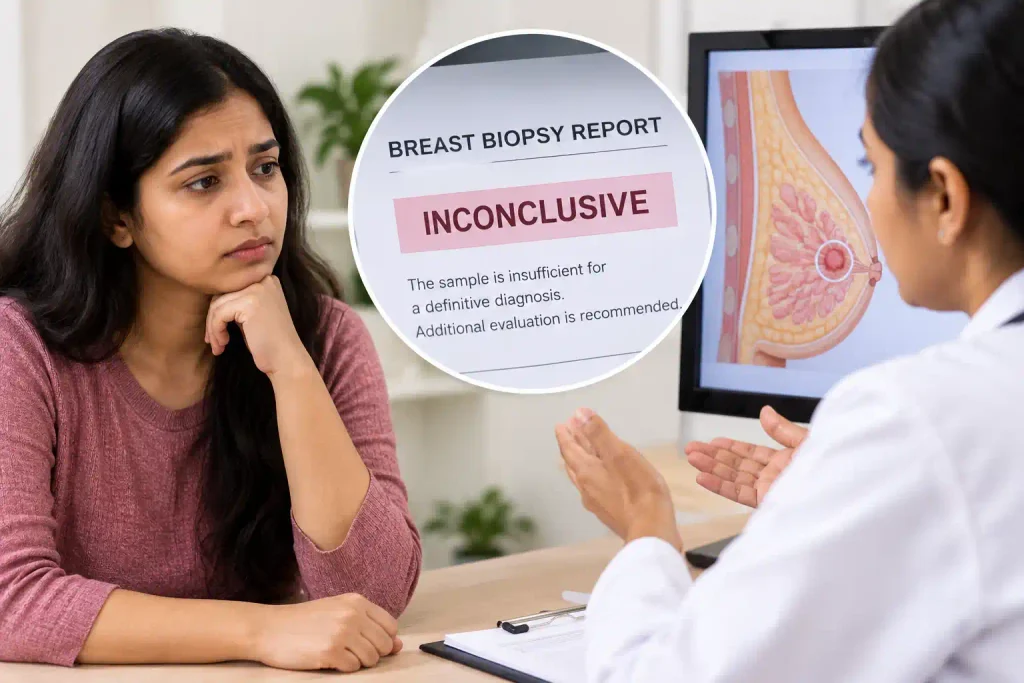
Book a review with a breast specialist as soon as your report comes back unclear, rather than waiting for your next routine screening date. Early discussion helps you understand which category your result falls into and what timeline is reasonable for follow-up. You should not delay a specialist visit if you notice any of the following alongside an unclear result:
- A lump that feels larger, harder, or more fixed than before
- New skin dimpling, nipple retraction, or discharge
- Persistent pain in one specific area of the breast
- A strong family history of breast or ovarian cancer
None of these signs confirm cancer by themselves, but they do mean the conversation with your doctor should happen sooner rather than later.
Getting a Breast Lump Diagnosis in Mohali
Patients across the tricity region often look for a breast lump diagnosis Chandigarh and Mohali clinics can coordinate quickly, since imaging, biopsy, and pathology review usually need to happen in close succession for an accurate picture. Dr Balvin Kaur Ghai works with this exact pathway at CLAGS, correlating imaging and histology findings before recommending repeat sampling or surgery.
Final Thought
An unclear biopsy result is frustrating, and it is fair to feel unsettled while you wait for a firmer answer. It is not, however, a diagnosis of cancer, and it is not a dead end. It is a checkpoint that exists precisely so your final diagnosis is accurate rather than rushed.
Working with a team that reviews your imaging and pathology together, and that explains each next step in plain language, turns that checkpoint into a short, manageable part of your care rather than an open-ended worry.
Frequently Asked Questions
1. What do inconclusive breast biopsy results mean in Mohali?
An inconclusive result means the pathologist could not confirm the lesion as clearly benign or clearly malignant from the sample provided. It is a request for more information, usually through repeat sampling, extra imaging, or a second pathology review, rather than a final diagnosis.
2. Why can a breast biopsy result be unclear or indeterminate?
Results often come back unclear because the tissue sample was too small or damaged, because the biopsy did not exactly match the area shown on imaging, or because the cells look atypical without meeting the full criteria for cancer. Lab processing factors can occasionally play a role as well.
3. Does an inconclusive breast biopsy mean cancer?
No, an inconclusive result does not mean you have cancer. It simply means the tissue examined was not enough, or not clear enough, to make that call either way, so your doctor will recommend further steps to reach a confident diagnosis.
4. What should I do after an inconclusive breast biopsy in Mohali?
Book a follow-up appointment with your breast specialist promptly rather than waiting for your next scheduled screening. They will review your imaging alongside the pathology report and decide whether repeat biopsy, additional scans, or a second opinion is the most appropriate next step for your specific case.
5. Will I need a repeat breast biopsy after inconclusive results?
Many, though not all, inconclusive results are followed by a repeat breast biopsy, often using a different technique to collect a larger or more representative sample. Whether repeat sampling is recommended depends on how strongly your imaging and pathology findings disagree with each other.
6. What are the next steps after an inconclusive biopsy?
The usual next steps include repeat biopsy with a different sampling method, short-interval follow-up imaging to watch for change, or a second pathology opinion on the existing slides. Your specialist will choose based on your imaging category and personal risk factors.
7. Is an inconclusive breast biopsy the same as a negative biopsy?
No, these are different outcomes. A negative or benign biopsy clearly shows no cancer and typically leads to routine follow-up, while an inconclusive result means the sample was insufficient or discordant with imaging and needs further action before that question can be answered.
8. Can follow-up imaging clarify an unclear breast biopsy result?
Yes, additional ultrasound or mammography often helps confirm whether the biopsy needle sampled the correct area and whether the lesion has changed in size or appearance. This information guides whether repeat sampling or a period of monitoring is more appropriate.
9. Can a pathology report be reviewed after a non-diagnostic biopsy?
Yes, a second pathologist can review the same slides to check for anything the first reading may have missed, and this is a routine, accepted practice in breast diagnostics. It does not always require a new procedure and can sometimes resolve the uncertainty on its own.
10. What does an inconclusive core needle biopsy mean?
An inconclusive core needle biopsy means the small tissue cylinder removed by the needle did not contain enough representative cells, or showed findings that did not match the imaging closely enough, to reach a definite benign or malignant classification. Repeat sampling with a larger needle or vacuum-assisted technique is often considered.
11. What does atypia or atypical ductal hyperplasia mean after a biopsy?
Atypia or atypical ductal hyperplasia means the cells look somewhat abnormal under the microscope but do not fully meet the criteria for cancer. It is not a cancer diagnosis, though it does raise future breast cancer risk slightly and usually prompts closer monitoring or a larger excisional biopsy.
12. How common are non-diagnostic or inconclusive breast biopsies?
Non-diagnostic results occur in a meaningful minority of breast biopsies, and studies following these cases through repeat sampling have found malignancy in a notable share of them, which is the main reason doctors take unclear results seriously rather than dismissing them.
13. When should I see a breast specialist in Punjab after an unclear biopsy?
You should arrange a specialist review as soon as your report comes back, rather than waiting weeks for your next routine visit. This is especially important if you notice a new lump change, skin dimpling, nipple discharge, or a strong family history of breast cancer alongside the unclear result.
14. Where can I get a breast lump diagnosis in Chandigarh?
Clinics across the Chandigarh, Mohali, and wider Punjab region offer coordinated imaging, biopsy, and pathology services for breast lump diagnosis. Choosing a centre where these three steps are reviewed together, rather than at separate unconnected facilities, generally leads to a faster and more accurate final answer.
15. What happens if a breast lesion remains unresolved after an inconclusive biopsy in Mohali?
If uncertainty remains after repeat sampling or a second pathology opinion, your specialist may recommend a surgical excisional biopsy to remove the entire area of concern for full examination. This step is usually reserved for cases where imaging and pathology still do not agree after the earlier, less invasive options have been tried.