


Finding a breast lump during pregnancy can be unsettling, especially when you are already adjusting to so many changes in your body. Breast tissue naturally becomes fuller, more tender, and sometimes lumpy as hormones prepare the breasts for breastfeeding. That can make it difficult to know what is simply part of pregnancy and what needs a closer look.
The reassuring part is that most breast lumps found during pregnancy are harmless. Still, a new lump should not be ignored just because you are pregnant. If you notice a breast lump during pregnancy in Mohali, a proper clinical examination can help identify the likely cause and determine whether you need an ultrasound or further testing. Knowing which changes are common and which signs deserve attention can make the situation feel far less frightening.
Key Takeaways
- Most breast lumps in pregnancy are benign. One review found that roughly 80% of lesions detected during pregnancy and lactation turn out to be non-cancerous, most often fibroadenomas, cysts, or galactoceles.
- Pregnancy-related breast cancer is rare, affecting about 1 in 3,000 pregnancies, but it is treatable and safe imaging exists to check any lump properly.
- Fibroadenomas, the most common solid breast lump, can grow rapidly during pregnancy because they respond to rising hormone levels.
- Ultrasound is the first and safest imaging tool for a breast lump in pregnancy, since it does not use radiation.
- A lump that is hard, fixed in place, growing quickly, or paired with skin changes or nipple discharge should always be examined promptly, even if it later turns out to be harmless.
Why Your Breasts Change So Much in Pregnancy
Pregnancy hormones, mainly oestrogen and progesterone, tell your breast tissue to prepare for feeding your baby. Glands multiply, ducts widen, and fat and fluid shift around. This is why breasts often feel fuller, lumpier, and more tender than before.
This natural lumpiness is one reason a genuine breast lump during pregnancy can go unnoticed for weeks. It also explains why women sometimes worry about a normal change and delay checking a real one. Both situations are common, and neither is anything to feel embarrassed about.
8 Common Causes of a Breast Lump During Pregnancy
Here are the causes we see most often when a patient in Mohali comes in with a new breast lump during pregnancy.
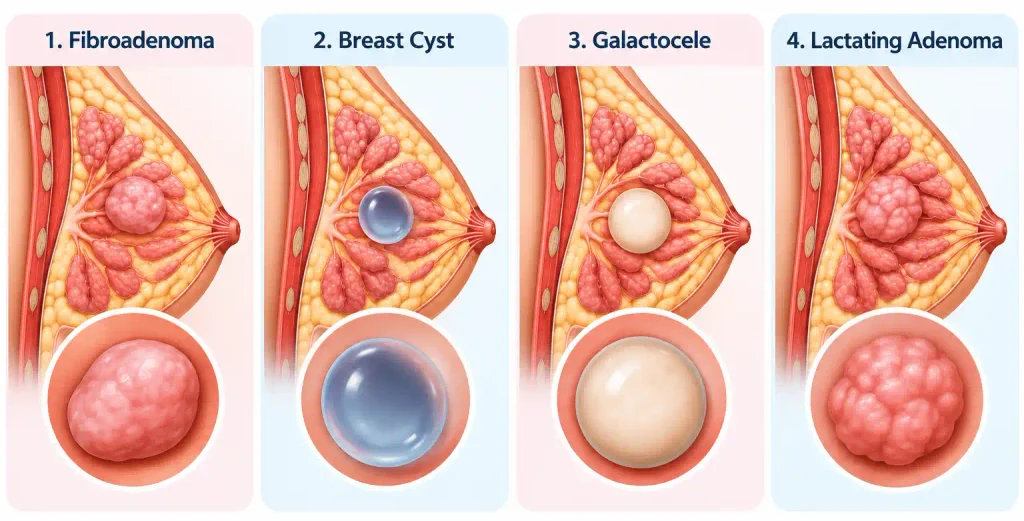
1. Fibroadenoma
A fibroadenoma is a smooth, firm, and usually painless lump that moves easily under your fingers. It is the most frequent solid breast lump in women of childbearing age. Because it is sensitive to hormones, an existing fibroadenoma can grow larger during pregnancy, and new ones can also appear.
2. Breast cyst
Cysts are small, fluid-filled sacs that form inside the breast tissue. They can feel soft or firm, and their size sometimes changes with hormone shifts. Most breast cysts in pregnancy are simple and need no treatment beyond monitoring.
3. Galactocele
A galactocele is a milk-filled cyst. It usually shows up later in pregnancy or after delivery, once the breast starts producing milk. It feels smooth and round, and it often develops near the nipple.
4. Lactating adenoma
This is a benign glandular growth that appears in late pregnancy or during breastfeeding. It is firm, mobile, and can grow noticeably over a few weeks, which sometimes worries patients more than it should.
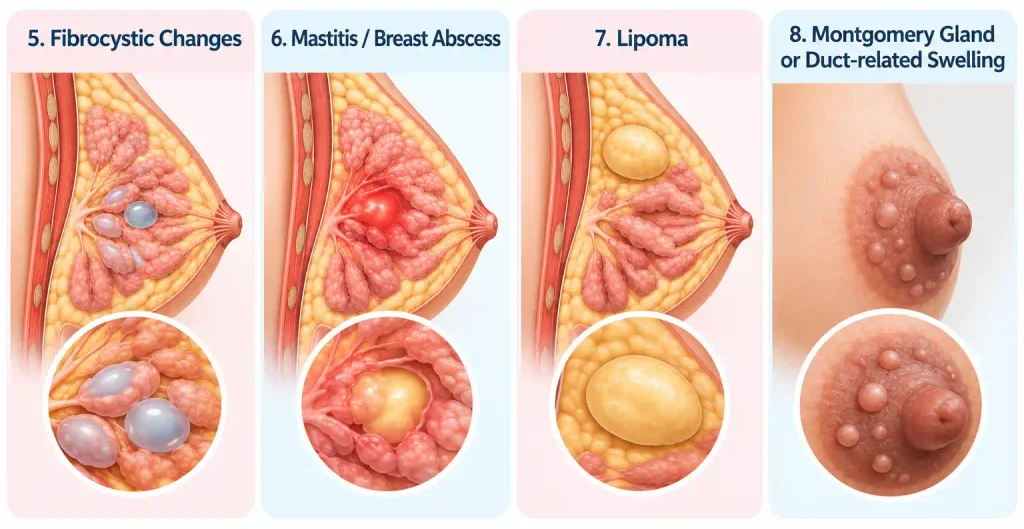
5. Fibrocystic changes
Fibrocystic tissue feels rope-like, thickened, or generally “lumpy-bumpy” rather than one distinct mass. Pregnancy hormones can make these areas more noticeable, especially in the upper, outer part of the breast.
6. Mastitis or a breast abscess
Late in pregnancy or after delivery, a blocked duct can lead to mastitis, a painful, warm, and sometimes red area of breast tissue. If untreated, it can progress to an abscess, which feels like a tender, fluctuant lump and usually comes with fever or flu-like symptoms.
7. Lipoma
A lipoma is a soft, painless fatty lump that sits just under the skin. It is unrelated to pregnancy hormones and tends to stay the same size or grow very slowly over months or years.
8. Montgomery gland or duct-related swelling
The small glands around your areola (Montgomery’s tubercles) can sometimes swell or become blocked, feeling like a tiny lump near the nipple. This is usually harmless and settles on its own.
“In more than two decades of practice, I have seen far more fibroadenomas and cysts than anything worrying. But I never tell a patient to ‘just wait and watch’ without examining her first. A five-minute clinic visit brings peace of mind that months of worrying never will.”Dr Balvin Kaur Ghai
Pregnancy Breast Changes vs a Lump That Needs Checking
Use this table as a quick guide, not a diagnosis. When in doubt, get it examined.
| Feature | Normal Pregnancy Breast Change | Lump Needing a Check |
| Location | Diffuse, affects both breasts fairly evenly | Usually one distinct spot, often one-sided |
| Texture | General fullness, mild lumpiness | A clear, separate lump you can outline with a finger |
| Growth pattern | Gradual, matches pregnancy stage | Sudden growth, or growth over just days |
| Pain | Mild tenderness, comes and goes | Persistent pain in one exact spot, or no pain at all with a hard lump |
| Skin changes | Stretch marks, darker areola, visible veins | Dimpling, redness, puckering, or an orange-peel texture |
| Nipple | Colostrum leaking from both breasts | Bloody or one-sided discharge |
When a Breast Lump During Pregnancy Needs a Check in Mohali
This is also a good time to keep up with your routine pregnancy checkups, where a breast check can be added alongside your regular antenatal review. Book an appointment promptly if you notice:
- A lump that feels hard, irregular, or fixed to the skin or chest wall
- Rapid growth over one to two weeks
- Skin dimpling, puckering, or an orange-peel appearance
- Nipple discharge that is bloody or comes from only one breast
- A lump with redness, warmth, and fever, which may point to infection
- A new lump that has not gone away after two to three weeks
Waiting for delivery “to be safe” is one of the most common mistakes we see. Pregnancy does not delay proper evaluation, and modern imaging is designed to be safe at every trimester.
How We Diagnose a Breast Lump During Pregnancy
A proper work-up follows three steps, and none of them need to wait until after your baby arrives.
Clinical breast examination. We start with a hands-on check of size, shape, mobility, and any skin or nipple changes. This alone rules out many false alarms.
Ultrasound imaging. Breast ultrasound uses sound waves, not radiation, so it is the first-choice scan during pregnancy. It clearly shows whether a lump is solid or fluid-filled, which narrows down the likely cause immediately. Patients often ask about our in-house ultrasound centre for same-day scanning.
Fine needle or core biopsy, if needed. Not every lump needs a biopsy. Simple cysts and typical fibroadenomas on ultrasound often just need monitoring. A biopsy is recommended only when the scan shows a suspicious feature, and it can be done safely under local anaesthesia at any stage of pregnancy. Samples go through our pathology lab for a fast, accurate report.
A Quick Comparison of the Three Most Common Causes
| Fibroadenoma | Simple Cyst | Galactocele | |
| Feel | Firm, smooth, moves easily | Soft to firm, round | Smooth, may feel doughy |
| Common timing | Any trimester | Any trimester | Late pregnancy or postpartum |
| Pain | Usually painless | Sometimes tender | Usually painless |
| Growth in pregnancy | Can grow rapidly | May fluctuate | Grows as milk collects |
| Usual next step | Ultrasound, monitor or biopsy if atypical | Ultrasound, drain only if painful | Ultrasound, drain if large or uncomfortable |
Treatment and Monitoring After Diagnosis

Most benign lumps are simply monitored through the rest of your pregnancy and reassessed after delivery, since some (like fibroadenomas) can shrink once hormone levels settle. Cysts and galactoceles are drained only if they are large, painful, or at risk of infection. Surgery during pregnancy is reserved for lumps that grow very quickly, cause significant discomfort, or show suspicious features on imaging, and it can be performed safely when genuinely needed.
If a biopsy does confirm something that needs surgical removal, our breast lump surgery team plans the timing and technique around your pregnancy stage, working closely with your obstetric team throughout.
Final Thought
A breast lump during pregnancy is common, and in the overwhelming majority of cases, it turns out to be one of the ordinary, benign changes your body goes through while preparing to feed your baby. Still, “probably fine” is not the same as “confirmed fine.” A short clinical visit and, if needed, a same-day ultrasound gives you an actual answer instead of nine more months of wondering.
If you have found a new lump, do not wait for it to feel more serious before acting. Book a consultation with Dr Balvin Kaur Ghai at CLAGS, Mohali, and get the clarity you and your baby deserve.
Frequently Asked Questions
1. Is it normal to have a breast lump during pregnancy?
Yes, it is fairly common. Pregnancy hormones make breast tissue lumpier and denser overall, and benign lumps such as fibroadenomas and cysts frequently appear or grow during this time. Common does not mean it should be ignored, so any distinct lump is still worth a check.
2. What causes a breast lump during pregnancy in Mohali?
The most frequent causes we diagnose are fibroadenomas, simple cysts, galactoceles, fibrocystic changes, and occasionally mastitis or a lactating adenoma. Lifestyle and climate in Mohali do not change these causes; they are driven by pregnancy hormones everywhere.
3. When should I see a doctor for a breast lump during pregnancy in Mohali?
See a doctor as soon as you notice a lump that feels different from the rest of your breast tissue, especially if it is hard, growing quickly, or accompanied by skin or nipple changes. There is no need to wait for your next routine antenatal visit.
4. Can pregnancy hormones cause breast lumps to grow?
Yes. Rising oestrogen and progesterone can make existing fibroadenomas and some other benign growths enlarge noticeably during pregnancy. This growth usually slows or reverses after delivery, but the change should still be documented and monitored.
5. How can I tell the difference between normal pregnancy breast swelling and a lump?
Normal swelling tends to affect both breasts evenly and feels like general fullness rather than one clear mass. A true lump usually sits in one spot, often in one breast only, and you can trace its edges with your fingers.
6. Can a breast lump during pregnancy be cancerous?
It is possible, though uncommon. Pregnancy-associated breast cancer affects about 1 in 3,000 pregnancies, which is why a clinical exam and ultrasound are recommended for any new lump rather than assuming it is harmless.
7. Does having a breast lump during pregnancy increase the risk of breast cancer?
A benign lump such as a simple cyst or typical fibroadenoma does not raise your future cancer risk. Certain rarer, complex growths carry a very small increased risk, which is one more reason accurate diagnosis matters more than guessing.
8. What does a hard breast lump during pregnancy mean?
A hard lump can still be completely benign, such as a firm fibroadenoma or a fatty lipoma. However, firmness combined with irregular edges, fixation to surrounding tissue, or rapid growth needs prompt imaging to rule out anything more serious.
9. Should a painful breast lump during pregnancy be checked by a doctor?
Yes. Pain often points to something manageable, like a tender cyst or early mastitis, but it should still be examined so it can be treated correctly and promptly, especially if there is redness, warmth, or fever alongside it.
10. Can a fibroadenoma grow during pregnancy?
Fibroadenomas are known to grow rapidly during pregnancy because they are sensitive to hormonal changes. Many shrink back down after delivery, though ongoing monitoring with ultrasound helps confirm the growth pattern is typical.
11. Can a breast cyst develop during pregnancy, and does it require treatment?
Yes, cysts can develop or enlarge at any point during pregnancy. Most simple cysts need no treatment beyond periodic monitoring, and drainage is only considered if a cyst becomes large, uncomfortable, or shows unusual features on ultrasound.
12. Is an ultrasound safe for checking a breast lump during pregnancy?
Breast ultrasound is considered safe throughout pregnancy because it uses sound waves rather than radiation. It is the recommended first imaging test for any breast lump found during pregnancy or breastfeeding.
13. Will every breast lump during pregnancy need a biopsy?
No. Many lumps look clearly benign on ultrasound, such as a straightforward cyst, and only need monitoring. A biopsy is recommended when imaging shows a suspicious feature or when a lump behaves in an atypical way.
14. Can breast lumps during pregnancy go away on their own after delivery?
Some do. Fibroadenomas often shrink once hormone levels drop after delivery, and galactoceles usually resolve once breastfeeding settles or ends. Lumps that persist or grow after delivery should still be reassessed rather than assumed to be resolving.
15. Should I see a breast specialist in Mohali for a breast lump during pregnancy?
If your gynaecologist finds anything beyond typical pregnancy fullness, a referral to a breast specialist in Mohali for a focused ultrasound and clinical exam is a sensible next step. It adds a layer of certainty during a time when peace of mind matters most.