

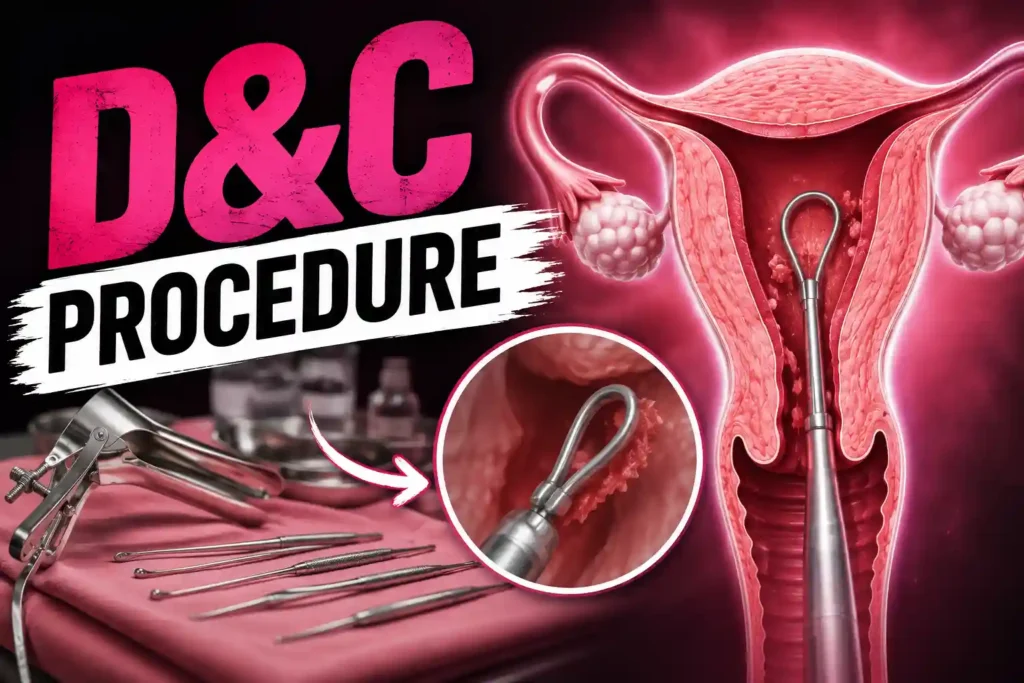
A D&C is one of those procedures most women hear about only when they are already going through something difficult: a miscarriage that did not complete on its own, bleeding that will not stop, or a biopsy result that needs a closer look. It is not a complicated surgery, but the timing, the reason behind it, and the cost all matter, and most women are not given a clear picture of any of these before they are asked to sign a consent form.
This article explains the Dilation and Curettage procedure in plain terms, covers what genuinely affects the D&C procedure cost in Chandigarh and Mohali, and helps you understand when it is medically necessary versus when an alternative might be worth discussing.
Key Takeaways
- Dilation and Curettage (D&C) is a short surgical procedure that removes tissue from inside the uterus. It takes 15 to 30 minutes in most cases.
- The most common medical reasons for a D&C are incomplete miscarriage, abnormal uterine bleeding, retained tissue after delivery, and diagnostic sampling when cancer needs to be ruled out.
- D&C procedure cost in Chandigarh and Mohali depends on whether it is done as a daycare procedure or requires overnight stay, and whether hysteroscopy is combined with it.
- About 50% of women who miscarry do not need a D&C at all, since the body often completes the process on its own before 10 weeks.
- Recovery is fast. Most women resume normal activity within 2 to 3 days.
What Exactly Is a Dilation and Curettage (D&C)?

The name sounds more intimidating than the procedure itself. Dilation means gently widening the cervix (the opening of the uterus). Curettage means carefully removing tissue from the inside lining of the uterus, either with a thin instrument or gentle suction.
According to the American College of Obstetricians and Gynecologists (ACOG), a D&C is used both as a diagnostic tool and as a treatment. Diagnostically, it helps identify the cause of abnormal bleeding by collecting tissue that can be examined under a microscope. Therapeutically, it clears the uterus of tissue that should not remain inside.
The entire procedure takes 15 to 30 minutes, is done under short anaesthesia, and most patients go home the same day.
When Is a D&C Medically Necessary?
A D&C is not something doctors recommend casually. It is performed when there is a clear medical reason:
- Incomplete miscarriage: when the body has not passed all the pregnancy tissue on its own, and remaining tissue can cause infection or heavy bleeding if left inside
- Abnormal uterine bleeding: heavy or irregular bleeding that has not responded to medication, especially in women over 35 where the uterine lining needs to be examined for abnormal cells
- Retained tissue after delivery: when small pieces of placental tissue remain in the uterus after childbirth and cause continued bleeding or infection risk
- Diagnostic biopsy: when an endometrial biopsy done in the clinic was inconclusive or insufficient, and a more thorough tissue sample is needed to rule out conditions like endometrial hyperplasia or cancer
- Polyp or growth removal: small growths inside the uterus that are causing bleeding can often be removed during a D&C, especially when combined with hysteroscopy
Do All Miscarriages Need a D&C?
No, and this is important to understand before assuming the procedure is unavoidable.
According to Cleveland Clinic, about 50% of women who miscarry do not need a D&C at all. When a miscarriage happens before 10 weeks, the body usually completes the process naturally. After 10 weeks, the risk of incomplete passage rises, and a D&C becomes more likely to be recommended.
Your doctor will typically confirm via ultrasound whether tissue has been retained before recommending the procedure. If the ultrasound shows the uterus is already clear, a D&C is not necessary.
D&C Procedure Cost in Chandigarh and Mohali: What Changes the Price
The D&C procedure cost in Chandigarh and Mohali is not one fixed number. It depends on:
| Factor | How It Affects Cost |
|---|---|
| Daycare vs overnight stay | Most D&Cs are daycare procedures. If overnight monitoring is needed (e.g., heavy bleeding or anaemia), cost increases |
| Anaesthesia type | Short general anaesthesia is standard. Local anaesthesia for very simple cases costs less |
| Combined with hysteroscopy | If a camera is used to view the uterus before curetting, this adds equipment and time cost |
| Lab and pathology | Tissue sent for biopsy adds a pathology lab fee, which is essential when abnormal cells need to be ruled out |
| Urgency | An emergency D&C after heavy bleeding may cost differently from a planned, scheduled procedure |
A proper consultation and ultrasound before the procedure gives you both a medical reason and an accurate cost estimate. Without that, any number quoted over the phone is a guess.
Government Hospital vs Private Clinic: What’s the Real Difference?
This is the most searched comparison for the D&C procedure cost in Chandigarh and Mohali, and the honest answer goes beyond just the fee:
| Factor | Government Hospital | Private Clinic |
|---|---|---|
| Procedure fee | Minimal or subsidised | Higher, but covers surgeon, anaesthesia, and facility in one quote |
| Wait time | Can be days to weeks depending on queue | Usually scheduled within days |
| Same doctor throughout | Often assigned on the day, may not be the consulting doctor | Consulting doctor performs the procedure personally |
| Privacy | Shared wards, less personal space | Private or semi private rooms |
| Follow up | OPD queue based follow up | Scheduled appointment with the same doctor |
Neither option is universally “better.” It depends on your financial situation, how urgent the procedure is, and how much continuity of care matters to you.
What Happens During a D&C: Step by Step
- You will be asked to fast for 6 to 8 hours before the procedure if general anaesthesia is planned
- An IV line is placed, and short anaesthesia is given so you sleep through the 15 to 30 minute procedure
- The cervix is gently dilated using thin rods that gradually widen the opening
- A thin curette or suction device removes the tissue from inside the uterus
- If combined with hysteroscopy, a small camera is inserted first to view the uterine cavity before the tissue is removed
- You wake up in the recovery area and are monitored for 2 to 4 hours before discharge
Why I Combine D&C With Hysteroscopy Whenever Possible
A standard D&C is done “blind,” meaning the doctor cannot see inside the uterus while removing tissue. This works well for most cases, but it means small polyps or focal growths can occasionally be missed.
In my practice, I prefer combining a D&C with hysteroscopy whenever the clinical picture suggests something beyond a straightforward clearance. The camera gives a direct view of the uterine cavity before any tissue is removed, which means nothing is missed and the curetting is more precise. It adds a small amount to the D&C procedure cost in Chandigarh and Mohali, but it avoids the situation where a patient comes back months later with the same symptoms because a small growth was left behind.
Dr. Balvin Kaur Ghai, Founder and Lead, CLAGS Centre for Laser Aesthetics and Gynaecology Services, Mohali
Recovery After a D&C: What to Expect
- Day 1: mild cramping similar to a period, light bleeding or spotting. Rest at home. Eat normally once the anaesthesia effect passes.
- Day 2 to 3: most women feel well enough to resume light daily activity. Spotting may continue.
- Week 1 to 2: bleeding tapers off. Avoid heavy lifting, swimming, and intercourse until your doctor confirms healing.
- 4 to 6 weeks: normal period should return. If it does not, a follow up visit is recommended.
When Should You Be Concerned After a D&C?
Call your doctor immediately if you experience any of these after the procedure:
- a. Bleeding heavy enough to soak a pad within an hour, lasting more than 2 hours
- b. Fever above 100.4°F (38°C)
- c. Foul smelling vaginal discharge
- d. Severe abdominal pain that is getting worse rather than improving
These are uncommon, but they can signal infection or retained tissue and need immediate attention.
Getting a D&C Assessment in Mohali or Chandigarh Tricity
Women from Chandigarh, Panchkula, and Ambala can get the ultrasound, consultation, and procedure scheduling done in a single visit at our clinic. For most patients, the D&C itself is completed as a daycare procedure, meaning you go home the same day. Dr. Balvin Kaur Ghai performs every procedure personally, so the doctor you consult with is the same doctor in the operating room.
Frequently Asked Questions
Is a D&C painful?
No. It is done under short anaesthesia, so you sleep through the procedure and feel nothing. Mild cramping afterward is normal and usually manageable with simple pain relief.
How long does a D&C procedure take?
The procedure itself takes 15 to 30 minutes. Including preparation and recovery, you are in the hospital for 4 to 6 hours total.
Can I go home the same day?
Yes, in most cases. D&C is typically a daycare procedure. Overnight stay is only needed if there are complications or if the patient has a condition requiring closer monitoring.
Will a D&C affect my ability to get pregnant later?
A single, properly performed D&C rarely affects future fertility. In very rare cases, repeated D&Cs can cause scarring inside the uterus, but this is uncommon with modern technique.
How soon after a D&C can I try to conceive?
Most doctors recommend waiting for one to two normal menstrual cycles before trying to conceive, to allow the uterine lining to fully recover.
Is a D&C the same as an abortion?
No. A D&C is a medical procedure used for multiple reasons including miscarriage management, abnormal bleeding, and diagnostic biopsy. It is a clinical tool, not a single purpose procedure.
What if my ultrasound shows the uterus is already clear after a miscarriage?
Then a D&C is usually not needed. The procedure is only recommended when retained tissue is confirmed or strongly suspected.
Can a D&C be done without anaesthesia?
Technically yes, with local anaesthesia and pain relief, but most doctors and patients prefer short general anaesthesia for comfort and a smoother procedure.
How soon will my period return after a D&C?
Usually within 4 to 6 weeks. If it has not returned by 8 weeks, consult your gynaecologist.
Do I need a D&C if I had a miscarriage at 6 weeks?
Not always. Very early miscarriages often complete naturally. An ultrasound will confirm whether any tissue remains and whether a D&C is actually needed.