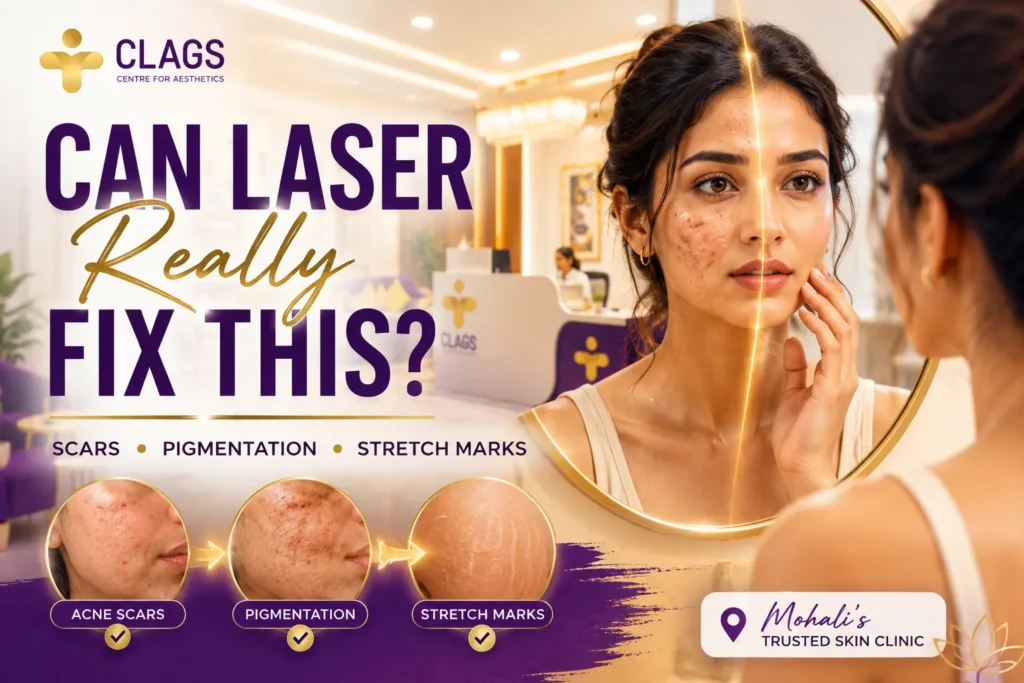
Most people carrying a scar or a dark patch on their skin have been told the same thing for years.
“It will fade on its own.”
“Just use this cream.”
“Nothing much can be done.”
None of that is true anymore. Laser skin treatment in Mohali has made real, visible improvement possible for acne scars, pigmentation, stretch marks, surgical scars, and more. Not a miracle. Not overnight. But consistent and meaningful results over a proper course of treatment.
This guide covers what laser can actually fix, what it cannot, how many sessions are needed, what it costs, and what the experience is actually like.
The Three Skin Problems People in Mohali Search Laser For Most
Walk into any skin specialist clinic in Mohali or Chandigarh and three concerns come up more than anything else.
Acne scars and pits. Years of breakouts leave behind marks that do not fade. Some are dark patches. Some are actual indentations in the skin. Both types affect confidence in a way no concealer fully covers.
Pigmentation and dark spots. Uneven skin tone, patches that darken with sun exposure, marks left behind after inflammation. In Mohali’s climate, with strong summer sun for months at a stretch, pigmentation is a genuinely common problem.
Stretch marks. From pregnancy, rapid weight change, or growth spurts. They are not harmful but they are permanent without treatment, and many people want them reduced.
All three respond to laser skin treatment. Not equally, and not identically, but all three improve with the right approach.
What Laser Skin Treatment Actually Does to the Skin
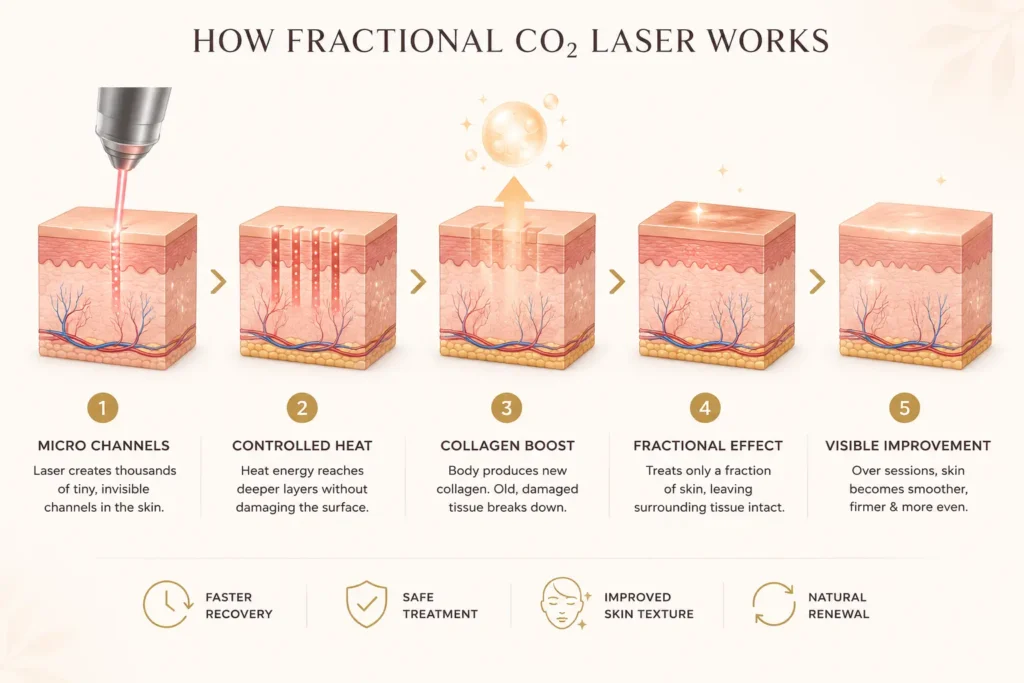
The most commonly used laser for skin resurfacing is the fractional CO2 laser. Here is how it works in plain terms.
The laser creates thousands of tiny, invisible channels in the skin. These are microscopic columns of controlled heat energy that go into the deeper layers of the skin without damaging the surface around them.
The body’s response to this is to produce new collagen, the structural protein that makes skin firm, smooth, and even. Old, damaged tissue breaks down. New, healthier tissue forms in its place.
The “fractional” part means the laser treats only a fraction of the skin at a time, leaving surrounding tissue intact. This is what makes recovery fast and the treatment safe enough to be done without general anaesthesia.
Over a course of sessions, the cumulative effect is a measurable improvement in skin texture, tone, and the appearance of scars.
Acne Scars and Pits, Can Laser Actually Fix Them?
Yes. But the honest answer involves a few layers.
There are different types of acne scars. Flat, dark patches, called post-inflammatory hyperpigmentation, respond very well to laser treatment. These are pigment-based and the laser breaks down that excess melanin effectively.
Depressed or pitted scars, the ones that create a sunken texture in the skin, also improve with fractional laser. The collagen produced after each session gradually fills in those pits from below. The improvement is real but it is progressive, not immediate.
Rolling scars and boxcar scars, which are wider and shallower, typically see the best results. Ice pick scars, which are very narrow and deep, are more resistant and may need a combination of laser with other treatments like subcision or dermal fillers for the best outcome.
The realistic expectation is a 40 to 70 percent improvement over a full course of sessions. The scars become significantly less visible, the skin texture becomes smoother, and the overall appearance is meaningfully better.
That is not perfect skin. But for most people, it is transformative.
Pigmentation and Dark Spots, Which Laser, Which Skin
Pigmentation is not one single problem. It comes in several forms and each responds differently to treatment.
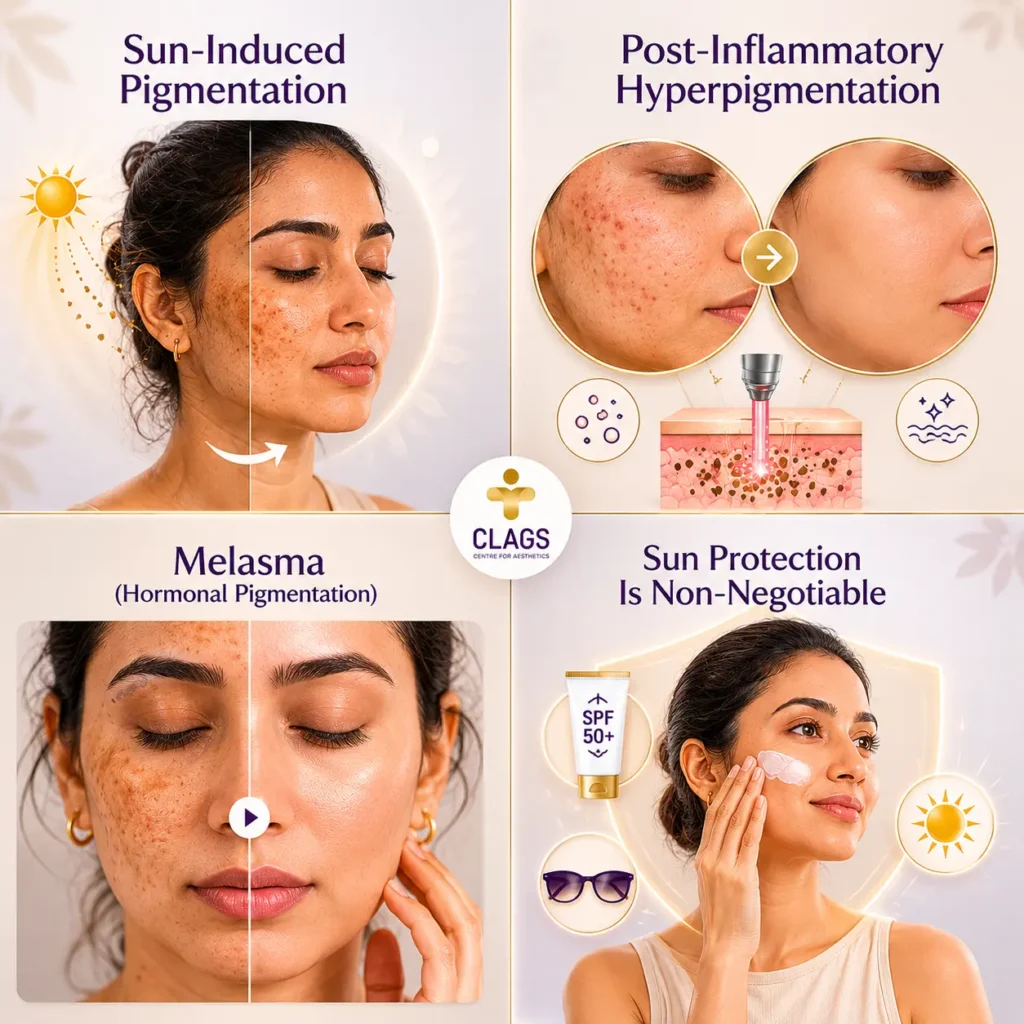
Sun-induced pigmentation and flat dark spots respond very well to laser treatment. The laser targets the melanin directly and breaks it down.
Post-inflammatory hyperpigmentation, the dark marks left after acne, injury, or irritation, also responds well. These are surface-level pigment deposits that fractional laser clears effectively over a few sessions.
Melasma, the deeper hormonal pigmentation that often appears on the forehead, cheeks, and upper lip, especially in women, is more complex. Laser can improve it, but melasma has a tendency to recur because its root cause is hormonal. Maintenance and sun protection are essential for managing it long term.
One important note: Mohali’s sun exposure is intense for a significant part of the year. Any laser treatment for pigmentation must be paired with strict sun protection between sessions. Without SPF, the laser’s work gets undone by continued UV exposure. This is not optional.
Surgical and Injury Scars, What Realistic Improvement Looks Like
Laser skin treatment can improve the appearance of surgical scars, burn scars, and injury scars by making them flatter, softer, and closer in colour to the surrounding skin.
It does not erase them. A scar is a scar. But the difference between a raised, red, textured scar and a flat, skin-toned, smooth one is enormous, and laser treatment consistently moves scars in that direction.
The best results come from starting treatment once the scar is fully healed, which is typically 3 to 6 months after the original injury or surgery. Treating a scar too early, before the tissue has stabilised, can interfere with the healing process.
If you are not sure whether your scar is ready for treatment, bring it to a consultation. The doctor will assess the scar maturity and advise on the right time to begin.
Stretch Marks, The Honest Answer on What Laser Can and Cannot Do
Stretch marks are one of the more complex things laser treats, and it is worth being upfront about this.
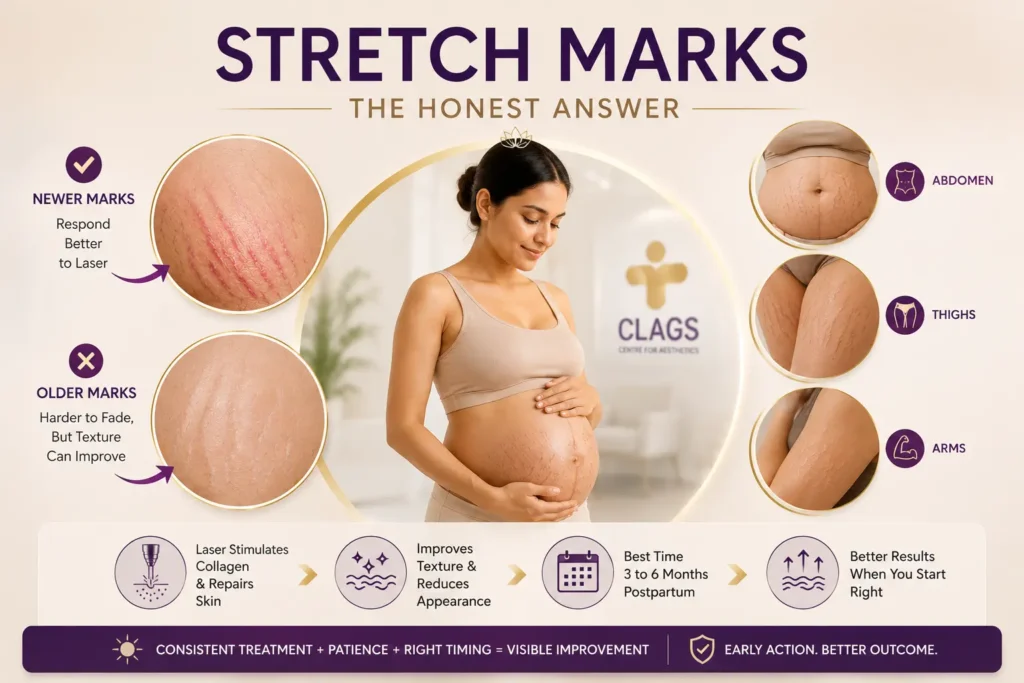
Fresh stretch marks, the ones that are still red or purple, respond much better to laser treatment than old, white, silvery ones. The newer ones still have active blood supply and the surrounding tissue responds well to collagen stimulation.
Old white stretch marks are essentially scar tissue with very low activity. Laser can improve their texture and make them slightly less visible, but significant fading of old white stretch marks is difficult to achieve with any treatment.
For women who have recently delivered, starting stretch mark laser treatment 3 to 6 months postpartum, once the body has stabilised, gives the best results. Waiting years before starting treatment reduces what is achievable.
How Many Sessions Does Laser Skin Treatment in Mohali Take?
It depends on the concern, the depth of the problem, and how your skin responds. Here is a general guide:
Surface pigmentation and dark spots: 3 to 4 sessions, spaced 4 to 6 weeks apart
Acne scars and pitting: 4 to 6 sessions, spaced 4 to 6 weeks apart
Surgical or injury scars: 3 to 5 sessions depending on scar depth and age
Stretch marks: 4 to 6 sessions for fresh marks, more for older ones
Overall skin resurfacing and texture: 3 to 4 sessions
The spacing between sessions is intentional. The skin needs 4 to 6 weeks to complete its collagen production cycle after each session. Doing sessions too close together does not produce better results, it just stresses the skin.
Is Laser Skin Treatment in Mohali Safe for Indian Skin?
Yes, when done correctly.
Indian skin has higher melanin content, which means it can be more reactive to laser energy if the wrong settings are used. The risk with improperly calibrated laser on dark skin is post-inflammatory hyperpigmentation, which is darkening of the treated area. That is the exact opposite of what you are trying to achieve.
The solution is a proper skin assessment before treatment and laser settings calibrated for your specific Fitzpatrick skin type. Not a one-size protocol applied to every patient.
At CLAGS in Mohali, this assessment is done at the first consultation. Kajol Puri, the laser and cosmetology specialist, works specifically with Indian skin tones and adjusts the approach accordingly.
If any clinic offers you a laser skin treatment without first assessing your skin type, walk out.
What Does Laser Skin Treatment Actually Feel Like?
A topical numbing cream is applied to the treatment area 30 to 45 minutes before the session. This significantly reduces sensation during the procedure.
During the session, most people describe a warm prickling sensation, like heat being applied in small pulses. It is not pleasant but it is short, and the numbing cream makes it manageable for most people.
After the session, the treated area will look red and feel like mild sunburn. This is normal and expected. It typically settles within 24 to 72 hours. Some flaking or peeling in the following days is also normal as the treated skin sheds and fresh skin forms underneath.
Most people return to normal activities within 2 to 3 days. There is no hospitalisation and no significant recovery period.
What to Avoid After Each Laser Skin Session
Sun exposure is the most important thing to avoid. Stay out of direct sun for at least 2 weeks after each session. If you must go outside, SPF 50 is non-negotiable.
Do not use any exfoliating products, retinoids, or active skincare for at least a week after the session. The skin is rebuilding. Harsh products interfere with that process.
Do not pick or scratch any peeling skin. Let it shed naturally. Picking causes post-inflammatory pigmentation, exactly what you are trying to treat.
Keep the skin moisturised. Hydrated skin heals faster and responds better to subsequent sessions.
Your clinic will give you a specific aftercare protocol. Follow it. The results you get are significantly influenced by how well you care for the skin between sessions.
What Does Laser Skin Treatment Cost in Mohali?
Cost varies by the area being treated, the type of concern, and the number of sessions in your plan. Here is a general range at specialist clinics in Mohali and the Tricity:
Face, pigmentation or surface treatment: Rs. 5,000 to Rs. 12,000 per session
Acne scar treatment, face: Rs. 6,000 to Rs. 15,000 per session
Scar treatment, body area: Rs. 4,000 to Rs. 10,000 per session depending on size
Stretch marks, abdomen or thighs: Rs. 6,000 to Rs. 15,000 per session
Package pricing for a full course is available and significantly more cost-effective than per-session pricing. At CLAGS, exact costs are discussed openly at the consultation stage after the skin has been assessed and the treatment plan confirmed.
Why Patients from Across the Tricity Come to CLAGS for Laser Skin Treatment
Laser skin treatment in Mohali requires more than a machine. It requires someone who understands how different skin types respond, how to calibrate the treatment to the individual, and how to manage the skin through a full course of sessions.
General clinics offering laser as one of many services often do not have this depth of experience. CLAGS was built specifically around laser treatments, and laser skin work is one of its core services, not an add-on.
Patients regularly seeking laser skin treatment in Mohali come to CLAGS from Chandigarh, Panchkula, Phase 5 and Phase 10 Mohali, Kharar, Zirakpur, and Derabassi because the combination of specialist expertise and the full range of laser services in one clinic is genuinely uncommon in the Tricity.
Read more about Dr Balvin Kaur Ghai Founder & cosmetic gynecologist at CLAGS
Also explore chemical peels at CLAGS, a complementary skin treatment option
Quick FAQ, Laser Skin Treatment in Mohali
How long before I see results from laser skin treatment?
The skin takes 4 to 6 weeks after each session to complete its collagen production cycle. Some improvement is visible sooner, especially with surface pigmentation. The most noticeable results come after the second or third session. Patience is part of the process.
Can laser make my skin darker?
If done incorrectly on the wrong settings for your skin type, yes, it can cause post-inflammatory hyperpigmentation. This is why a proper skin assessment before treatment is essential. At a specialist clinic using the right protocols for Indian skin, this risk is significantly reduced.
I have both acne scars and pigmentation. Can both be treated together?
Yes. Fractional CO2 laser addresses both simultaneously. The same treatment that stimulates collagen for scar remodelling also breaks down surface melanin causing pigmentation. Your doctor will confirm the appropriate settings based on which concern is dominant.
Is there any treatment that works better than laser for scars?
For most types of acne scarring and pigmentation, fractional laser skin treatment in Mohali is the gold standard for the Tricity region. For very deep or fibrotic scars, a combination approach combining laser with subcision or dermal fillers may produce better results. Your doctor will recommend the most appropriate option after assessing the scar type.
Can I wear makeup after the session?
Not immediately. Wait at least 3 to 5 days after the session before applying makeup to the treated area. The skin is in an active healing phase and covering it with product can cause irritation or interfere with recovery.
I have very oily skin. Does that affect laser treatment?
Oily skin does not contraindicate laser treatment. In fact, oily skin often has a stronger collagen response, which can produce good results. Your clinician will factor your skin type into the treatment protocol.
Can I combine laser skin treatment in Mohali with laser hair removal sessions?
Typically not in the same session on the same area. They can be done in sequence, or on different areas at the same visit, depending on the clinic’s assessment. Discuss this at your consultation and the doctor will advise on the most efficient schedule.