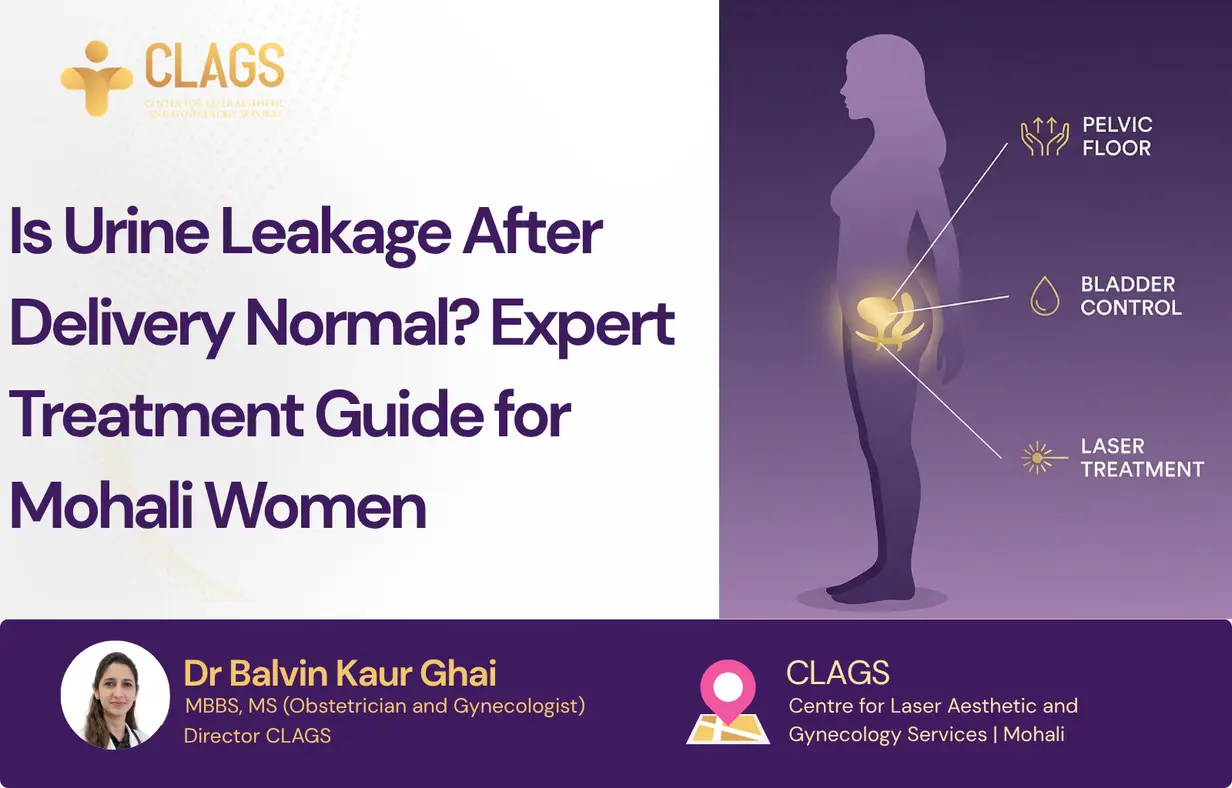
You sneeze and feel it. You laugh at something and feel it. You pick up the baby and feel it. That little leak of urine that was not there before your delivery - and now it shows up at the worst moments. You are not imagining it. You are not alone. And no, you do not just have to live with it.
Urine leakage after delivery is one of the most common postpartum problems Indian women deal with - and one of the least talked about. Most women feel embarrassed, assume it is normal, and quietly manage with pads for months or even years without ever asking anyone about it. But this is a medically recognised condition with real, effective treatment options. The first step is understanding what is actually happening in your body and why.
Many women suffer in silence for years after delivery simply because nobody told them that urine leakage is treatable - not just something to accept.
During pregnancy, your growing baby sits directly on top of your bladder for months. The weight, combined with the hormonal changes that loosen your pelvic ligaments to prepare your body for birth, puts enormous pressure on the muscles that support your bladder. Then comes the delivery itself - particularly a vaginal delivery - where those muscles stretch dramatically to allow the baby through the birth canal.
The group of muscles responsible for bladder control is called the pelvic floor. Think of it as a hammock of muscle stretched across the base of your pelvis. It holds up your bladder, uterus and bowel, and it controls the urethral sphincter - the valve that keeps urine in.[1] When the pelvic floor is weakened from pregnancy and delivery, that valve cannot hold under sudden pressure. So when you cough, sneeze, laugh, exercise or pick something up, the pressure spike forces a small amount of urine out before the muscle can respond.
This specific type of leakage is called stress urinary incontinence (SUI) - stress here meaning physical pressure on the bladder, not emotional stress. It is the most common type of urine leakage after delivery.[2] Some women also experience urge incontinence, where there is a sudden strong need to urinate that is difficult to hold back. Some experience a combination of both, which is called mixed incontinence.
Not every woman experiences this the same way. Some notice a few drops. Others have more significant leakage. The symptoms that typically point to postpartum stress urinary incontinence include:
These symptoms often appear in the weeks following delivery but sometimes only become noticeable months later. Hormonal changes during breastfeeding reduce estrogen levels, which also affect the tissue tone of the bladder and urethra - so some women notice the problem worsening during their breastfeeding period even if it was mild just after delivery.
Urine leakage after delivery is common - but common does not mean permanent. Most women who get proper guidance and treatment see significant improvement. Based on clinical data from NHS UK and National Institutes of Health
This is the question almost every woman asks, and the honest answer is: for most women, no - it is not permanent. Research shows that many women see natural improvement in the first 3 to 6 months after delivery as the body heals.[3] However, improvement does not always happen on its own - especially without pelvic floor rehabilitation. More than one third of women continue to experience leakage beyond 6 weeks postpartum, and some carry the problem for years without treatment.
Key factors that affect recovery include how much pelvic floor damage occurred during delivery, whether any nerve injury happened during a prolonged labour, whether the woman does targeted exercises consistently, and how many deliveries she has had. Women who have had multiple vaginal deliveries generally take longer to recover and may need medical intervention.
The important point is this: even if you have had urine leakage for months or years after delivery, it can still be treated effectively. It is never too late to address it.
The foundation of treatment for urine leakage after delivery is pelvic floor rehabilitation through kegel exercises. These exercises directly target and rebuild the muscles that control your bladder, and when done correctly and consistently, they produce meaningful improvement in most cases of mild to moderate stress incontinence.[4]
The most common reason kegels fail to work is that women either squeeze the wrong muscles or are inconsistent. Here is the right approach:
The Mayo Clinic recommends at least 3 sets of 10 kegel repetitions daily.[5] Most women who are consistent notice improvement within 4 to 6 weeks, with significant results by 3 to 4 months. If you have had an uncomplicated vaginal delivery, you can typically start gentle kegels within days of giving birth. For complicated deliveries with significant tearing or an episiotomy, check with your gynaecologist before starting.
Alongside kegel exercises, several daily habits can make a real difference to how often and how severely you leak:
For some women, consistent pelvic floor exercises produce the improvement they need. For others - particularly after multiple deliveries, a difficult birth, significant tearing or after months of leakage without improvement - exercises alone are not sufficient to restore full bladder control. This is not a failure on anyone's part. It simply reflects the degree of structural and muscular change that occurred during delivery.
If you have been doing kegel exercises regularly for 3 to 4 months without meaningful improvement, it is the right time to discuss medical treatment options with a gynaecologist. Several effective non-surgical and surgical options exist.
Laser treatment is the leading non-surgical option for postpartum stress urinary incontinence and has become increasingly popular with women in Mohali and Chandigarh who want effective results without surgery or downtime.
The procedure uses a controlled CO2 or Erbium laser delivered internally via a small probe. The laser energy heats the upper layers of the vaginal wall and the tissue surrounding the urethra. This triggers the body's collagen production response in the underlying tissue layers - producing new, firmer collagen that tightens and restructures the vaginal walls and provides better support to the bladder and urethra.[2]
As the new collagen forms over 4 to 8 weeks following each session, the urethral support improves and the bladder control improves with it. Most women require 3 to 5 sessions spaced 4 to 6 weeks apart. The procedure takes 20 to 30 minutes, involves no cutting or stitches, and has no recovery downtime - most women return to normal activities the same day.
At CLAGS Centre Mohali, our laser vaginal rejuvenation treatment is performed by our cosmetic gynaecologist using internationally certified equipment. For women who also experience vaginal laxity alongside urine leakage, this treatment addresses both concerns simultaneously.
For women with significant or long-standing stress incontinence that has not improved with exercises or laser treatment, a surgical option called the mid-urethral sling procedure provides a highly effective and lasting correction. A small synthetic mesh is positioned under the urethra to provide the structural support that the weakened pelvic floor can no longer offer.
This is generally reserved for women who have completed their family and whose incontinence significantly affects quality of life. It is done under local or spinal anaesthesia and involves a short recovery period. For women with both significant vaginal laxity and urine leakage, this can sometimes be combined with vaginal tightening surgery at CLAGS Centre for comprehensive correction in a single procedure.
| Treatment | Best For | Downtime | Results Timeline | Invasiveness |
|---|---|---|---|---|
| Kegel Exercises | Mild to moderate leakage | None | 3 to 6 months | None |
| Lifestyle Changes | Any severity, supporting role | None | Immediate to weeks | None |
| Laser / RF Treatment | Moderate leakage, no surgery preferred | None | 4 to 8 weeks per session | Minimally invasive (probe only) |
| Surgical Sling | Severe or persistent incontinence | 2 to 3 weeks | Immediate improvement post-recovery | Surgical |
Women across Mohali, Kharar, Zirakpur and Chandigarh often search for a female gynaecologist for bladder problems after delivery - and hesitate for months before actually booking an appointment. The hesitation is understandable. This is a deeply personal concern that most women were never told it was okay to discuss openly.
At CLAGS Centre on Airport Road, Sector 79, Mohali, our team is led by Dr Balvin Kaur Ghai, a cosmetic gynaecologist with specialist training in vaginal health and laser treatments. All consultations for this concern are with a female specialist, conducted in complete privacy, and structured around what you actually need - not what makes the clinic revenue.
We have worked with women who had been leaking urine for 2 to 3 years after their delivery, assuming nothing could be done. All of them saw meaningful improvement with treatment. If urine leakage after delivery is affecting your daily life, your confidence or your relationships - you do not have to keep managing it with pads alone. Help is accessible, private and effective.
You can also read our detailed guide on vaginal looseness after delivery treatment which covers the full picture of postpartum pelvic floor recovery, including vaginal tightening options that often go hand in hand with treating urine leakage.
Asking for help about urine leakage after delivery is not embarrassing. It is taking care of yourself - which is exactly what your family needs you to do.
Talk confidentially with our female gynaecologist at CLAGS Centre. We will assess your symptoms, explain your options clearly and build a treatment plan that fits your life.
Book Your Consultation NowYou can also call us directly at +91-8800188334. Our clinic is at 2nd Floor, SCO-24, Sector-79, Airport Road, Mohali, Punjab. Find our location on the clinic map and contact page or see patient results in our photo gallery.
No, it is not permanent in the vast majority of cases. Most women see natural improvement within 3 to 6 months after delivery, especially with consistent pelvic floor exercises. For those who do not improve on their own, non-surgical laser treatment and surgical options provide highly effective and lasting results. The key is not to ignore it and assume you just have to live with it - because you do not.
This is called stress urinary incontinence. During delivery, the pelvic floor muscles that support your bladder get stretched and temporarily weakened. When something creates sudden pressure inside your abdomen - like a cough, sneeze or laugh - the weakened muscles cannot clamp the urethra shut fast enough. A small amount of urine escapes before the muscle can react. It is a mechanical problem with a very specific solution - strengthening those muscles through kegel exercises and, if needed, laser or surgical treatment.
For some women, it resolves on its own within a few weeks. For others it can persist for months or longer, particularly without pelvic floor rehabilitation. Studies suggest more than one third of women still experience leakage beyond 6 weeks postpartum. If you are still leaking urine 6 months after your delivery and have not seen meaningful improvement with exercises, it is the right time to consult a gynaecologist for further assessment and treatment options.
For mild to moderate stress urinary incontinence, consistent kegel exercises can produce significant or even complete improvement. The key word is consistent - 3 sets of 10 repetitions daily for a minimum of 3 to 4 months, done with correct technique. For more severe cases or where significant structural weakening occurred, kegels alone may not be enough and medical treatment is the logical next step.
It is very common - but common does not mean you should just accept it. If urine leakage is affecting your daily life, causing you to avoid social situations or exercise, or persisting beyond 6 months, consulting a female gynaecologist is strongly recommended. Treatment is straightforward, private and in most cases very effective. The earlier you address it, the easier it is to treat.
The best treatment depends on severity. For mild leakage, kegel exercises and lifestyle changes are the starting point. For moderate leakage where exercises have not produced enough improvement, laser vaginal treatment at CLAGS Centre Mohali strengthens the urethral support tissue without surgery. For persistent or severe incontinence, a surgical sling procedure provides permanent correction. A consultation with our female gynaecologist in Mohali is the right way to determine which option fits your specific situation.
Yes, although vaginal delivery carries a significantly higher risk. Pregnancy itself puts months of sustained pressure on the pelvic floor regardless of how the baby is delivered. Women who laboured for a long time before a C-section may have already experienced pelvic floor strain before the surgery. So while a C-section reduces risk, it does not eliminate it - and some women do experience urine leakage postpartum even after a caesarean.
Yes, each subsequent vaginal delivery adds further strain to the pelvic floor and can worsen existing leakage or cause new symptoms. This is exactly why early treatment matters - addressing the problem after your first delivery gives the pelvic floor the best possible chance of withstanding a second pregnancy. Women who strengthen their pelvic floor before a subsequent delivery generally recover faster afterwards as well.
Yes. Caffeine is the most significant bladder irritant - tea, coffee, cola and energy drinks all make leakage worse. Spicy and acidic foods, carbonated drinks and alcohol can also irritate the bladder lining. Being overweight increases pressure on the pelvic floor. Constipation and straining at stools repeatedly weakens pelvic floor muscles over time. Addressing these factors alongside kegel exercises gives you the best chance of improvement without needing medical intervention.
Laser treatment for stress urinary incontinence is safe, non-surgical and causes no significant pain. The procedure uses a small internal probe to deliver controlled laser energy to the vaginal tissue surrounding the urethra. This stimulates collagen production, which firms and tightens the tissue that supports bladder control. Most women describe the sensation as mild warmth. There is no cutting, no stitches and no recovery downtime. At CLAGS Centre Mohali, the procedure is performed by a trained cosmetic gynaecologist using certified equipment.
References
[1] NHS UK. Urinary incontinence. nhs.uk/conditions/urinary-incontinence. Updated 2023.
[2] Cleveland Clinic. Stress Urinary Incontinence. my.clevelandclinic.org/health/diseases/17596-stress-urinary-incontinence
[3] University of Colorado Urogynecology. Incontinence After Childbirth. urogyn.coloradowomenshealth.com
[4] Mayo Clinic. Urinary incontinence - Diagnosis and treatment. mayoclinic.org/diseases-conditions/urinary-incontinence/diagnosis-treatment/drc-20352814
[5] Mayo Clinic. Kegel exercises: A how-to guide for women. mayoclinic.org/healthy-lifestyle/womens-health/in-depth/kegel-exercises/art-20045283


Quick Links
| Home |
| Photo Gallery |
| Video Gallery |
| Book Appointment |
| Contact Us |
Services
| Hymen Repair |
| Vaginoplasty |
| Lap Gynec Surgery |
| MTP / Abortion |
| Antenatal Management |
| Pathology Lab |
| Laser Hair Removal |
Follow Us
 |
 |
 |
 |
 |
 |

