
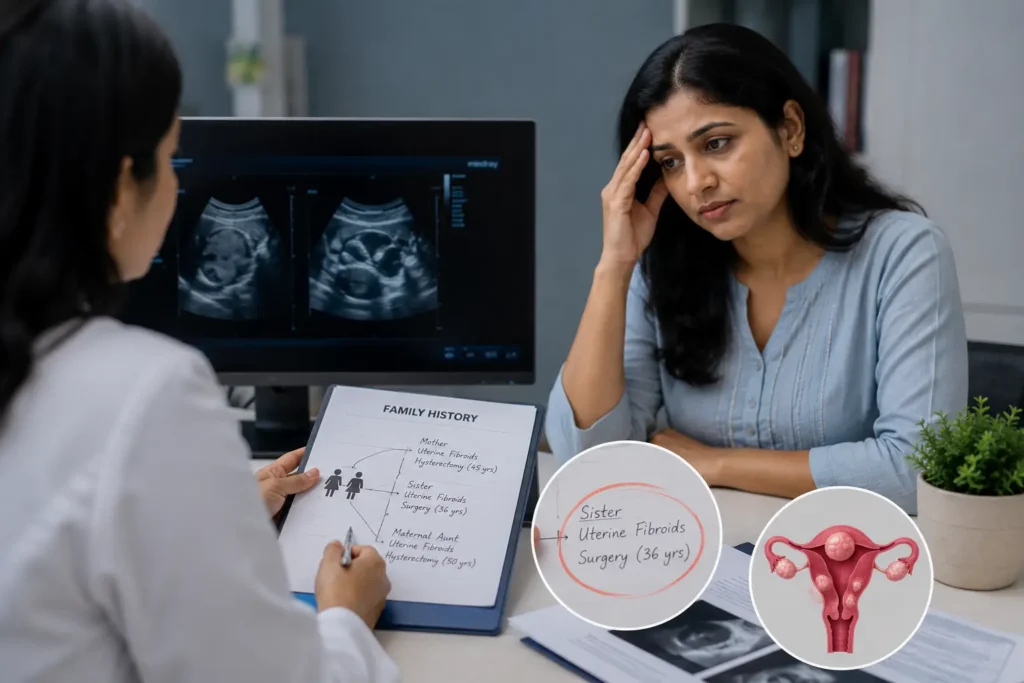
A mother and daughter walk into the same clinic two years apart, both with the same diagnosis. It happens more often than most people realise. If your mother or sister has had uterine fibroids, your own risk is more than double, and that single fact surprises most patients the first time they hear it. Fibroids are not caused by anything a woman did wrong, yet the causes of uterine fibroids are still widely misunderstood, even among women who have already been diagnosed once.
This is the second article in our complete guide to uterine fibroids, and it focuses specifically on why fibroids form in the first place.
Key Takeaways
Family history roughly doubles your risk, and the risk climbs even higher if a relative was diagnosed young.
Vitamin D deficiency, extremely common across North India, is now considered a genuine risk factor, not just a coincidence.
Obesity raises oestrogen levels in fat tissue, which can directly fuel fibroid growth.
Starting periods before age eleven, or never having been pregnant, both raise lifetime risk.
None of the causes of uterine fibroids point to anything a woman did wrong. Genetics and hormones drive most cases.
What Causes Uterine Fibroids in the First Place?
No single trigger explains every case, which is part of why the causes of uterine fibroids frustrate researchers and patients alike. What is well established is the role of oestrogen and progesterone, the two hormones that regulate the menstrual cycle. Fibroid cells respond to these hormones far more actively than normal uterine muscle does, which is why fibroids tend to grow during the reproductive years and shrink once hormone levels fall after menopause. At a cellular level, researchers have also found genetic abnormalities inside fibroid tissue itself, present in a large proportion of the tumours examined in published studies, which suggests that a fibroid is not simply “extra tissue” but a distinct growth with its own altered biology from the moment it begins forming.
Do Environmental Factors or Diet Quietly Contribute Too?
Genetics and hormones explain most of the picture, but researchers have also been examining subtler contributors in recent years. Chronic low grade inflammation, exposure to certain endocrine disrupting chemicals found in some cosmetics and plastics, and diets consistently low in fresh vegetables have all been studied as possible contributing factors. None of these are proven causes on their own, and no one should feel they caused their own fibroid by using a particular product or skipping a meal now and then. But the overall pattern reinforces something doctors already tell patients: a diet built around fresh, minimally processed food tends to support hormonal balance in ways that matter well beyond fibroid risk alone.
Do Fibroids Run in the Family?
Yes, and the link is stronger than most patients expect. According to a Mayo Clinic physician response, heredity plays a real role, and women whose mother or sister had fibroids carry a meaningfully higher risk themselves. Research published on PubMed has found that first degree relatives of women with fibroids face more than twice the likelihood of developing them, and the risk climbs to nearly six times higher when the relative was diagnosed at a young age. Twin studies point in the same direction: identical twins are far more likely to share a fibroid diagnosis than non identical twins, which is about as strong a signal of genetic influence as researchers can find outside a laboratory. If your mother or a sister was treated for fibroids in her thirties, it is worth mentioning this at your very first gynaecology visit rather than waiting for symptoms to appear.
Can Vitamin D Deficiency Actually Cause Fibroids?
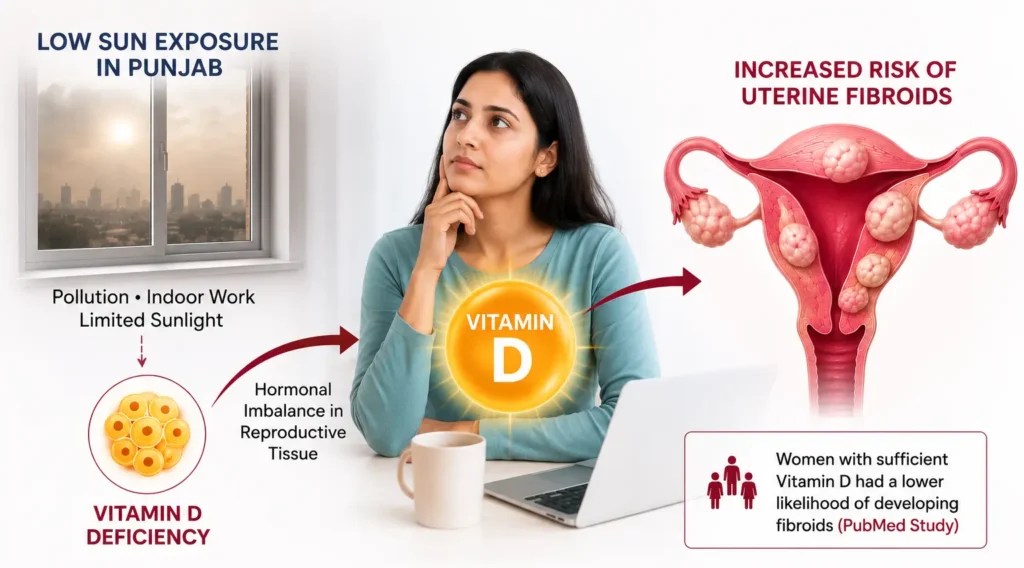
This is one of the more surprising causes of uterine fibroids, and it is especially relevant here in Punjab, where indoor working hours and pollution both limit natural sun exposure. Vitamin D behaves like a hormone inside reproductive tissue rather than simply supporting bone health, which is why researchers started studying it in the context of fibroid growth in the first place. A study published on PubMed found that women with sufficient vitamin D levels had a measurably lower likelihood of developing fibroids compared with women who were deficient, and the effect held even after accounting for other risk factors like age and body weight. A simple blood test can check your levels, and correcting a deficiency through safe sun exposure or supplementation is one of the few genuinely modifiable steps available to lower risk, particularly for women who spend most of their working day indoors under artificial light.
Does Obesity or Body Weight Increase Fibroid Risk?
Yes, and the mechanism is fairly direct. Fat tissue produces its own oestrogen, so a higher body fat percentage effectively adds fuel to fibroid growth on top of what the ovaries already produce. Several published reviews estimate that women with higher body fat carry two to three times the risk of developing fibroids compared with women at a healthy weight, which is a larger gap than most patients expect from a single modifiable factor. Research from Mayo Clinic lists obesity alongside family history and vitamin D deficiency as one of the three most consistently confirmed risk factors, which is why maintaining a healthy weight is one of the few preventive steps doctors can genuinely recommend rather than simply hope for. This does not mean every overweight woman will develop fibroids, or that every slim woman is protected, but the statistical pattern across large studies is consistent enough that gynaecologists take it seriously during a first consultation.
How Do Doctors Investigate the Cause During a First Consultation?
A thorough first visit usually goes well beyond simply confirming that a fibroid exists, since understanding the likely causes of uterine fibroids in your specific case helps guide how closely it should be monitored. Expect your gynaecologist to ask about your mother’s and sisters’ gynaecological history, your age at first period, whether you have been pregnant before, your general diet pattern, and sometimes your sun exposure and vitamin D supplement use. None of these questions are asked to assign blame. They help the doctor understand how aggressively a particular fibroid is likely to grow and how closely it needs to be monitored. Bringing a simple written note of your family’s gynaecological history to your first appointment can genuinely speed up this part of the consultation.
Which Other Risk Factors Raise the Chances of Fibroids?
Beyond genetics, vitamin D, and weight, several other patterns show up consistently when researchers study the causes of uterine fibroids across large groups of women:
- Starting periods before the age of eleven, which extends the total number of years fibroid tissue is exposed to oestrogen and progesterone over a lifetime
- Never having carried a pregnancy to term, since pregnancy appears to have a modest protective effect against fibroid development
- A diet heavy in red meat and low in leafy vegetables and fruit, a pattern that several studies have linked to higher fibroid incidence
- Regular alcohol consumption, which can influence circulating oestrogen levels over time
- Chronic, unmanaged stress over several years, which affects hormone regulation through the body’s stress response system
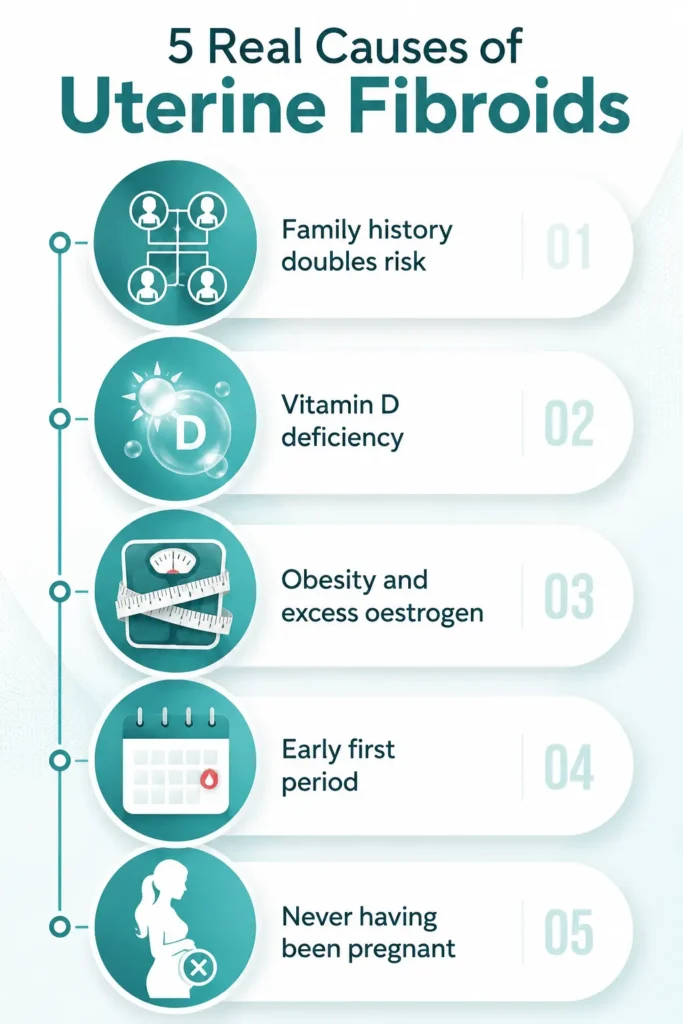
None of these factors guarantee a fibroid will develop, and plenty of women with several of these risk factors never get one. They simply shift the odds, which is exactly why regular pelvic checkups matter more than trying to pinpoint a single cause. A woman with two or three of these risk factors is not destined to develop fibroids, but she is a reasonable candidate for slightly more frequent monitoring than someone with none of them.
Is There a Difference Between Causes and Risk Factors?
| Term | What It Means | Example |
|---|---|---|
| Cause | A direct biological driver of fibroid growth | Oestrogen and progesterone stimulating fibroid tissue |
| Risk factor | Something that raises the odds without directly causing growth | Family history, obesity, vitamin D deficiency |
Doctors rely on risk factors to decide how closely to monitor a patient, even before any early symptoms of fibroids appear, and understanding this distinction is genuinely useful for anyone researching the causes of uterine fibroids on their own before a consultation.
Why I Ask Every Patient About Family History First
When a new patient comes to me with heavy periods, the very first question I ask is whether her mother or sister has ever had fibroids. It sounds like a small detail, but it changes how quickly I recommend a scan. I have seen women delay a checkup for years simply because nobody in their family had talked about fibroids openly, even though two relatives had already been treated for it. If fibroids run in your family, please do not wait for symptoms. Ask for a baseline pelvic ultrasound in your late twenties or early thirties.
Dr. Balvin Kaur Ghai, Founder and Lead Gynae, CLAGS Centre for Laser Aesthetics and Gynaecology Services, Mohali
Can Birth Control Pills or Hormonal Medication Cause Fibroids?
This is a common worry, and the evidence does not support it in any straightforward way. Hormonal contraceptives can occasionally influence the size of an existing fibroid, but they are not considered a direct cause of new fibroids forming. Women often confuse correlation with causation here simply because fibroids are commonly diagnosed during the same years many women are already on hormonal contraception.
Is It Possible to Prevent Uterine Fibroids Entirely?
Not entirely, since genetics and hormone biology cannot be controlled. But several of the causes of uterine fibroids are genuinely modifiable, including body weight, vitamin D levels, and diet quality. Anyone actively trying to lower her personal risk should focus on these modifiable causes of uterine fibroids rather than the ones, like genetics, that cannot be changed. Combining regular physical activity with a diet built around vegetables, fruit, and fibre, while limiting red meat and alcohol, is the closest thing to a prevention strategy that current research actually supports.
Should You Get Screened If Fibroids Run in Your Family?
If a close relative has been diagnosed, a baseline ultrasound scan in Mohali in your late twenties gives you a clear starting point, even without symptoms. This matters more than people realise, since how large fibroids can grow depends heavily on how early they are caught. Catching a fibroid while it is still small keeps every treatment option, including future fertility, open.
Frequently Asked Questions
Is it my fault if I have fibroids?
No. Fibroids are driven mainly by genetics and hormone biology, factors that are not within a woman’s control.
Can stress alone cause fibroids?
Chronic stress is associated with hormonal changes that may contribute to fibroid growth, but it is not considered a standalone cause on its own.
Do fibroids only affect older women?
No. Fibroids are most often diagnosed between the ages of twenty and forty, though risk continues to rise until menopause.
Can having children reduce fibroid risk?
Research suggests women who have carried a pregnancy to term have a somewhat lower risk compared with women who have not.
Does diet really make a difference?
Diets higher in red meat and lower in vegetables and fruit are associated with increased risk, though diet alone does not determine whether fibroids develop.
Is vitamin D deficiency common in Punjab?
Yes, it is widespread across North India due to indoor working hours, pollution, and limited sun exposure, especially among working women.
Can fibroids be caused by an infection?
No. Fibroids are not caused by infection. They develop from smooth muscle tissue within the uterine wall itself.
Does having fibroids mean my daughter will get them too?
Not necessarily, but her risk is higher than average, so mentioning your history at her first gynaecology visit is worthwhile.
Can losing weight shrink existing fibroids?
Weight loss does not shrink fibroids that already exist, but it can help slow further growth by lowering oestrogen produced by fat tissue.
At what age should family history prompt a checkup?
Doctors generally suggest a baseline scan in the late twenties or early thirties if a mother or sister has been diagnosed with fibroids.