
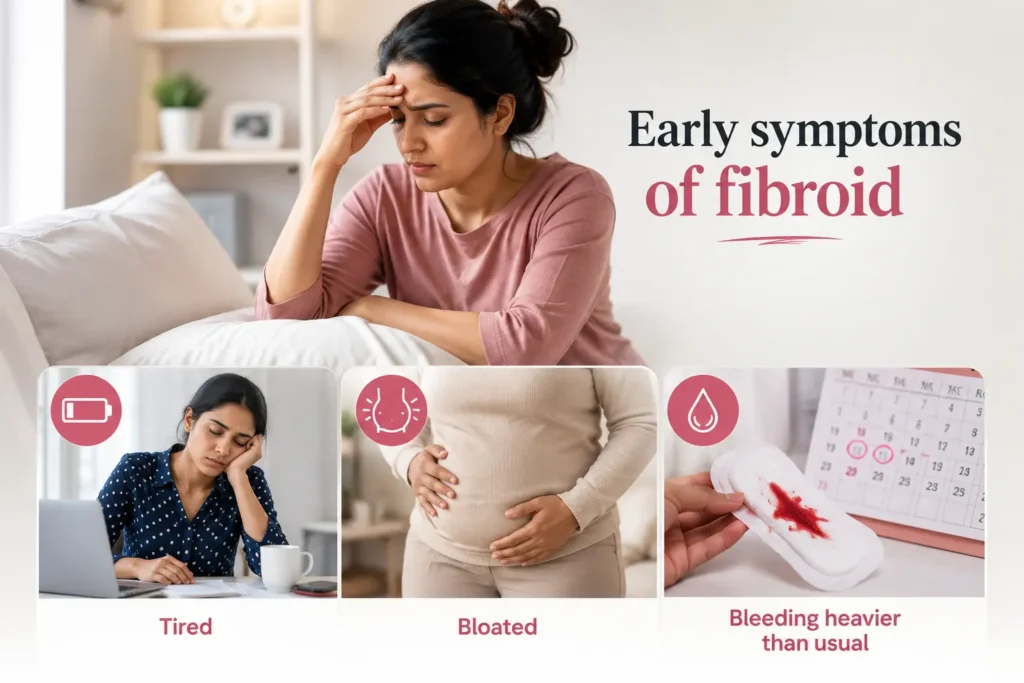
Heavy periods are common. So most women don’t think twice about them.
But heavy periods can also be one of the first signs of a fibroid. And many women miss this sign for years.
This is the real problem. Fibroid symptoms often feel “normal” until they are not.
According to the National Institute of Child Health and Human Development, many women with fibroids have no symptoms at all. Others live with pain and heavy bleeding for years before they get a diagnosis. Knowing the early symptoms of fibroids helps you catch the problem sooner, while treatment is still simple.
This article is part of our complete guide to uterine fibroids. Here, we focus only on symptoms. What they feel like, and when they mean it’s time to see a doctor.
Key Takeaways
- Heavy or long periods are the most common early symptom of fibroids.
- Pelvic pressure, frequent urination, and bloating are also common signs.
- Many fibroids cause no symptoms at all, especially when they are small.
- Fatigue and breathlessness can be signs of anemia caused by heavy bleeding.
- You do not need every symptom on this list to have a fibroid. Even one or two matter.
What Are the Early Symptoms of Fibroids?
Symptoms depend on the size and location of the fibroid. Some women feel a lot. Some feel nothing at all.
That is what makes the early symptoms of fibroids so easy to miss. There is no single “textbook” pattern that fits every woman.
Here are the signs doctors see most often:
- Periods that last longer than seven days
- Bleeding heavy enough to soak a pad within an hour
- A heavy, dragging feeling in the lower belly
- Needing to urinate often, even at night
- Constipation or a bloated feeling
- Pain during sex
- Lower back pain that does not go away
If you notice two or more of these, it is worth getting checked.
You do not need every symptom on this list. Even one, if it lasts more than a cycle or two, is reason enough to ask a doctor.
Why Do So Many Women Miss These Signs?
Most women grow up believing heavy periods are just “how their body is.” Many mothers and grandmothers said the same thing.
So heavy bleeding often gets ignored for years.
Work, family, and daily life also keep women busy. A symptom that comes and goes with each period is easy to push aside, month after month.
By the time a woman finally sees a doctor, the fibroid may already be large. This is one of the most common patterns we see in clinic.
This is exactly why we want more women to recognise the early symptoms of fibroids, not just the advanced ones.
Heavy Periods: The Most Common Fibroid Symptom
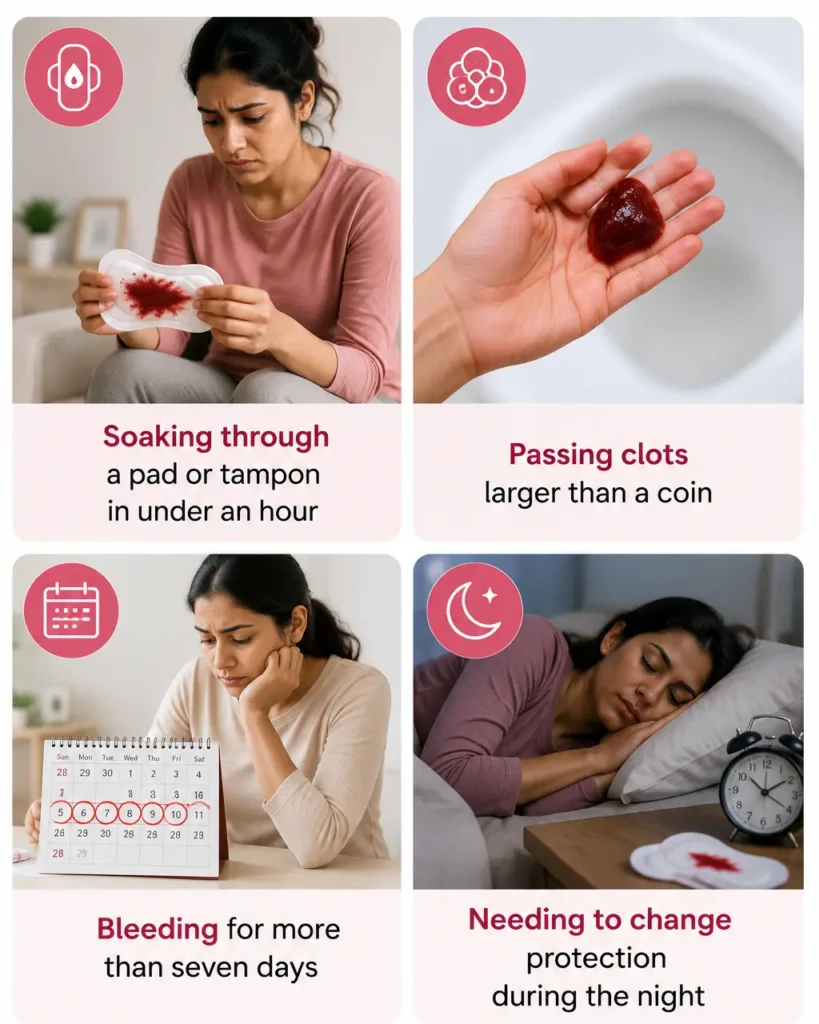
Heavy periods are the number one symptom of fibroids. Research shows that up to 40 percent of women with fibroids experience heavy menstrual bleeding, according to a study published on PubMed.
What counts as “heavy”? Here is a simple way to check:
- Soaking through a pad or tampon in under an hour
- Passing clots larger than a coin
- Bleeding for more than seven days
- Needing to change protection during the night
If any of this sounds familiar, it is not something to simply “manage.” It is something to get checked.
Can Fibroids Cause Pain?
Yes, but not always in an obvious way.
Many women describe it as a dull ache or heaviness, rather than sharp pain. It often gets worse just before or during periods. Some also feel pain during sex, especially if a fibroid is pressing against nearby organs.
A few women feel sudden, sharp pain. This can happen if a fibroid outgrows its own blood supply. It is less common, but it is a reason to see a doctor quickly.
Is Pelvic Pressure Really a Symptom, or Just “Feeling Off”?
Pelvic pressure is one of the hardest symptoms to describe. Women often say things like “I just feel heavy down there” or “something feels off, but I can’t explain it.”
This vague feeling is still worth mentioning to a doctor. It is one of the early symptoms of fibroids that rarely gets taken seriously enough, simply because it is hard to put into words.
Frequent Urination and Constant Bathroom Trips
A growing fibroid can press against the bladder. This makes the bladder feel full even when it isn’t.
Some women start waking up two or three times a night just to urinate. Many assume this is a bladder issue and never connect it to a fibroid.
If you have ruled out a urine infection and the frequent bathroom trips continue, a pelvic scan is a reasonable next step.
Bloating and That “Heavy Belly” Feeling
A larger fibroid can make the lower belly look and feel swollen. Some women mistake this for weight gain.
It can also press on the bowel, causing constipation or a constant feeling of fullness.
Can Fibroids Make You Tired or Breathless?
Yes. This is one of the symptoms people rarely connect to fibroids.
Heavy bleeding, month after month, can lower your iron levels. This leads to anemia. Anemia can cause tiredness, breathlessness, dizziness, and pale skin.
Some women describe it simply as “always feeling low on energy,” without realising heavy periods are the reason.
If you feel unusually tired and also have heavy periods, ask your doctor to check your iron levels.
Common Myths About Fibroid Symptoms
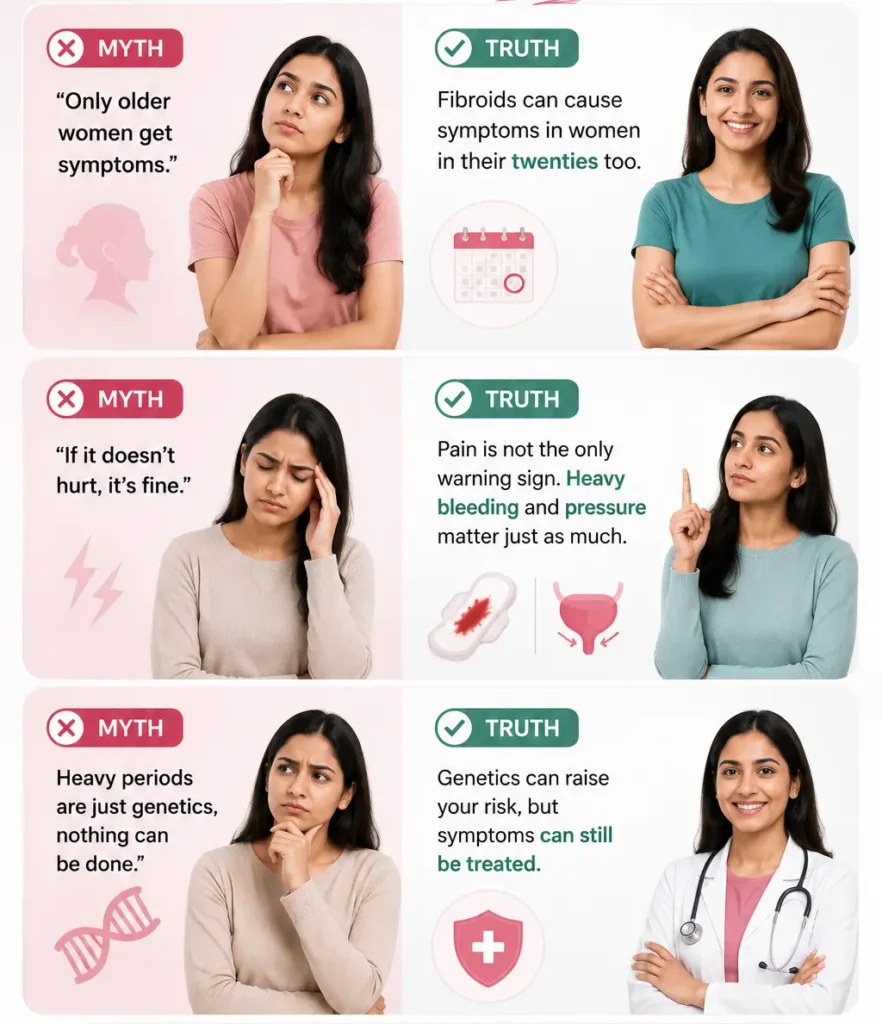
A few beliefs come up again and again in clinic. Most of them are not true.
- “Only older women get symptoms.” Fibroids can cause symptoms in women in their twenties too.
- “If it doesn’t hurt, it’s fine.” Pain is not the only warning sign. Heavy bleeding and pressure matter just as much.
- “Heavy periods are just genetics, nothing can be done.” Genetics can raise your risk, but symptoms can still be treated.
What If You Have No Symptoms At All?
Many fibroids cause no symptoms. This is completely normal, especially for small fibroids.
These are usually found by accident, during a routine ultrasound scan in Mohali. A silent fibroid does not always need treatment. But it is still worth knowing it’s there, so it can be watched over time.
Silent fibroids are actually one reason doctors recommend a baseline scan even when nothing feels wrong, especially if fibroids run in your family.
What Should You Do If You Notice These Symptoms?
Start simple. Keep a short note of your cycle for one or two months.
Write down:
- How many days your period lasts
- How heavy the flow feels
- Any pain, and when it happens
- Any bathroom or bowel changes
Bring this note to your gynaecologist. It sounds small, but it makes the consultation faster and far more useful. Most cases of early symptoms of fibroids are picked up quickly once a doctor has this kind of pattern in front of them.
Quick Symptom Checklist
| Symptom | What It Feels Like | Should You See a Doctor? |
|---|---|---|
| Heavy periods | Soaking pads within an hour, large clots | Yes, soon |
| Pelvic pressure | Dull ache or heaviness low in the belly | Yes, if it lasts weeks |
| Frequent urination | Needing the bathroom often, even at night | Yes, especially if new |
| Fatigue | Feeling tired or breathless often | Yes, check for anemia |
| No symptoms | Nothing felt at all | Routine checkup is still wise |
Why I Tell Patients Not to Wait for “Textbook” Symptoms
In my clinic, I meet many women who say the same thing: “I thought this was just normal for me.”
Heavy periods are common. But common does not mean normal.
I always tell my patients this: if your period has changed, even slightly, it is worth asking about. You do not need to wait for pain. A simple scan can tell us a lot, long before symptoms become severe.
Dr. Balvin Kaur Ghai, Founder and Lead, CLAGS Centre for Laser Aesthetics and Gynaecology Services, Mohali
Do Symptoms Get Worse Over Time?
Often, yes. Fibroids tend to grow slowly. As they grow, symptoms can become more noticeable.
This is also connected to how large fibroids can grow if left unchecked for years. A fibroid that starts small and silent can, over time, cause much heavier symptoms.
This is exactly why early symptoms of fibroids should never be brushed aside, even when they seem mild. Catching a change early usually means simpler treatment later.
Do Symptoms Change During Pregnancy?
Sometimes. Fibroids can behave differently during pregnancy, and fibroids and pregnancy symptoms are worth tracking separately with your gynaecologist.
Some fibroids grow faster due to hormone changes. Others stay the same size through the whole pregnancy.
If you already know you have a fibroid and are planning a pregnancy, it helps to mention this early, rather than after symptoms show up mid pregnancy.
How Long Before Mild Symptoms Turn Serious?
There is no fixed timeline. It depends on the fibroid’s size, location, and how fast it is growing.
Some women live with mild symptoms for years without much change. Others notice symptoms worsening within months.
This is why a scan matters more than guessing. It gives your doctor a clear picture, instead of relying on symptoms alone.
Should You Wait, or See a Doctor Right Away?
A short wait to observe a pattern is usually fine. Ignoring it for years is not.
If your periods have changed for more than two cycles in a row, that is enough reason to book an appointment. You do not need to wait for symptoms to become severe.
Recognising the early symptoms of fibroids early on almost always means simpler, gentler treatment later.
Frequently Asked Questions
Can fibroids cause no symptoms at all?
Yes. Many small fibroids cause no symptoms and are only found during a routine scan.
Is heavy bleeding always a sign of fibroids?
Not always, but it is one of the most common signs. A scan can confirm the cause.
Can fibroids cause back pain?
Yes. Larger fibroids can press on nearby nerves and muscles, causing lower back pain.
Can fibroid symptoms come and go?
Yes. Symptoms can feel worse during periods and lighter in between.
Do fibroid symptoms feel different for every woman?
Yes. Size, number, and location all affect how symptoms feel and how strong they are.
Can young women get fibroid symptoms too?
Yes. Fibroids can start as early as the twenties, though they are more common after thirty.
Is pain during sex always a fibroid symptom?
Not always, but it is common enough that it should always be discussed with a doctor.
Can fibroids cause sudden, sharp pain?
Yes, though this is less common. It can happen if a fibroid twists or loses its blood supply.
How do I know if my period is “too heavy”?
If you are soaking through a pad in an hour, or passing large clots, that counts as heavy.
Should I track my symptoms before seeing a doctor?
Yes. A simple note of your period length, flow, and pain helps your doctor a lot.