

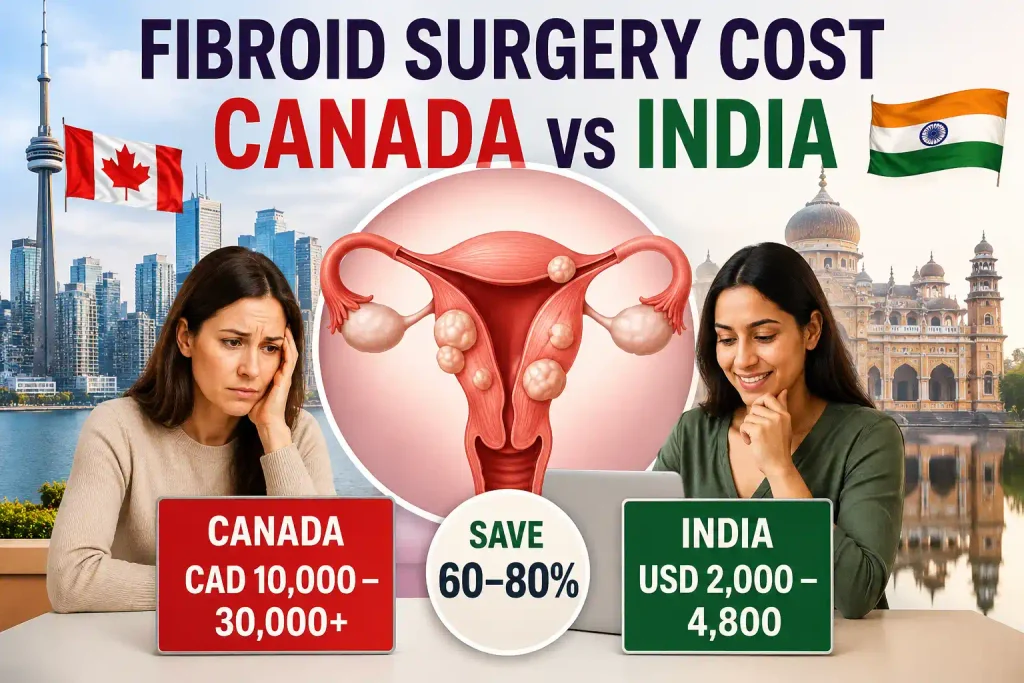
If you’re a Canadian woman living with fibroids, you’ve probably already felt the frustration. A specialist appointment gets booked months away. Then surgery gets booked even further out. Meanwhile, the heavy bleeding, pelvic pressure, or pain don’t wait for anyone’s calendar.
This is exactly why so many Canadians are now comparing the fibroid surgery cost Canada vs India before deciding where to get treated. The gap in price, and often in wait time, is large enough that it changes the entire decision.
I’ve treated hundreds of women from Canada, the US, the UK, and the Gulf at our centre in Mohali. In this guide, I’ll walk you through real cost ranges, what’s actually included in an India surgery package, how safe the process is, and what questions you should be asking before you book a flight.
Key Takeaways
- Uterine fibroids affect a large share of women during their reproductive years, with research suggesting fibroids occur in about 70% of women by the time they reach menopause.
- Canadian patients waiting in the public system face long delays. A national survey found the median wait was 28.6 weeks from GP referral to actual treatment in 2025.
- Private myomectomy in Canada typically costs between CAD 10,000 and CAD 30,000 or more, depending on the surgical approach and facility.
- Fibroid surgery in India for international patients generally costs a fraction of that, once you compare like-for-like inclusions.
- Package pricing in India, when done properly, should include the surgery, hospital stay, anaesthesia, and routine follow-up, not just the operating room fee.
What Are Fibroids and Why Does Surgery Cost So Much to Begin With?
Fibroids are non-cancerous growths that develop in or around the uterus. Most women don’t even know they have them until symptoms show up.
Common symptoms include heavy periods, pelvic pain, bloating, frequent urination, and trouble conceiving. Not every fibroid needs surgery. But when fibroids are large, multiple, or affecting fertility, a myomectomy or another surgical option usually becomes the recommended path.
Surgery cost depends on a few consistent factors everywhere in the world: the surgical technique used (hysteroscopic, laparoscopic, or open abdominal), the size, number, and location of the fibroids, hospital facility fees and the surgeon’s experience, and the length of hospital stay and anaesthesia charges.
What changes dramatically between Canada and India is not the medical complexity. It’s the healthcare system, labour costs, and infrastructure pricing behind the procedure.
Fibroid Surgery Cost in Canada: What Women Actually Pay
Canada’s public healthcare system doesn’t charge patients directly for medically necessary surgery like a myomectomy. But “free” doesn’t mean “fast.” Canadian patients referred through the public system often wait many months just to see a specialist, and longer still for the actual operating room date.
Some Canadians choose to pay privately instead, either within Canada where legally possible, or by travelling elsewhere. Private myomectomy pricing in Canada typically runs from around CAD 10,000 to CAD 30,000 or more, depending on whether it’s a hysteroscopic, laparoscopic, or open procedure, plus facility and anaesthesia fees.
“Most Canadian patients don’t come to us because Indian doctors are better,” I often tell first-time callers. “They come because they’re tired of waiting in pain for a system that keeps pushing their surgery date further away.”
Fibroid Surgery Cost in India for Canadian Patients
This is where the fibroid treatment cost Canada India comparison really shifts. In India, myomectomy pricing for international patients is generally quoted as a complete package rather than itemised line by line.
At a well-run centre, an affordable fibroid surgery India package usually includes the pre-operative consultation, the surgery itself, hospital stay, anaesthesia, medicines during admission, and a follow-up review before you fly home.
Cost also varies by surgical method. A hysteroscopic myomectomy, used for fibroids inside the uterine cavity, is the least invasive and usually the least expensive option. A laparoscopic myomectomy costs somewhat more because it involves keyhole instruments and a longer operating time. An open abdominal myomectomy, reserved for larger or multiple fibroids, tends to be the most expensive because of the longer hospital stay involved.
Comparison Table: Fibroid Surgery Cost Canada vs India
Here’s a simplified side-by-side view. Treat these as typical estimated ranges, since your final quote depends on your specific case.
| Procedure Type | Canada (Private, Estimated CAD) | India (Package, Estimated USD) |
| Hysteroscopic myomectomy | 8,000 – 12,000 | 2,000 – 3,000 |
| Laparoscopic myomectomy | 12,000 – 18,000 | 2,800 – 4,000 |
| Open/abdominal myomectomy | 15,000 – 30,000+ | 3,200 – 4,800 |
| Public system wait (no direct fee) | 28.6 weeks median wait | Not applicable |
| Typical hospital stay | 1 – 3 days | 3 – 5 days plus recovery time |
Why the Savings Are Real, Not a Compromise on Quality
For most Canadian patients, total savings, including flights and accommodation, still land between 60% and 80% compared with private surgery back home. That gap exists because real estate, staff salaries, and hospital overheads in India are simply a fraction of what they are in Canada, the US, or the UK, not because standards are lower.
This is the same underlying reason medical tourism India fibroids treatment has grown steadily over the past decade. The caution is this: affordability only holds up when the hospital is transparent. Ask for a written quote before travelling, and confirm exactly what it covers.
Choosing a Qualified Surgeon and a Safe Hospital
Safety comes down to two things: the hospital’s accreditation and the surgeon’s actual experience with international patients, not just local ones. Reputable centres in India follow the same surgical safety protocols used globally, including sterile operating theatre standards and post-operative monitoring.
Start with the surgeon’s specific gynaecological training and how many myomectomies they perform each year, not just their general reputation. Check how responsive the hospital’s international patient team is, and whether they’ll review your MRI or ultrasound reports and give you a real opinion before you commit to travel. You can read more on uterine fibroid causes and treatment options to understand which approach might suit your case.
The Travel Process: From Consultation to Recovery

Here’s roughly how the journey looks for a Canadian patient coming to our centre for fibroid surgery.
Step one: Remote consultation. You share your reports and symptoms over a video call or email, and receive a written surgical plan and cost estimate.
Step two: Travel and pre-admission workup. You arrive in India, usually two to three days before surgery, for final tests and an in-person consultation with your surgeon.
Step three: Surgery and hospital stay. Depending on the technique, you’ll typically stay in hospital for two to five days after the procedure.
Step four: Local recovery before flying. Most surgeons recommend staying in the country for one to two additional weeks after discharge, so your surgical team can confirm you’re fit to fly.
Step five: Follow-up care from home. Once you’re back in Canada, follow-up happens through video calls, with your local GP handling routine wound checks if needed.
A Note on Fertility and Related Procedures
If preserving your fertility matters, a myomectomy is generally the right conversation to have, since it removes fibroids while leaving the uterus intact. Say so clearly during your first consultation, well before travel plans are finalised. Our page on pregnancy and fibroids is a useful next read.
Fibroid surgery is often just one piece of a woman’s broader gynaecological care. Patients travelling for a myomectomy sometimes also ask about laparoscopic gynaecological surgery options, or a hysteroscopy procedure if fibroids are suspected but not yet confirmed.
Final Thoughts
Comparing the fibroid surgery cost Canada vs India isn’t just about finding the cheapest option. It’s about finding a path that gets you treated properly, without months of waiting in discomfort, and without unexpected bills along the way.
If you’re considering this route, start with a written cost estimate based on your own reports rather than a generic number you found online. That single step will tell you more about a hospital’s honesty than anything else.
Frequently Asked Questions
1. How much does fibroid surgery cost in Canada compared with India?
Private fibroid surgery in Canada usually costs between CAD 10,000 and CAD 30,000, depending on the surgical method and facility. In India, the same procedure is typically priced between USD 2,000 and USD 4,800 as a complete package. The gap comes from lower hospital overheads and staff costs in India, not lower medical standards.
2. How much can Canadians save by having fibroid surgery in India?
Most Canadian patients save between 60% and 80% on the total cost, even after adding flights and accommodation. For a laparoscopic myomectomy, that can mean saving CAD 8,000 or more compared with private treatment at home. The exact saving depends on the surgical method and how long your recovery stay runs.
3. What is the average fibroid surgery cost in India for Canadian patients?
For international patients, average myomectomy packages in India range from about USD 2,000 for a hysteroscopic procedure to around USD 4,800 for an open abdominal myomectomy. The final price depends on fibroid size, number, and the technique your surgeon recommends. A written quote based on your own reports gives the most accurate figure.
4. Is fibroid surgery in India really more affordable than private treatment in Canada?
Yes, and it’s a genuine price difference, not a quality shortcut. Hospital overheads, surgeon fees, and facility costs are structurally lower in India, which is why quality private surgery can be delivered at a fraction of Canadian pricing. Reputable Indian hospitals follow the same surgical safety standards used internationally.
5. What is included in the cost of fibroid surgery in India?
A properly structured package should include your pre-surgery consultation, the surgeon’s fee, operating theatre charges, anaesthesia, hospital stay, and routine follow-up before discharge. It typically does not include flights, visa costs, or accommodation outside the hospital. Always ask for a full breakdown before you travel.
6. Does the cost of myomectomy in India vary by surgical method?
Yes, quite significantly. A hysteroscopic myomectomy is the least expensive since it’s the least invasive, followed by laparoscopic myomectomy, with open abdominal myomectomy costing the most due to a longer hospital stay. Your surgeon will recommend the method based on fibroid size, number, and location, not on price.
7. How much does laparoscopic fibroid surgery cost in India compared with Canada?
Laparoscopic myomectomy in India for international patients generally costs between USD 2,800 and USD 4,000 as a full package. In Canada, the same private procedure typically runs from CAD 12,000 to CAD 18,000 once facility and anaesthesia fees are included. That’s often three to five times more expensive in Canada.
8. Are travel, accommodation and hospital stay included in India fibroid surgery packages?
This depends entirely on the hospital, so it’s worth confirming before you book. Some centres include the hospital stay and partner with nearby hotels for recovery, while others handle only the surgical portion. Always ask specifically what’s covered for accommodation, meals, and a companion’s stay.
9. Is medical tourism for fibroid surgery in India safe for Canadian patients?
Yes, when you choose an accredited hospital with genuine experience treating international patients. Reputable centres follow standard surgical safety protocols, including sterile operating theatres and post-operative monitoring. It’s wise to ask directly about the hospital’s complication rates and its emergency plan for issues that arise after you’ve returned home.
10. How do I choose a qualified fibroid surgeon and hospital in India?
Look at the surgeon’s specific experience with myomectomies, not just their general reputation, and ask how many they perform each year. Check how responsive the hospital’s international patient team is, and whether they’ll review your reports and give a clear opinion before you travel. A transparent surgeon will happily discuss past cases similar to yours.
11. Can a Canadian patient get a fibroid surgery cost estimate before travelling to India?
Yes, and you should insist on one. A responsible hospital will review your ultrasound or MRI report along with your symptoms and send a written cost estimate before you book any flights. If a clinic won’t commit to a written quote in advance, treat that as a warning sign.
12. How long should Canadians stay in India after fibroid surgery before flying home?
Most surgeons recommend staying 10 to 14 days after a laparoscopic or hysteroscopic myomectomy, and a little longer after an open abdominal procedure. This buffer lets your surgical team confirm you’re medically fit for a long-haul flight. Flying too soon increases the risk of blood clots after major surgery.
13. Will I need an MRI or other tests before travelling to India for fibroid surgery?
In most cases, yes. Surgeons typically ask for a recent pelvic ultrasound, sometimes an MRI for larger or multiple fibroids, and basic blood work including a clotting profile. Sending these reports ahead of time lets your surgeon confirm the surgical plan and cost estimate before you travel.
14. Can I have a myomectomy in India if I want to preserve my fertility?
Yes, fertility preservation is actually one of the most common reasons women choose myomectomy over hysterectomy. The procedure removes fibroids while keeping the uterus intact, though your surgeon will assess fibroid location carefully since that can affect future pregnancy planning. Make sure to mention your fertility goals clearly during your first consultation.
15. What are the risks and extra costs of having fibroid surgery abroad?
The surgical risks, such as bleeding, infection, or an anaesthesia reaction, are the same as they would be anywhere else in the world. The extra costs to budget for typically include travel insurance, a longer hotel stay if recovery takes more time than planned, and a companion’s travel expenses. Building in a small financial buffer for the unexpected is a sensible precaution.