


Once medication stops working, most women land on the same question: what does fibroid surgery actually cost, and which type do I even need? The truth is that fibroid surgery cost depends far less on the hospital’s brand name and far more on which procedure fits your specific fibroid, since the type of surgery drives everything else, including price, recovery time, and whether you can still have children afterward.
Most women searching for this have already tried medication, or their fibroid has grown to a point where medication was never going to be enough. Understanding the real cost drivers before your first consultation makes the whole process far less stressful.
This article is part of our complete guide to uterine fibroids, and it walks through the surgical options in plain terms, along with what genuinely changes the cost.
Key Takeaways
- Not every fibroid needs surgery. Size, symptoms, and growth speed decide that, not the diagnosis alone.
- Myomectomy preserves the uterus and fertility, while hysterectomy removes it as a permanent solution.
- Laparoscopic and hysteroscopic approaches usually cost less and heal faster than open surgery.
- Fibroid surgery cost depends mainly on the procedure type, fibroid size and number, and hospital stay length.
- A personalised estimate after an ultrasound is always more accurate than any number found online.
When Does a Fibroid Actually Need Surgery?
Surgery becomes the right choice once medication stops controlling symptoms, or once a fibroid grows large enough that medication was never going to work in the first place. Heavy bleeding causing anaemia, pain that disrupts daily life, or a fibroid that keeps growing on repeat scans are the usual triggers, which is why recognising the early symptoms of fibroids early on matters so much for keeping your options open. A small, silent fibroid found by accident rarely needs surgery at all.
Doctors also weigh how a fibroid affects your specific goals. A woman planning a pregnancy soon will often be guided toward earlier surgery for a fertility affecting fibroid, since fibroids and pregnancy planning works best when addressed before conception, while a woman closer to menopause may reasonably choose to wait and monitor instead.
What Are the Main Types of Fibroid Surgery?
There are three broad approaches, and each suits a different situation:
- a. Hysteroscopic myomectomy, done through the vagina with no external cuts, for fibroids bulging into the uterine cavity
- b. Laparoscopic myomectomy, done through a few small incisions, for most fibroids within the uterine wall
- c. Open myomectomy or hysterectomy, used for very large fibroids or multiple fibroids that keyhole surgery cannot safely manage
Myomectomy vs Hysterectomy: Which One Is Right for You?
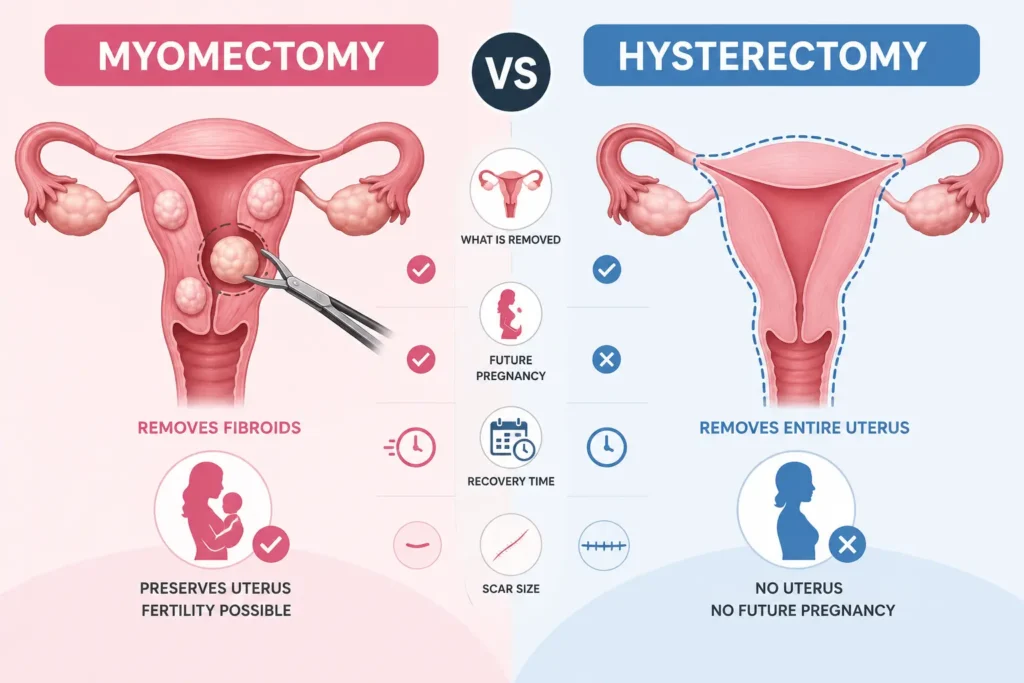
This is usually the biggest decision in the entire process, and it comes down mainly to whether you want to have children in the future.
| Factor | Myomectomy | Hysterectomy |
|---|---|---|
| Fertility | Preserved, uterus stays in place | Not possible afterward, uterus is removed |
| Fibroid recurrence | Possible, since new fibroids can still form | Not possible, since the uterus is gone |
| Best suited for | Women planning future pregnancy | Women who have completed their family |
| Recovery | Generally shorter, varies by technique | Similar or slightly longer, depending on approach |
According to Cleveland Clinic, myomectomy removes only the fibroids while leaving the uterus intact, so periods continue and pregnancy remains possible, whereas hysterectomy removes the fibroids along with the uterus itself, which is why it is considered the more permanent option.
Laparoscopic vs Open Surgery: What’s the Difference?
Laparoscopic surgery uses a few small incisions and a camera, while open surgery uses one larger incision across the abdomen. Laparoscopic surgery generally means less pain, a shorter hospital stay, and a faster return to normal life. Open surgery is still necessary for very large fibroids, multiple fibroids, or certain positions that keyhole instruments cannot reach safely, so it is not a matter of one approach simply being better in every case. Understanding how large fibroids can grow before they are caught helps explain why some cases genuinely need the open approach rather than keyhole surgery.
Your surgeon will usually only recommend open surgery when the laparoscopic route genuinely cannot be done safely, since most gynaecologists prefer the smaller incisions whenever the fibroid’s size and position allow it.
What Determines Fibroid Surgery Cost?
Fibroid surgery cost is not a single fixed number, and it changes based on several genuine factors rather than the hospital you choose:
- The surgical approach, since hysteroscopic procedures typically cost less than laparoscopic ones, and open surgery usually costs the most
- The number and size of fibroids being removed, since more fibroids generally mean longer surgery time
- The length of hospital stay, which is usually shortest for hysteroscopic procedures and longest for open surgery
- The type of anaesthesia used and any additional tests required before the procedure
Because of this, two women with the same diagnosis can be quoted very different fibroid surgery costs, simply because their fibroids differ in size, number, or position. This is exactly why estimates found online rarely match what you are actually quoted after a proper consultation.
Are There Non Surgical Options That Cost Less?
Yes, for some patients. Hormonal medication can control bleeding and shrink fibroids somewhat, without any surgery at all, and it is naturally the lowest cost option available. It works best for smaller fibroids and milder symptoms, and it can sit alongside a good fibroid diet and gentler home remedies for fibroids for extra symptom relief. Once a fibroid is large or is clearly affecting fertility, medication alone usually stops being enough, and surgery becomes the more realistic path forward.
Does Recovery Time Affect the Overall Cost?
Indirectly, yes. A randomised trial comparing recovery after fibroid ablation and minimally invasive myomectomy, published on PubMed, found that patients returned to normal activity in about 5.5 days after the less invasive option, compared with 13 days after minimally invasive myomectomy. A longer recovery usually means more follow up visits and more time away from work, which adds to the overall cost of the experience even when the surgery fee itself is similar.
Why I Walk Every Patient Through Cost Before Surgery, Not After
I have seen the stress that comes from an unexpected bill after surgery, and I do not want any of my patients to go through that. Before recommending any procedure, I explain exactly what is included, what could change during surgery, and what the realistic cost range looks like for that specific case. Fibroid surgery cost should never be a surprise. It should be part of the conversation from the very first consultation.
Dr. Balvin Kaur Ghai, Founder and Lead, CLAGS Centre for Laser Aesthetics and Gynaecology Services, Mohali
What Happens During Recovery After Fibroid Surgery?
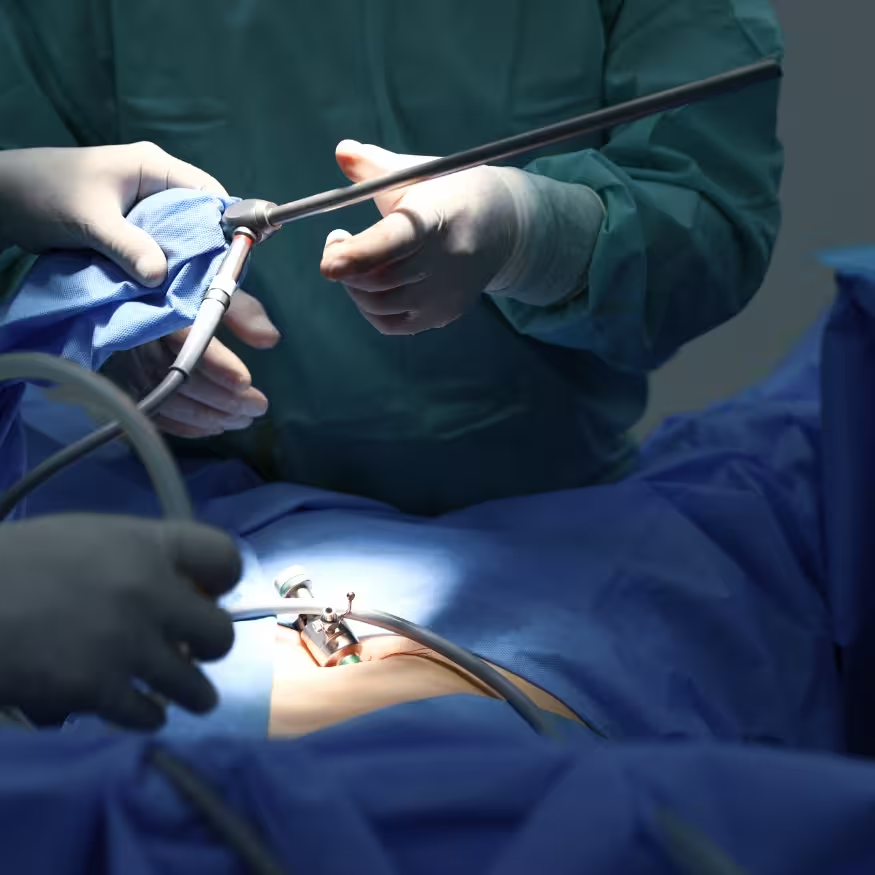
| Procedure | Back to Light Activity | Full Recovery |
|---|---|---|
| Hysteroscopic myomectomy | 2 to 5 days | 1 to 2 weeks |
| Laparoscopic myomectomy | 1 to 2 weeks | 4 to 6 weeks |
| Open myomectomy or hysterectomy | 3 to 4 weeks | 6 to 8 weeks |
These are general ranges. Your own recovery depends on the number of fibroids removed and how your body heals, which is why your surgeon will give you a more specific timeline after the procedure.
Do Fibroids Come Back After Surgery?
After a myomectomy, yes, new fibroids can form over time, since the underlying hormonal environment has not changed. After a hysterectomy, no, since the uterus itself is no longer there. This is one of the main reasons the choice between the two procedures depends so heavily on whether future pregnancy matters to you.
Recurrence does not mean the first surgery failed. It simply reflects why fibroids form in the first place, driven by hormones and genetics that surgery removes the effects of, but cannot permanently switch off.
Getting a Personalised Fibroid Surgery Cost Estimate in Mohali
The only reliable way to know your fibroid surgery cost is a proper consultation and ultrasound, ideally alongside a diagnostic hysteroscopy if the fibroid is close to the uterine cavity. We provide a written estimate after this assessment, so you know exactly what to expect before committing to a date, whether you are travelling from Mohali itself or further out from Chandigarh or Panchkula.
We also walk patients through what the estimate includes, from the surgeon’s fee to the hospital stay and any follow up visits, so there are no unexpected additions once the bill arrives.
Frequently Asked Questions
Is fibroid surgery always major surgery?
No. Hysteroscopic procedures involve no external cuts at all, and even laparoscopic surgery is far less invasive than open surgery.
Can I avoid surgery altogether?
Sometimes. Small, symptom free fibroids often do not need surgery, and some symptoms respond well to medication alone.
How long does fibroid surgery usually take?
It varies by approach and fibroid count, but most laparoscopic procedures take between one and three hours.
Will I need a blood transfusion during fibroid surgery?
It is uncommon but possible with larger or multiple fibroids. Your surgeon will discuss this risk beforehand if relevant.
Can I get pregnant after a myomectomy?
Yes, in most cases. Doctors usually recommend waiting three to six months before trying to conceive.
Does fibroid surgery affect periods?
After a myomectomy, periods continue as before. After a hysterectomy, periods stop permanently.
Is fibroid surgery covered by insurance?
Many policies cover it when symptoms are documented as medically necessary. It is worth confirming details with your insurer beforehand.
What is the youngest age for fibroid surgery?
There is no fixed age. Surgery is based on symptoms and fibroid size, not age alone, though it is less common in the very early twenties.
Can both myomectomy and hysteroscopy be needed together?
Yes, if fibroids exist both within the uterine cavity and the muscle wall, both approaches may be combined in one surgery.
How soon can I go home after fibroid surgery?
Hysteroscopic procedures are often same day. Laparoscopic surgery usually needs one to two nights in hospital.