

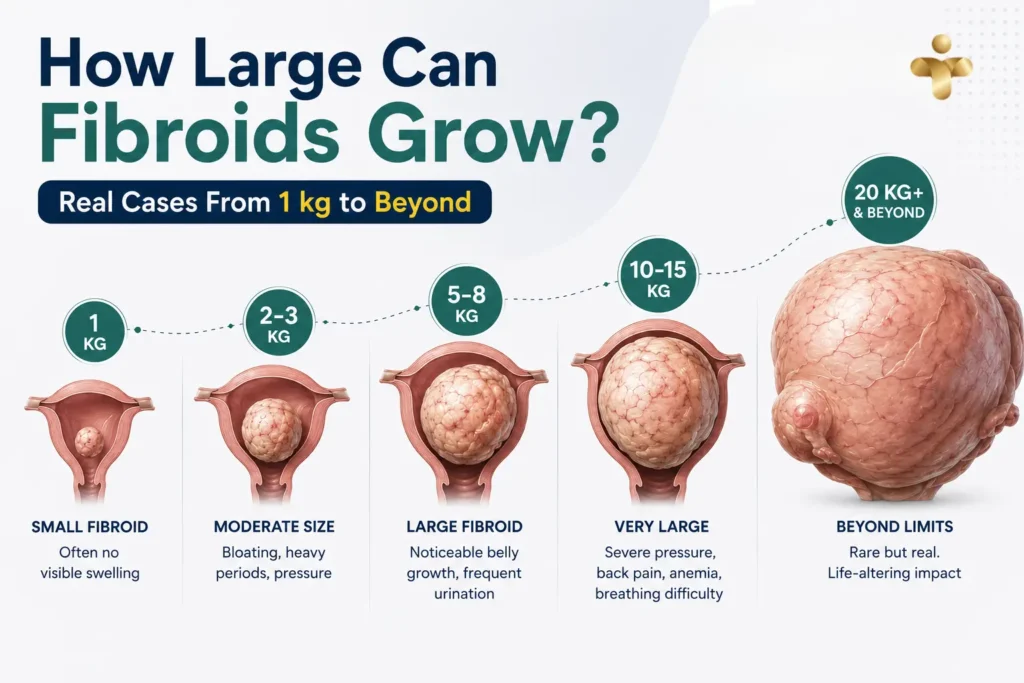
A fibroid that starts no bigger than a pea can, if it goes unnoticed for long enough, grow into something that changes the entire shape of a woman’s abdomen. This sounds extreme, but it happens more often than most people realise, and it is one of the clearest reasons doctors keep pushing for regular scans even when nothing feels wrong.
People search for how large fibroids can grow far more often than you might expect, usually after hearing about an extreme case from a relative or a news story. The real answer, backed by documented cases, is more surprising than most guesses.
This article is part of our complete guide to uterine fibroids, and it looks specifically at how large fibroids can grow, using real documented cases rather than rough estimates.
Key Takeaways
- Fibroids weighing over a kilogram are not rare in medical literature, especially when left untreated for years.
- A fibroid weighing 11.4 kg or more is classified in medical terms as a giant fibroid.
- Growth rate varies widely from woman to woman, so size alone cannot predict how quickly a fibroid will grow next.
- Some very large fibroids cause almost no symptoms until they reach an advanced size.
- Even large fibroids can sometimes be removed through minimally invasive surgery, depending on their position.
What Counts as a “Large” Fibroid?
Doctors usually describe fibroid size in centimetres or by comparing it to fruit, from a pea to a grapefruit to a small melon. In medical literature, a fibroid is only classified as “giant” once it crosses roughly 11.4 kilograms, a threshold that sounds almost unbelievable until you see the case reports behind it.
Most fibroids never come close to that threshold. But understanding where that upper limit sits helps explain just how much room a fibroid genuinely has to grow before it becomes unmanageable, which is part of why how large fibroids can grow is a question worth taking seriously rather than dismissing as unlikely.
Can a Fibroid Really Weigh 1 kg or More?

Yes, and this is far more common than most patients expect. A fibroid weighing between one and three kilograms shows up regularly in gynaecology practice, particularly in women who delayed a checkup for several years because their symptoms crept up slowly rather than appearing all at once. How large fibroids can grow really does depend on time more than anything else. The longer a fibroid goes unmonitored, the more room it has to keep expanding.
How Fast Do Fibroids Actually Grow?
Growth speed varies enormously from one woman to another, which is exactly why doctors avoid giving a single average timeline. Some fibroids stay roughly the same size for years. Others grow noticeably within a matter of months, particularly during pregnancy, when the hormonal shifts behind fibroids and pregnancy can accelerate growth, or in the years leading up to menopause when hormone levels shift the most. This unpredictability is precisely why a scan tells you far more than guessing based on how you feel.
This is also why doctors track fibroid size across repeat scans rather than relying on a single measurement. A fibroid that looks stable today can behave differently a year from now, and that pattern over time tells us far more about how large fibroids can grow in your specific case than any general average ever could. It also links back to why fibroids form in the first place, since the same hormonal drivers that start a fibroid are often what keep it growing.
Real Case: A Fibroid Weighing Nearly 13 Kilograms
A case published on PubMed described a 35 year old woman who had never been pregnant, presenting with multiple fibroid nodules that together weighed 12.9 kilograms, with the largest single nodule weighing 5.7 kilograms. The mass had grown slowly enough that she had adjusted to the changes in her body without realising how serious the underlying cause was. Doctors involved in the case noted that the sheer number of nodules, described as “hydra headed” because of how many separate growths were present, made the surgery more complex than a single large fibroid would have been. Cases like this are exactly why how large fibroids can grow matters as a question, not just as a curiosity.
Real Case: A 9.8 Kilogram Fibroid Missed for Years
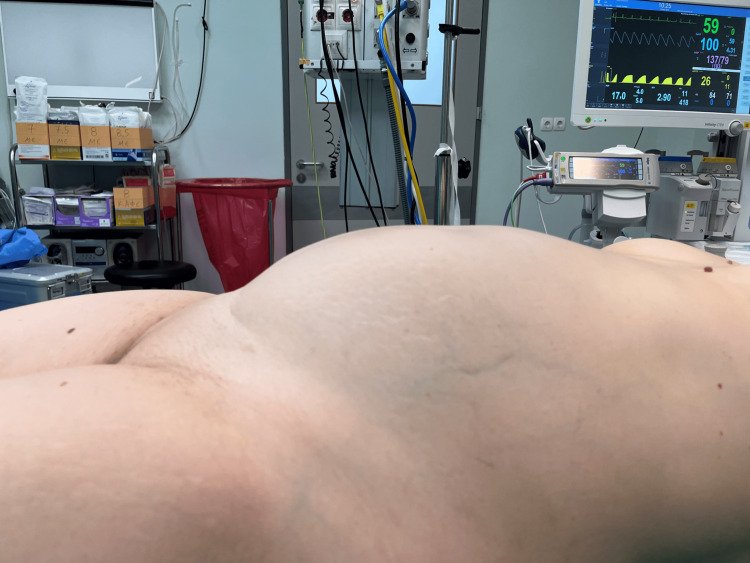
Another case documented on PubMed involved a 45 year old woman who had a large, painless abdominal mass discovered only during a routine gynaecological exam. Imaging confirmed a fibroid weighing 9.8 kilograms, just under the formal threshold for a “giant” classification, yet large enough to require a full hysterectomy. She had not attended a gynaecological consultation in years, which meant the mass had ample time to grow undetected. What stands out most in this case is that she reported no pain at all, only a gradual change in her abdominal size that she had not connected to a medical condition.
Why Do Some Fibroids Go Unnoticed Until They’re This Large?
The honest answer is that the abdomen has more room to expand than people expect, and fibroids typically grow slowly enough that the body adjusts gradually rather than all at once. A woman might notice her clothes fitting differently over a year or two, without ever connecting it to a fibroid. By the time abdominal swelling becomes obvious, the fibroid has often already been growing for a long time.
Does Fibroid Size Always Match Symptom Severity?
Not always, and this surprises a lot of patients. A relatively small fibroid in the wrong position, close to the uterine cavity, can cause heavy bleeding and pain, while a much larger fibroid growing outward on the outer surface of the uterus can stay almost silent for a long time. Position and type matter just as much as raw size when it comes to how a fibroid actually feels day to day, which is exactly why knowing the early symptoms of fibroids matters regardless of how large or small a fibroid currently is.
Do Symptoms Get Progressively Worse as a Fibroid Grows?
Often, though not in a straight line. A fibroid might cause mild pressure for a long stretch, then symptoms can escalate more noticeably once it crosses a certain size and starts affecting the bladder or bowel. This is one more reason tracking how large fibroids can grow over successive scans matters more than reacting only once symptoms become severe.
Can Very Large Fibroids Still Be Removed Without Open Surgery?
Sometimes, though it depends heavily on the specific case. Surgeons increasingly use techniques that avoid a large open incision even for sizeable fibroids, provided the fibroid’s position allows it. A laparoscopic approach is usually preferred whenever it is safely possible, since it means a shorter recovery even when the fibroid itself is large. The approach chosen also affects fibroid surgery cost, since open surgery generally runs higher than a laparoscopic procedure. Once a fibroid reaches the truly giant range, though, open surgery generally becomes the safer and more practical choice.
Why I Recommend Regular Scans Even Without Symptoms
I have seen patients come in with fibroids that had clearly been growing for years, simply because nothing hurt enough to prompt a visit. This is exactly the pattern that leads to the extreme cases you read about. A fibroid rarely announces itself loudly from the start. It grows quietly, and by the time it becomes impossible to ignore, the treatment options have narrowed considerably. A yearly scan costs very little time and tells us exactly where things stand, long before size becomes a problem.
Dr. Balvin Kaur Ghai, Founder and Lead, CLAGS Centre for Laser Aesthetics and Gynaecology Services, Mohali
What Should You Do If Your Fibroid Is Already Large?
Start with a proper ultrasound scan in Mohali to establish exactly how large the fibroid is and where it sits. From there, your gynaecologist can walk you through realistic options, whether that means monitoring, medication, or a surgical approach suited to the fibroid’s specific size and position. Alongside whatever treatment path you choose, a sensible fibroid diet can support your general health while you and your doctor decide on next steps. A large fibroid is not a reason to panic, but it is a strong reason to get a proper assessment rather than continuing to guess.
Frequently Asked Questions
Is a 1 kg fibroid considered dangerous?
Not automatically dangerous, but it usually requires surgical removal and closer monitoring than a smaller fibroid would.
Can a fibroid this large be mistaken for something else?
Yes, occasionally. Very large fibroids can sometimes be mistaken for pregnancy or other abdominal masses until imaging confirms the diagnosis.
Do all large fibroids need a hysterectomy?
Not necessarily. Some very large fibroids can still be removed through myomectomy, depending on their position and number.
How long does it take for a fibroid to reach 1 kg?
There is no fixed timeline. It can take years, and growth speed varies significantly from woman to woman.
Can a large fibroid affect breathing or movement?
In extreme cases, yes. A very large fibroid can press on the diaphragm or restrict comfortable movement.
Are giant fibroids more common in certain age groups?
They tend to appear more often in women who delayed treatment for years, regardless of a specific age group.
Can a large fibroid come back after removal?
New fibroids can form afterward, though a fibroid of that size recurring at the same scale is uncommon.
Does fibroid size affect anaesthesia risk during surgery?
It can influence surgical planning and duration, which your anaesthesia team will factor into your specific case.
Can a large fibroid be reduced with medication first?
Medication can sometimes shrink a fibroid modestly, but very large fibroids usually still require surgical removal.
How is fibroid size measured before surgery?
Mainly through ultrasound, with an MRI sometimes added for very large or complex cases to plan surgery more precisely.